
Quantifying the Great Divide: A New Metric for Polarization in Online Argumentation
Quantitative Modeling of Polarization in Online Intelligent Argumentation and Deliberation for Capturing Collective Intelligence
This paper introduces a novel quantitative method for measuring polarization in online argumentation using the Intelligent Cyber Argumentation System (ICAS). By integrating a fuzzy logic engine to derive participant agreement and adapting the Esteban-Ray economic polarization index, the authors create a localized metric that captures the nuances of group homogeneity and heterogeneity.
TL;DR
Deliberation platforms aim to harness Collective Intelligence, but polarization often turns constructive debate into tribal warfare. This paper presents a sophisticated quantitative model—built on Fuzzy Logic and Economic Polarization Theory—to measure exactly how divided a community is. Moving beyond simple variance, this method accounts for the "density" of poles and the "alienation" between them.
The "Why": Why Traditional Metrics Fail
In the quest for "Crowd Wisdom," the presence of polarization is a red flag. If a group is split into two warring camps, they aren't collaborating; they are stagnating. Historically, researchers used two flawed approaches:
- Social Network Analysis (SNA): Works for Facebook or Twitter where users "follow" each other, but fails in structured argumentation where interactions are "argument-centric" and social graphs are sparse (average degree of 0.88 in the authors' data).
- Simple Variance: Statistical variance doesn't care where the groups are. A distribution with one large pole and three tiny outliers might show higher variance than two large, equally matched opposing poles, even though the latter is clearly more "polarized."
Methodology: From Fuzzy Logic to Economic Indices
The authors leverage the Intelligent Cyber Argumentation System (ICAS) to transform messy text headers and reactions into a clean mathematical distribution.
1. The Fuzzy Logic Engine
Human reasoning isn't binary. Using 25 inference rules (e.g., "If Arg A opposes Arg B and Arg B supports Position C, then A implicitly attacks C"), the system reduces complex argument trees into a single sentiment score for each user, ranging from -1 (total disagreement) to +1 (total agreement).
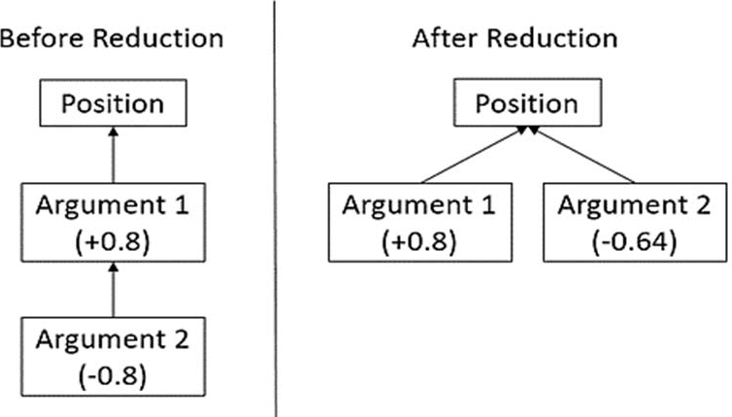
2. The Modified Esteban-Ray (MER) Model
The core innovation lies in adapting an economic income-inequality metric for sentiment. The polarization value is calculated based on:
- Identification (): How much a participant feels "at one" with others who hold similar views.
- Alienation: The distance/hostility felt toward those in other groups.
The paper introduces a critical Logarithmic Identity Function. It ensures that if a user is the only person with a specific view (an isolate), they contribute zero to the overall polarization. Polarization requires a "tribe."
Experimental Validation
The researchers tested the model on 15 hot-button topics, including healthcare mandates and campus gun laws.
The "Acid Test" of Polarization
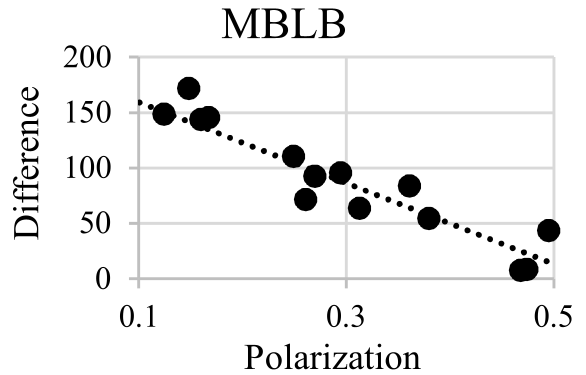
In a direct comparison with other models, the MER (Modified Esteban-Ray) model was the only one that correctly ranked the complexity of group dynamics. For instance, in the "Gun Control" (G3) vs. "Same-Sex Adoption" (S1) debate:
- S1 had one massive majority and a few lone dissenters.
- G3 had two distinct, powerful clusters.
While variance-based models (FM) struggled to differentiate, the MER model correctly identified G3 as more polarized because it possessed two significant "poles" rather than one dominate group and noise.
Critical Insight & Future Work
The value of this work is its Axiomatic Approach. By defining polarization through four specific attributes—homogeneity, heterogeneity, number of poles, and relative size—the authors move the field away from "vibes-based" analysis toward rigorous software-ready metrics.
Limitations: The model currently operates at the "Position" level (e.g., a specific stance on healthcare). The authors acknowledge that the next frontier is Issue-Level Polarization, measuring how participants navigate across multiple related solutions to find common ground.
Conclusion
If we cannot measure the divide, we cannot bridge it. By providing a normalized [0,1] index for polarization, ICAS offers a roadmap for future AI moderators to detect rising tensions and intervene before a deliberation collapses into a digital shouting match.