
Structured thought: The Mathematical Blueprint of Cognitive Linguistics
2Q )RUPDO 0RGHOV RI &RJQLWLYH /LQJXLVWLFV
The paper introduces a formal theoretical framework for Cognitive Linguistics, centered on the Deductive Grammar of English (DGE). Utilizing denotational mathematics, it establishes a hierarchical model ranging from lexis to entire essays, providing a rigorous mathematical foundation for computational intelligence and machine language comprehension.
TL;DR
This research moves beyond the "black box" of statistical NLP to propose the Deductive Grammar of English (DGE). By leveraging denotational mathematics, the authors provide a rigorous, top-down hierarchy that models how the human mind structures language—from a single letter to a complete essay—transforming linguistic intuition into computable algebraic structures.
Background: Beyond Statistical Probability
For decades, the field of linguistics has been caught between the descriptive theories of Noam Chomsky and the modern era of statistical probability. While Large Language Models (LLMs) excel at predicting the next word, they often lack a formal "understanding" of the underlying cognitive rules. Wang and Berwick argue that without a mathematical model of grammar, human knowledge cannot be systematically conveyed to cognitive systems. Their goal is to create a deterministic, deductive framework where language is not just predicted, but derived.
Methodology: The 5-Tuple Abstract Language
At the core of this paper is the definition of a language as a structured set.
The Formal Definition
The authors define the abstract language model as:
- : The Alphabet.
- : Lexical relations.
- : The set of words (lexis).
- : Syntactic relations.
- : Semantic relations.

By treating language as a mathematical object, the authors allow for the use of Concept Algebra to perform semantic manipulations.
The Hierarchy of English Structure: Lexis to Phrase
The paper meticulously classifies 19 lexical and syntactic elements. These are categorized into Lexis (N, V, Adj, etc.), Modifiers (Determiners, Auxiliaries, etc.), and Phrases (NP, VP, PP, etc.).
One of the most powerful insights is the formal modeling of Inflections and Recursive Phrases. For example, a Noun Phrase (NP) is not just a list of words but a recursive structure that can contain other phrases or even clauses:
This formal notation allows a machine to "parse" a sentence by matching it against these predefined templates, much like a compiler parses code.
Experimental Blueprint: The General Sentence Pattern
The research culminates in a Universal Syntactic Diagram. Instead of analyzing infinite sentence variations, the authors suggest using a general pattern as a template.
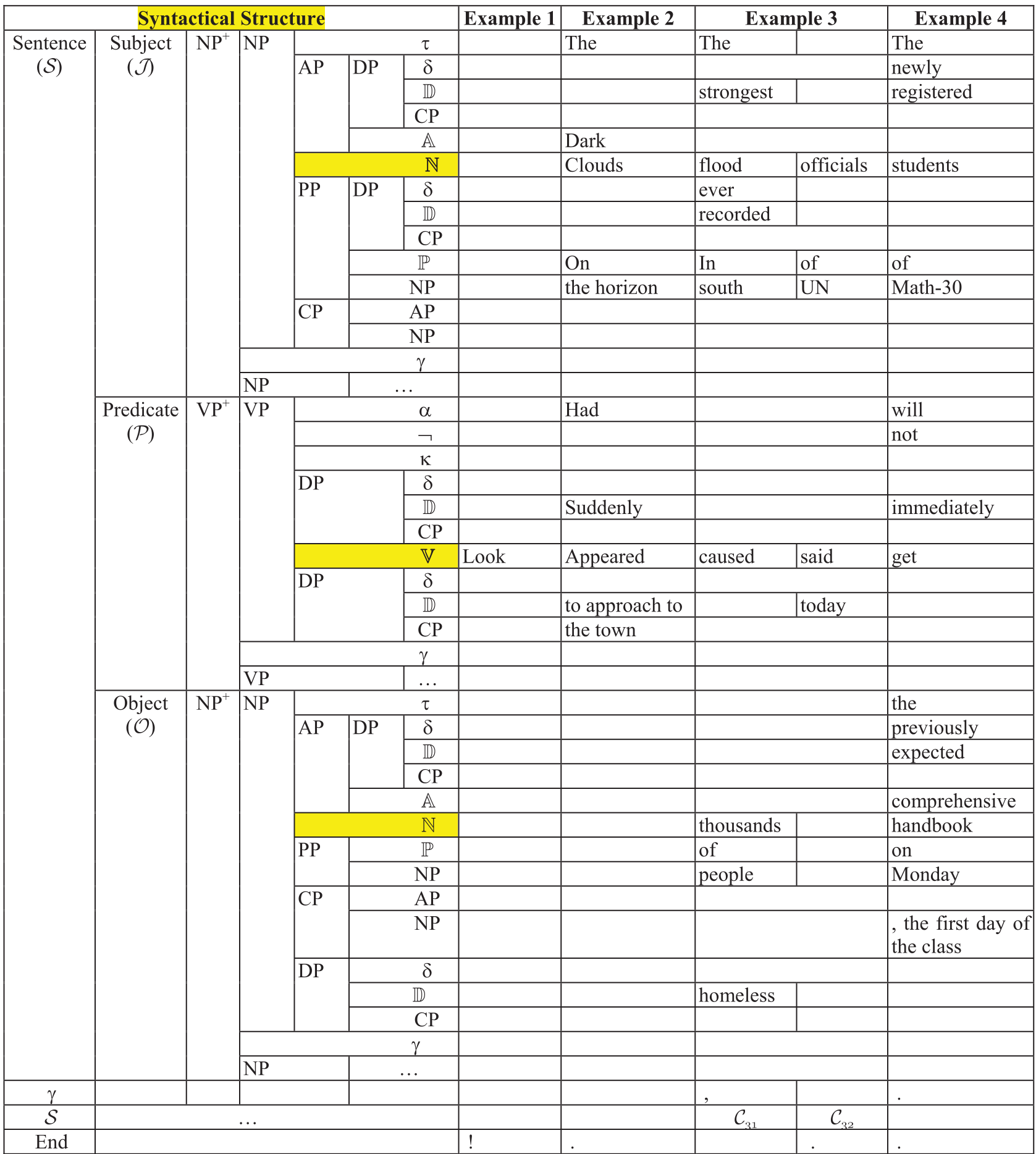
In the table above, complex sentences like "The newly registered students... will not immediately get the previously expected handbook" are mapped onto a rigid subject-predicate-object structure. This demonstrates that no matter how complex the thought, it fits into a recursive, deductive hierarchy.
Critical Insight: Why This Matters
The "Deductive" in Deductive Grammar is the key. In traditional NLP, we hope the model "learns" grammar through data. In DGE, the grammar is a law.
- Precision: This model eliminates ambiguity in syntactic parsing.
- Machine Comprehension: It provides a path toward "Semantic Computing," where machines don't just process tokens but manipulate "Concepts."
- Efficiency: It reduces the need for massive datasets by providing the "rules of the game" upfront.
Conclusion and Limitations
This work sets the stage for a new generation of Cognitive Robots and Autonomous Learning systems. However, its main challenge lies in its rigidity. While it captures the ideal structure of English, natural human speech is often ungrammatical, filled with slang, and context-dependent. Future work must bridge this formal deductive logic with the messy, heuristic nature of real-world communication.
Ultimately, Wang and Berwick have provided a "Periodic Table" for linguistics—a fundamental structure that brings mathematical order to the complexity of human thought expressed through speech.