
Question Waves: Leveraging Physical Wave Intuition for Efficient Social Search
Question Waves: A multicast query routing algorithm for social search
This paper introduces Question Waves (QW), a multicast query-routing algorithm designed for social search in agent-based P2P networks. By mimicking the propagation of physical waves, it prioritizes routing queries to the most trustable acquaintances first, achieving an answer ranking where early arrivals are highly likely to be the most relevant.
TL;DR
Social search—finding information by asking the right people—often struggles with redundant messaging or poor result quality. Question Waves (QW) re-imagines query propagation as a physical wave: queries travel faster through "trusted" media (reliable friends) and slower through others. This results in the best answers arriving first, reducing the need for complex re-ranking and cutting network traffic by up to 3x.
The Problem: The "Who You Know" Bottleneck
In the era of the "Social Machine," searching isn't just about indexing keywords; it's about navigating human expertise. Current P2P search protocols (like BFS or Gnutella-style flooding) are inefficient. They either:
- Flood the network: Querying everyone, which kills scalability.
- Unicast and Fail: Querying one-by-one, where a single unresponsive node breaks the chain.
- Lack Ranking: Answers arrive in a random heap, forcing the user to wait for many responses before deciding which to trust.
Methodology: The Physics of Information
The authors treat a search query as a disturbance in a social medium. By applying local heuristics, each agent in the network manages several wave properties:
- Effort (Energy): A question starts with a specific energy . As it passes through mediators, energy is spent (communication costs) or lost to "friction" (lack of motivation/trust).
- Question Delay (Speed): Instead of constant speed, the link "viscosity" varies. A question is sent to high-trust acquaintances immediately, but held back (delayed) for lower-trust ones.
- Interference: If an agent receives a relevant answer, it emits a "stop message"—a form of destructive interference that halts further query expansion.
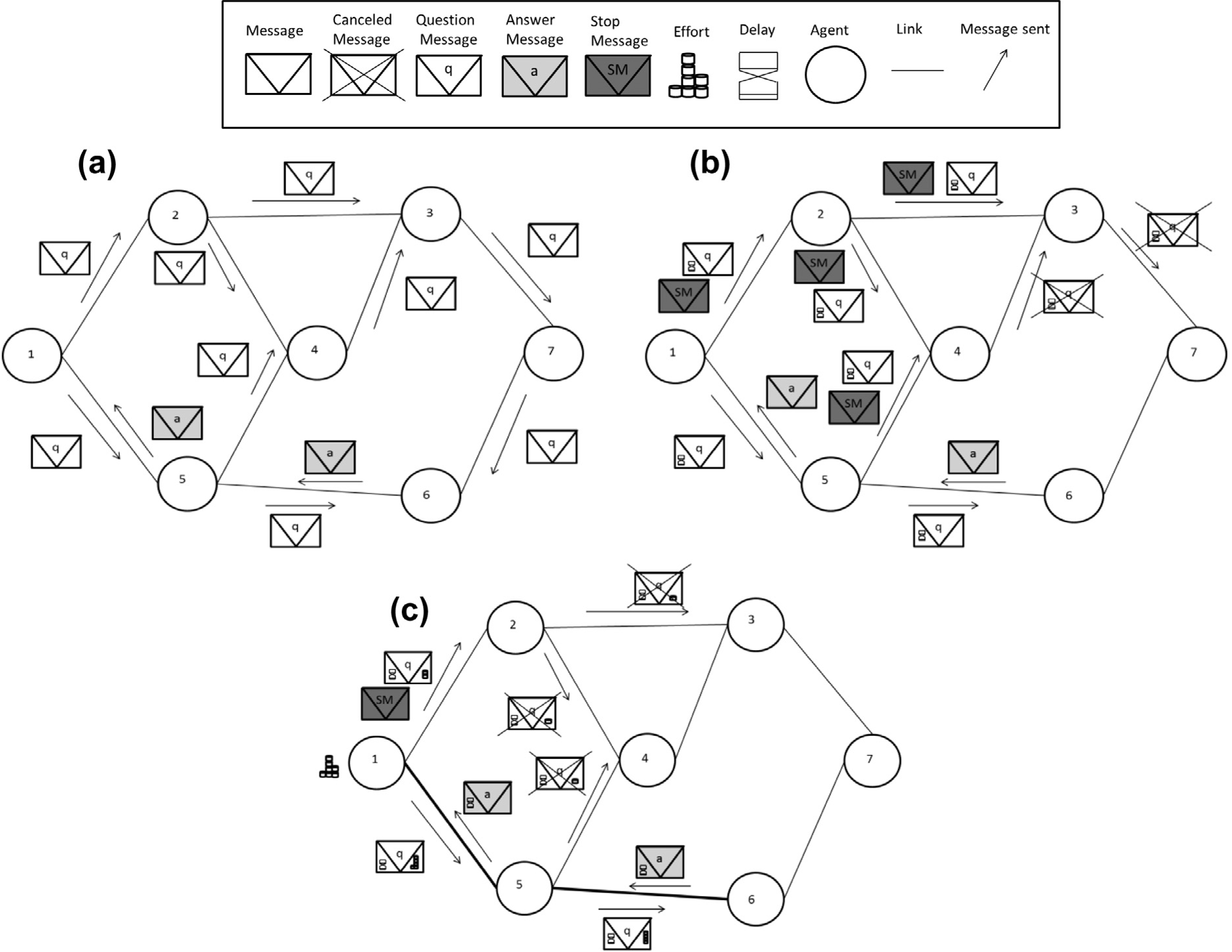 The image depicts how QW (c) uses trust-based link thickness to prioritize propagation compared to standard BFS (a).
The Equation of Probability
The authors expand the Social Query Model (SQM) to a multicast environment. The probability of satisfying a query depends on the probability at the previous distance plus the unique contribution of new nodes at distance , modified by expertise .
Experiments: Real-World Social Feedback
The team tested QW using two distinct datasets:
- KE Dataset: Synthetic data to test raw expertise and trust correlations.
- Movielens Dataset: Using movie ratings as "subjective answers" to map the algorithm onto a real-world Social Feedback System (SFS).
Key Result: Relevance Arrives First
In social search, "Time is Quality." By correlating the arrival order with the actual rating of the answer, the authors found that QW outperforms traditional re-ranking agents.
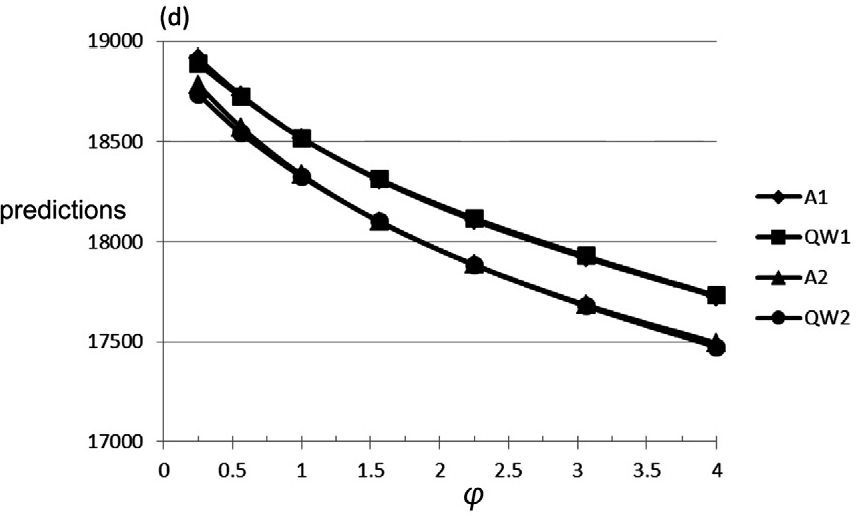 Performance metrics (MAE/MSE) show that QW approaches centralized Collaborative Filtering accuracy while using significantly fewer messages.
Critical Insight: Why Does This Work?
The genius of Question Waves lies in Temporal Sorting. By design, the "shortest path" in a QW network isn't measured in hops, but in trust-weighted time. This creates an implicit ranking system. If an answer arrives late, it is statistically more likely to be from a less-trusted source or a distant expert with lower profile similarity.
Conclusion & Future Work
Question Waves proves that decentralized systems don't need a "Global Brain" to rank results. By simply delaying the propagation of queries through less-trusted channels, the network self-organizes to deliver high-quality results instantly.
Future Outlook: The authors suggest applying this to epidemic models of message propagation and integrating Natural Language Processing (NLP) to better handle the nuances of open-ended questions on platforms like Twitter or Quora.
Takeaway for Tech Leads: If you are building decentralized marketplaces or P2P knowledge sharing tools, stop trying to rank results after they arrive. Instead, rank the routing itself to let the network's natural latency do the heavy lifting for you.