
From Turing to Collective Intelligence: The New Paradigm for Solving "Wicked" Problems
Quo Vadis computer science: From Turing to personal computer, personal content and collective intelligence
This paper explores the paradigm shift from traditional Turing machines and the Fifth Generation Computer Systems (FGCS) to "Collective Intelligence" (CI). It defines CI as a human-computer ecosystem where networked social groups and machines synergize to solve "wicked" problems that require diverse cultural and professional perspectives.
TL;DR
Is the future of computing just more powerful processors, or is it something more social? This paper argues that we are moving beyond the Turing machine and massive parallelism (FGCS) toward Collective Intelligence (CI). By combining the storage and inference power of machines with the creative and contextual insights of humans, CI creates an ecosystem capable of tackling "wicked" problems—complex challenges like global climate change or disaster response that no single algorithm or expert can solve alone.
Background: The Limits of Logic and Silicon
For decades, the trajectory of computer science was dictated by Moore’s Law—faster, smaller, and more centralized. We saw the rise of mainframes, then PCs, and then massive parallel projects like Japan’s Fifth Generation Computer Systems (FGCS).
However, Kapetanios points out that FGCS largely failed because it relied too heavily on rigid logic programming and ignored the "technology curve" of user interaction (the GUI and the Internet). The bottleneck wasn't just processing speed; it was the Knowledge Acquisition Bottleneck. Machines are great at crunching data, but they lack the cultural context and nuanced intuition that humans possess.
The Shift: Metcalfe’s Law and the Social Web
The paper suggests that the 21st century is governed by Metcalfe’s Law: the value of a network is proportional to the square of its users. This shift has transitioned us from:
- Personal Computers: Individual tools for data processing.
- Personal Content: The era of Web 2.0 (Blogs, Flickr, Facebook).
- Collective Intelligence: Aggregating diverse contributions to create emergent knowledge.
Methodology: The Architecture of Synergy
The core insight of the CI framework is the synergy between humans and machines.
- Humans as Producers: We interpret data, provide metadata, and participate in social problem-solving.
- Machines as Enablers: They store, remember, search, and perform mathematical/logical inference.
Kapetanios defines a true Collective Knowledge System as one where the resulting answers or discoveries are not found in the original human contributions but emerge from the computation and inference performed over that collected information.
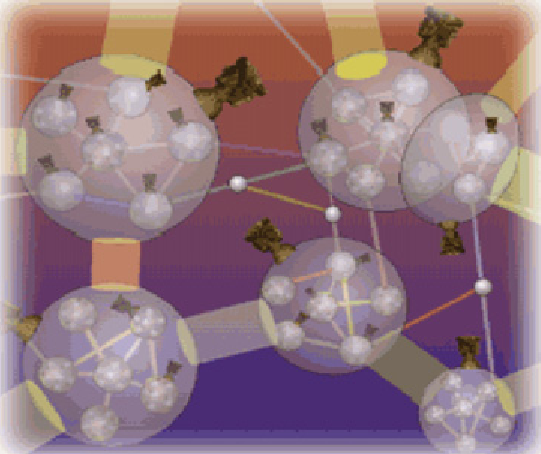
The figure above illustrates the "CI Universe," where collections of user communities intersect with databases, software-as-a-service, and contextualized computational models.
Collaboration vs. Co-operation
A critical distinction in the paper is the "Ladder of Synergy." Kapetanios clarifies that most current systems only reach the lower rungs:
- Information Sharing: Blogs, Chats (The weakest form).
- Co-ordination: Workflow systems, Protocols.
- Co-operation: Playing by the same rules (e.g., Wikipedia, multiplayer games).
- Collaboration: The highest form. A synergistic interaction among diverse experts and users to create strategic solutions for "messy" problems.
Applications and the "Wicked" Problem
What can CI actually do? The paper lists 11 application domains, including:
- Citizen Journalism: Replacing mainstream press with diverse perspectives.
- Collaborative Science: Mashups of satellite data and human observation to track climate change.
- Education 2.0: Group-based collaborative learning environments.
The "Wicked Problems" (e.g., Hurricane Katrina recovery, sustainable agriculture in developing nations) require more than just a 1st-order logic query. They require a Social Network of Problem Solvers who can bridge communication gaps across different cultural and professional backgrounds.
Critical Analysis & Future Outlook
While the paper is visionary, Kapetanios acknowledges the Grand Challenges:
- Trust & Security: How do we ensure quality and trustworthiness in a decentralized network?
- Inherent Complexity: How do we harness the "messiness" of human input without it becoming noise?
- Autonomy: Can we integrate systems without sacrificing the independence of the participants?
Takeaway: The move "beyond Turing" isn't about simulating a human brain in silicon (Classic AI); it's about building a digital nervous system that connects billions of human brains with the processing power of the cloud. This is the Sixth Generation of computing.
Conclusion
Collective Intelligence represents a fundamental contribution to STEM. It moves computing from a tool for the individual to a platform for the collective. As we face global crises that no single government or supercomputer can manage, the synergistic model of CI offers a promising, logic-defying path forward.