
Strategic Integration: How Newcomers Can Capture Social Network Centrality
Establishing Connections in a Social Network - Radial Versus Medial Centrality Indices
This paper explores the "Social Network Building" problem, where a newcomer seeks to maximize their influence by establishing strategic links. The authors propose three heuristics—MaxEig, Express, and Community—and evaluate their performance across Radial (Closeness, Eigenvector) and Medial (Betweenness) centrality metrics in both synthetic and real-world networks.
TL;DR
Joining a new professional or social community is more than just making friends; it's an optimization problem. This paper investigates how a "newcomer" can establish a limited number of links () to maximize their influence. By distinguishing between Radial (outward interaction) and Medial (mediation) centrality, the authors provide a toolkit of heuristics—MaxEig, Express, and Community—that outperform random networking by several orders of magnitude.
Problem & Motivation: The Geometry of Influence
In social network theory, a node's position determines its access to information, opportunities, and power. However, most research focuses on identifying existing central nodes rather than becoming one. For a newcomer (e.g., a student at their first conference), the challenge is: Who should I connect with first?
The authors identify two critical gaps in prior work:
- Structural Blindness: Existing methods often ignore whether a network has one central core (Unimodal) or multiple distinct clusters (Multimodal).
- Metric Confusion: "Centrality" isn't a single value. A "broker" (high betweenness) plays a fundamentally different role than a "popular leader" (high eigenvector).
Methodology: Three Algorithmic Flavors
The paper introduces three strategies based on different structural intuitions:
- MaxEig (The "Eager" Logic): Targets nodes with the highest Eigenvector centrality. It assumes connecting to "popular" people makes you popular. It uses an -neighborhood exclusion to ensure the newcomer doesn't just link to a single tight-knit clique.
- Express (The "Broker" Logic): Aims to build "bridges" between distant regions. It pairs a high-degree node with the node furthest from it, positioning the newcomer as the shortest path between them.
- Community (The "Holistic" Logic): Uses community detection to partition the network into clusters. The newcomer then links to the most central node in each community, effectively bridging the entire multimodal landscape.
Experiments & Results: Radial vs. Medial
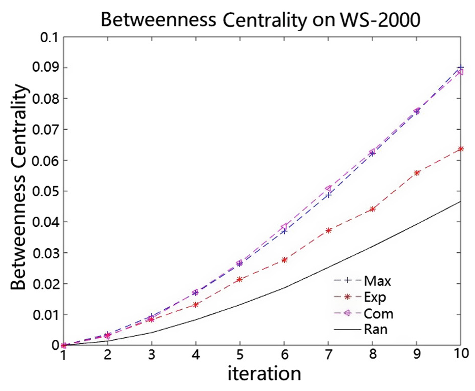
The researchers tested these algorithms on Barabási-Albert (BA) scale-free networks, Watts-Strogatz (WS) small-world networks, and four real-world datasets (Facebook, Google+, etc.).
Key Findings:
- The "Community" Supremacy: In BA networks (which often have a clear core), the
Communityalgorithm showed the steepest growth for radial centralities (Closeness and Eigenvector). - Betweenness vs. The Rest: There is a clear "dichotomy." An algorithm that excels at making you "close" to everyone (Radial) often fails to make you a "gatekeeper" (Medial).
- Massive Gains: In real-world graphs like
soc-Anybeat, theCommunityheuristic achieved a staggering 541x improvement in betweenness centrality over a random strategy.
Critical Analysis & Conclusion
This work provides a rigorous framework for what many "super-connectors" do intuitively. It proves that network topology dictates strategy:
- In Unimodal networks (one core), focus on the most influential leaders (
MaxEig). - In Multimodal networks (many clusters), focus on bridging the gaps between those clusters (
Community).
Limitations & Future Outlook
While the heuristics are powerful, the study assumes a static network. Real networks are "living" organisms—edges form and break over time. Future research should investigate how these strategies hold up in dynamic environments where existing members might react to the newcomer's arrival. Furthermore, combining these metrics into a single "Hybrid Centrality" score could offer an even more robust optimization target.
Takeaway: If you want to be the "gatekeeper" of information, don't just follow the crowd—find the clusters and build the bridges.