
Virtualizing the Airwaves: Scaling Social IoT via SDN-Enabled RAN
15340_Radio Access Network Virtualization for the Social Internet of Things.
The paper introduces an SDN-enabled Radio Access Network (RAN) virtualization framework tailored for the Social Internet of Things (SIoT). It proposes a requirement-first greedy allocation algorithm to maximize the number of virtual RAN (vRAN) groups supported on a single physical infrastructure while strictly adhering to latency and rule-space constraints.
TL;DR
As the Internet of Things evolves into the Social IoT (SIoT), the demand for isolated, group-specific network resources is skyrocketing. This paper presents a virtualization framework that uses Software-Defined Networking (SDN) to carve out independent virtual RANs (vRANs) from a single physical infrastructure. By treating the limited hardware "rule-space" as a precious resource, the authors achieve a 60% improvement in network capacity compared to standard allocation methods.
The Motivation: Why SIoT Changes the Game
In a Social IoT ecosystem, "things" establish relationships similar to human social networks. For these friendships to function securely and efficiently, the network must be partitioned into distinct groups.
However, current Radio Access Networks (RANs) are rigid. Virtualizing them isn't just about sharing frequency; it's about managing the forwarding rules in the switches. If a switch runs out of memory (TCAM) for these rules, it must "ask" the controller what to do with every new packet, leading to massive latency that ruins time-sensitive applications like cloud gaming or VoIP.
Methodology: Solving the TCAM Bottleneck
The core contribution is a two-step mapping process and a greedy optimization algorithm.
1. Dual-Plane Mapping Architecture
The framework acts as a shim layer in the SDN controller.
- Packet Mapping: It intercepts notifications from physical switches, translates IP addresses from the physical domain to a virtual domain, and hands them to the group's virtual controller.
- Rule Mapping: When the virtual controller responds with a forwarding command (e.g., "Send to Port 1"), the framework translates this back to physical hardware addresses (e.g., "Switch 3, Port 4").
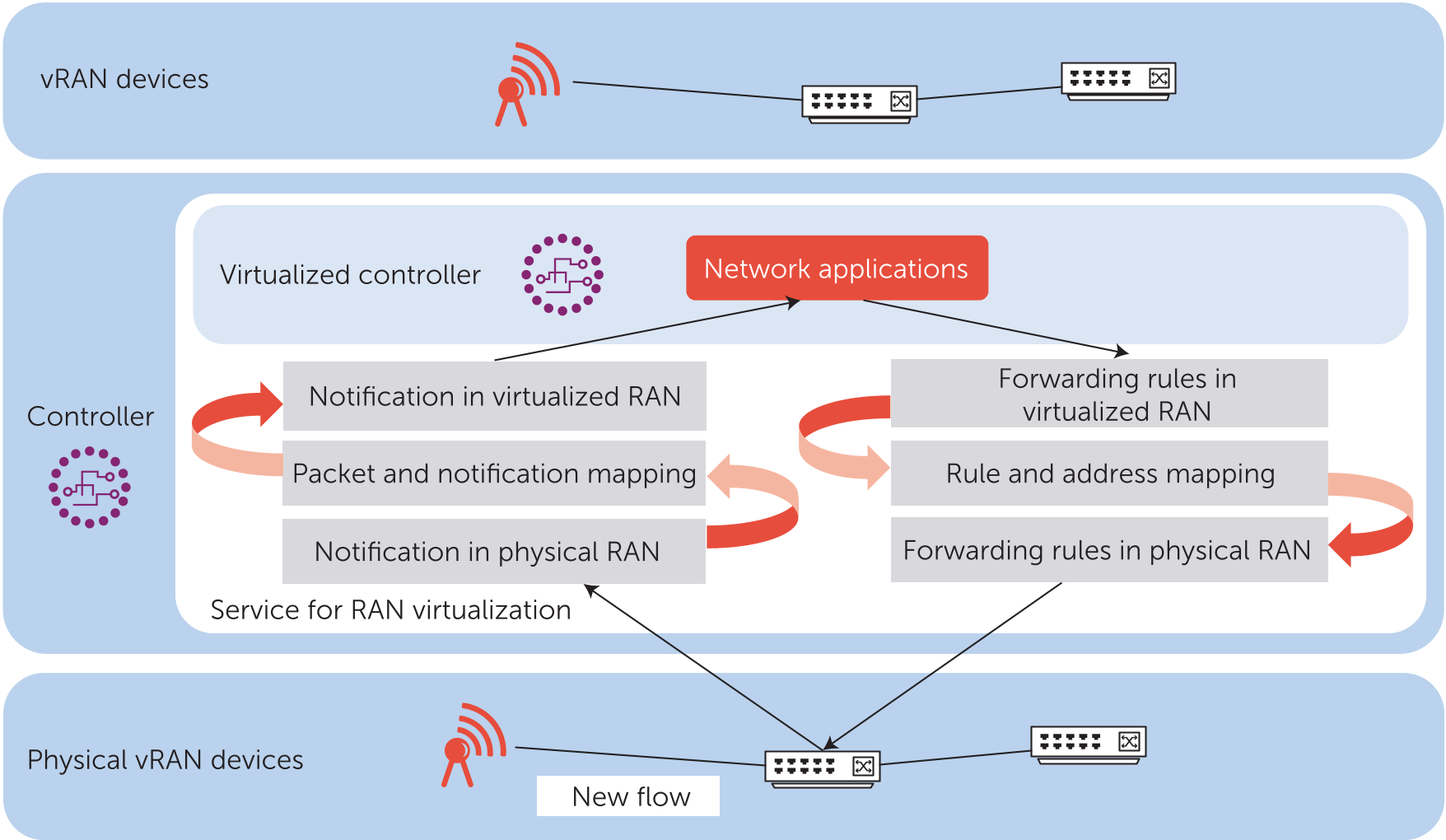 Figure 1: The architecture shows how virtualization services in the controller mediate between physical switches and virtual RAN applications.
2. Requirement-First Greedy Allocation
The RARV (RAN Virtualization) problem is NP-hard. To solve it, the authors use a strategy of "Maximal Packing":
- Sort vRANs by their footprint (those needing fewer rules come first).
- Greedily Assign rules to switches while keeping the average latency below a pre-set threshold (e.g., 900ms).
- Validate capacity; if a vRAN's requirements can't be met without breaking the latency budget, it is skipped to save space for others.
Experimental Results: Real-World Simulation
The team tested their framework using a topology modeled after Muroran, Japan, simulating up to 90,000 devices.
Key Performance Metrics:
- Rule Entry Scaling: As the switch capacity increased from 5,000 to 10,000 entries, the proposed algorithm supported nearly double the number of vRANs compared to FIFO or Random allocation.
- Latency Sensitivity: The system is highly sensitive to the defined QoS. Lowering the allowed latency dramatically reduces the number of groups the network can support, highlighting the trade-off between "social" scale and performance.
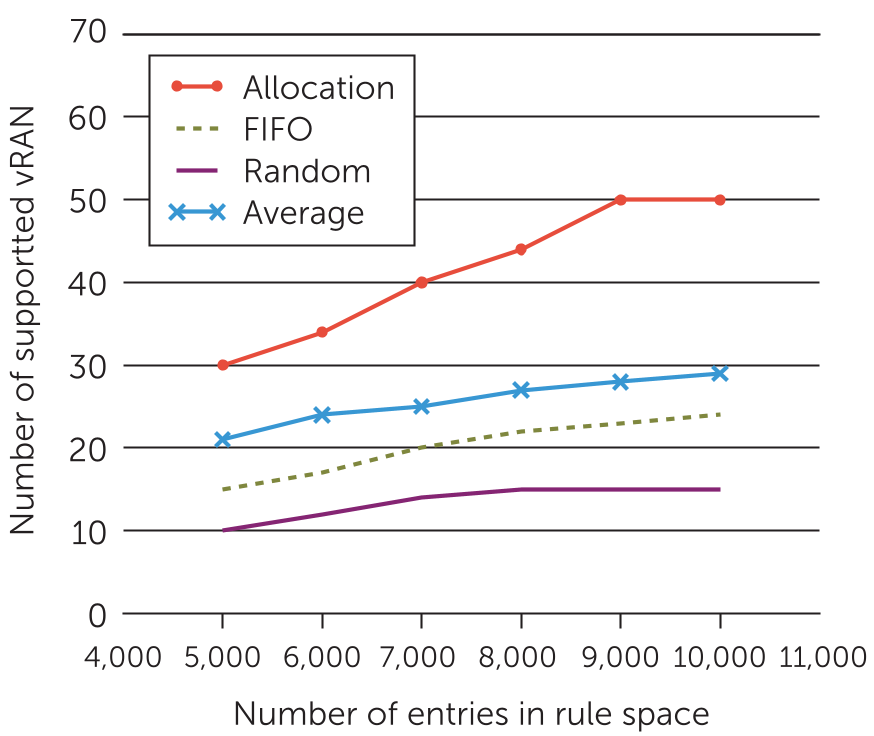 Figure 2: Performance comparison showing the proposed algorithm (solid line) consistently outperforming baselines across varying rule spaces and latency requirements.
Critical Analysis & Conclusion
The Takeaway
The shift toward SDN-enabled vRANs is inevitable for 5G and beyond. This work proves that intelligent rule management is just as important as spectrum management. By prioritizing smaller, highly efficient groups, network providers can maximize their infrastructure's ROI.
Limitations
While the framework is robust, it assumes a relatively static distribution of flows within each hour. In high-mobility scenarios (e.g., connected vehicles), the frequent updating of rule-spaces might introduce a "signaling storm" at the controller level, a challenge that remains for future research.
Senior Editor's Note: This paper effectively bridges the gap between social network theory and hard-core networking constraints, offering a pragmatic path for infrastructure providers to monetize the burgeoning SIoT market.