
RAF-AU: Decoding the Complex Language of Real-World Facial Expressions
RAF-AU Database: In-the-Wild Facial Expressions with Subjective Emotion Judgement and Objective AU Annotations
The paper introduces RAF-AU, a novel "in-the-wild" facial expression database that provides both subjective emotion judgements (crowdsourced) and objective Facial Action Unit (AU) annotations. It bridges the gap between Basic Emotion Theory and the Facial Action Coding System (FACS) for complex, blended real-world expressions, achieving a baseline AU detection accuracy of 88.73% AUC using a multi-label AU-CNN.
TL;DR
The RAF-AU database is a game-changer for affective computing, moving away from "lab-perfect" smiles to the messy, blended reality of everyday life. By combining subjective human perception with objective muscular coding (Action Units), it provides a robust framework for training AI to understand not just what an emotion is, but how it is physically constructed.
Context: This work addresses the "Coherence Problem"—the gap between what a face does (muscular movement) and what a human perceives (emotion)—positioning itself as a bridge between sign-based and judgment-based research.
The Problem: The "In-the-Wild" Wall
Most facial expression recognition (FER) systems are trained on datasets like CK+ or MMI, where actors pose "standard" emotions. In the real world, faces are rarely that clear. We encounter:
- Blended Emotions: A face might show a mix of fear and anger.
- Environmental Noise: Poor lighting, rotations, and occlusions (e.g., hair covering the forehead).
- Physical Ambiguity: Is that wrinkle between the eyebrows a permanent feature of an elderly face, or a sign of concentration?
Current mapping rules (EMFACS) often fail because real-world AUs don't always align with the "textbook" definition of basic emotions.
Methodology: The Dual-Label Approach
The authors built RAF-AU (Real-world Affective Face - Action Unit) using 4,601 images. Its unique value lies in the interplay of two viewpoints:
- Subjective (Judgment-based): Using the wisdom of the crowd to label what an emotion feels like to a human observer.
- Objective (Sign-based): Using FACS experts to code 26 different Action Units.
This allowed the researchers to calculate exactly which AUs "drive" certain perceptions. For instance, they discovered that AU25 (Lips Part) is a universal contributor across modern "wild" expressions, appearing in Surprise, Fear, Happiness, and Anger.
Model Architecture: Multi-Label AU-CNN
To establish a baseline, they designed a multi-label CNN capable of detecting 13 frequent AUs simultaneously. Unlike standard classification, this model handles the imbalanced distribution (where some AUs like AU25 are very common, while AU39 is rare) by using a multi-label cross-entropy loss.
 Figure 1: Examples of in-the-wild images from the RAF-AU dataset with objective AU annotations.
Experiments and Results
The researchers compared handcrafted features (HOG, LBP) against deep learning approaches.
SOTA Comparison
The results were clear: Deep features specifically trained on the RAF-AU dataset (AU-CNN) significantly outperformed general-purpose DCNNs.
- Average AUC-ROC: 88.73% (AU-CNN) vs 80.31% (HOG).
- F1 Score: 65.95% (AU-CNN) vs 43.75% (HOG).
Key Insight: The Relationship Matrix
One of the most valuable outputs of the study is the correlation matrix between emotions and AUs.
| Emotion | Primary Contributing AU | Weight |
|---|---|---|
| Happiness | AU12 (Lip Corner Puller) | 0.7040 |
| Sadness | AU4 (Brow Lowerer) | 0.6723 |
| Disgust | AU10 (Upper Lip Raiser) | 0.5964 |
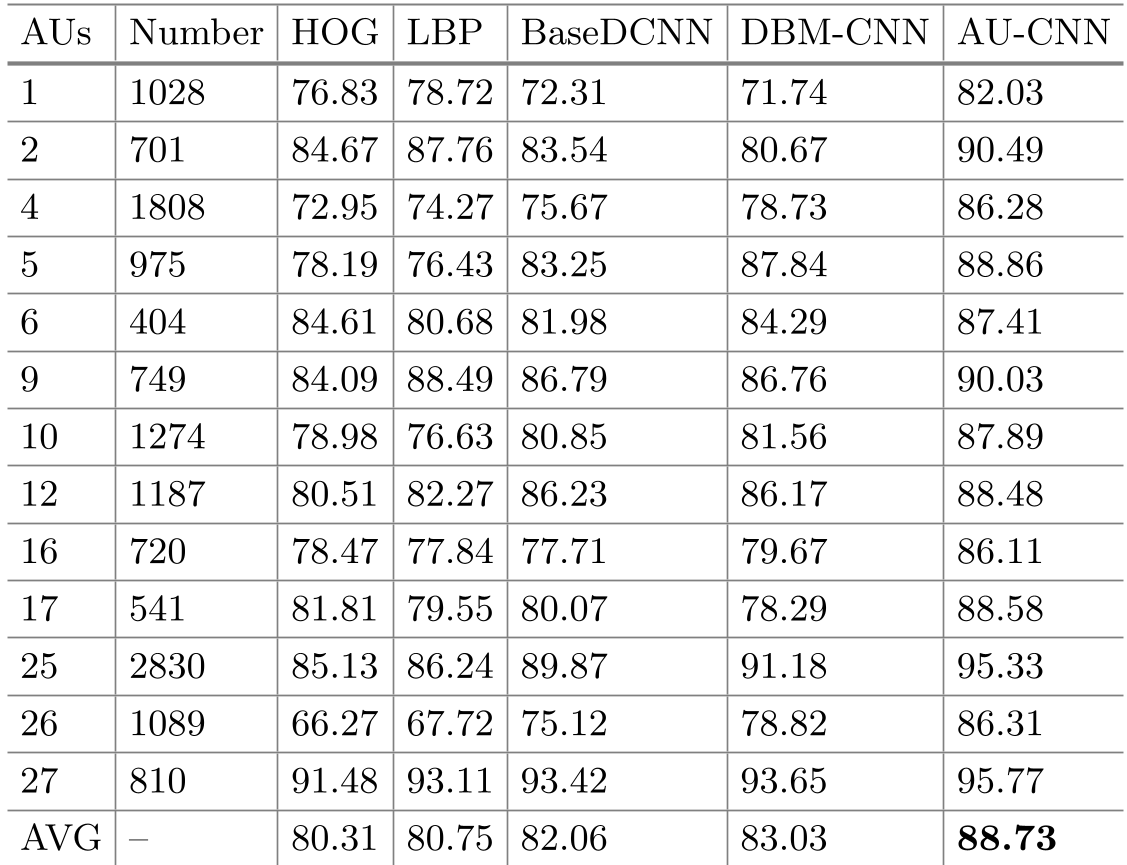 Table 6: AUC-ROC performance across 13 Action Units, highlighting the superiority of the AU-CNN feature.
Critical Analysis & Conclusion
Takeaway
RAF-AU provides the necessary data to train AI that doesn't just "guess" an emotion but understands the muscular evidence behind it. This is crucial for high-stakes applications like psychological analysis or human-robot interaction.
Limitations
Despite the high AUC, the F1 scores remain relatively low for certain AUs (e.g., AU17). This indicates that "in-the-wild" detection is still heavily hampered by imbalanced data and the "trace-level" subtlety of spontaneous expressions.
Future Work
The next frontier is extending this to temporal video data and exploring cross-cultural differences in how Action Units are combined to signal social intent, as the current dataset primarily focuses on images from Chinese social networks.