
RAMID: Quantifying the Viral Threat of Misinformation on Social Networks
RAMID: A Novel Risk Assessment Model of Information Dissemination on Social Network
The paper proposes RAMID, a novel risk assessment model specifically designed to quantify the threats of false information dissemination on social networks. It utilizes the Analytic Hierarchy Process (AHP) to evaluate risks across four dimensions: website, user, information content, and dissemination process.
TL;DR
In an era where a single false tweet can wipe out $130 billion in stock market value in minutes, traditional cybersecurity—which focuses on firewall breaches and server uptimes—is no longer enough. This paper introduces RAMID (Risk Assessment Model of Information Dissemination), a hierarchical framework that uses the Analytic Hierarchy Process (AHP) to quantify the specific risks associated with how false information spreads across social platforms.
Contextual Positioning
Most security models treat "risk" as a technical failure. However, RAMID treats "risk" as a structural vulnerability of the social network itself. It moves the discourse from Operational Safety to Information Safety, providing a standardized way to compare the inherent risks of platforms like WeChat versus Weibo.
The Core Challenge: Why Traditional Models Fail
The authors argue that the threat of false information is distinct from system threats because its primary requirements are not Confidentiality or Integrity, but Reliability, Controllability, and Non-repudiation. Traditional vulnerability scanning cannot detect the risk of a viral rumor because the "exploit" is human psychology and network topology, not a bug in the code.
Methodology: The RAMID Framework
The authors decompose a social network into four critical dimensions to calculate the potential for adverse effects:
- Website Dimension: The platform provider and terminal type (Mobile vs. PC).
- User Dimension: Focusing on identity authentication and the "tightness" of social circles.
- Information Dimension: Analyzing the degree of relevance and the strictness of post/repost auditing.
- Dissemination Process: Quantifying the direction of flow and the sheer volume of active users.
Model Architecture
The paper uses AHP to determine the weight of each factor. For instance, in the "User" dimension, User Identity is weighted at 0.7, while User Relationship is 0.3, reflecting the insight that anonymous or unverified users are the primary drivers of risk.
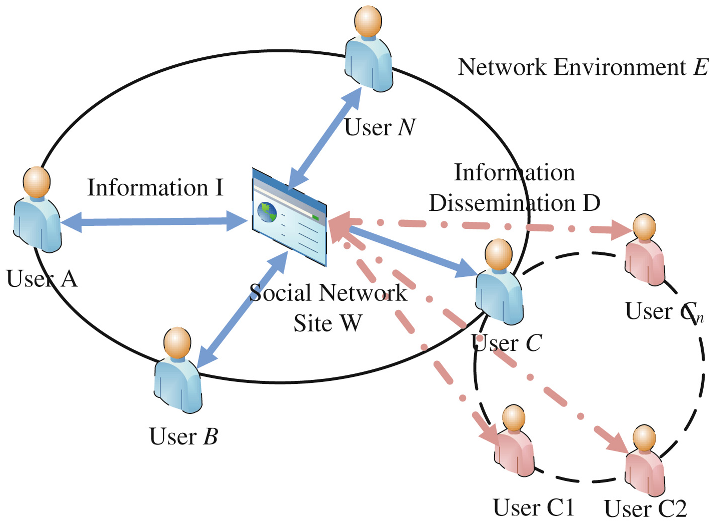 Fig 1: The transmission mode identifying key entities (W: Site, U: Users, I: Information, D: Dissemination).
Experimental Insights: Weibo vs. WeChat
The authors applied RAMID to two giants of the Chinese social landscape:
- Tencent WeChat: Found to have higher risks in user authentication and auditability. Because WeChat is a semi-closed "friend circle," it often bypasses the public scrutiny that helps debunk rumors.
- Sina Microblog (Weibo): Showed higher risk in the dissemination process. Its one-to-many broadcast architecture allows information to reach millions of daily active users almost instantaneously.
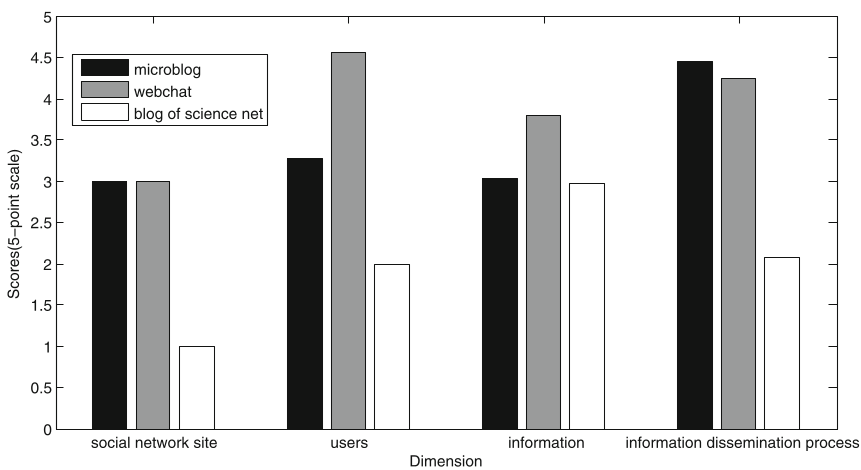 Fig 2: Comparative risk scores across different platforms. Note the significantly lower risk profile of traditional ScienceNet blogs compared to social apps.
Critical Analysis & Conclusion
The RAMID model provides a much-needed quantitative baseline for regulators and platform owners. By assigning numerical "Risk Scores," it transforms a qualitative problem (rumors) into a manageable engineering metric.
Takeaway: The primary risk point in modern networks is not just "who" says something, but "how easily" it can be reposted without audit.
Limitations: The model relies on manual parameter setting for certain weights (AHP is semi-subjective). Future iterations would benefit from integrating real-time traffic data and NLP-based sentiment analysis to dynamically adjust risk scores as a topic goes viral.