
Beyond Greedy: A High-Efficiency Random-Based Approach to Influence Maximization
A Random-Based Approach to Social Influence Maximization
This paper introduces a novel random-based algorithm for the Social Influence Maximization (IM) task. By combining community detection with a "Jump-Crawl" sampling strategy, the method identifies influential seed nodes while significantly reducing computational overhead compared to traditional greedy algorithms.
TL;DR
Influence Maximization (IM) is the art of finding a small set of "seed" users to trigger the largest possible cascade of information. While greedy algorithms provide high accuracy, they are notoriously slow. This paper proposes a hybrid strategy that uses Community Detection to prevent influence overlap and a Random Jump-Crawl mechanism to find high-impact nodes locally. The result is a scalable algorithm that performs as well as SOTA greedy methods but at a fraction of the temporal cost.
The Scalability Wall and the "Rich Club" Trap
The field of Social Network Analysis has long struggled with a dilemma: accuracy vs. scalability.
- Greedy Algorithms: Accurate but computationally expensive (NP-hard).
- Heuristic Measures: Fast (like Degree Centrality) but often fall into the "Rich Club" trap, where all selected seeds are friends with each other, leading to massive redundant influence.
The authors argue that in massive networks, we don't need to see the whole graph. We just need to sample it smartly.
Methodology: Jump, Crawl, and Group
The proposed algorithm operates on three logical layers to solve the "Where to look?" and "Who to pick?" questions.
1. Community-First Partitioning
To avoid the overlapping information problem, the algorithm first divides the network into communities. By forcing seed selection to happen across different groups, the algorithm naturally achieves an Inductive Bias toward diversity.
2. The Jump-Crawl Mechanism
Instead of calculating scores for every node (), the authors use:
- Jump: Pick a node at random.
- Crawl: Explore that node’s immediate neighborhood.
This simulates a "recommendation" process: ask a random person to point out the most influential leader in their circle.
3. The Influence Metric ()
The paper defines a specific metric to rank local candidates: Where is the node's degree (local power) and is the count of its third-order neighbors (reach expansion).
Note: The methodology relies on traversing finite nodes rather than the entire network graph.
Experimental Performance
The authors tested their approach on four datasets, including Facebook and arXiv (CA-GrQc).
Propagation Efficiency
Under the Independent Cascade Model (ICM), the random-based algorithm showed a propagation spread that was consistently competitive with NewGreedyIC and DegreeDiscountIC.
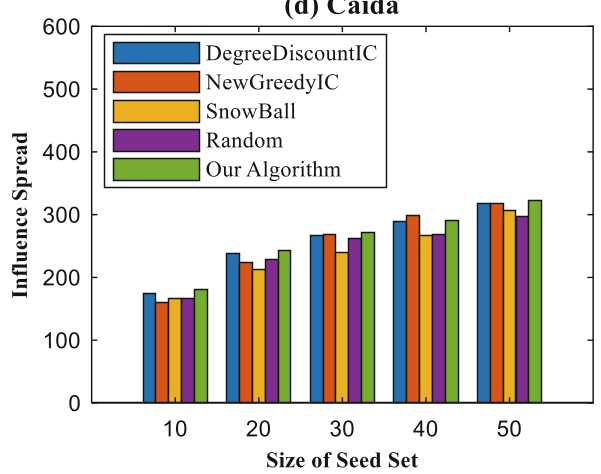 Fig 1: Influence spread as k (seed count) varies. Notice how the proposed algorithm (solid line) mirrors or exceeds the greedy baselines.
Key Observations:
- Facebook Network: The algorithm performed exceptionally well here, likely due to the clear community structures in social friendship data.
- Complexity: Unlike Greedy methods that require thousands of simulations, this approach only looks at neighbors of sampled nodes, offering a massive reduction in memory and time.
Critical Insight & Conclusion
The brilliance of this paper lies in its simplicity. By acknowledging that influence is often local, the authors bypass the need for global graph knowledge.
Limitations: The algorithm's success depends heavily on the quality of the initial community detection. If the communities are poorly defined, the random "jumps" might still land in overlapping influence zones.
Future Outlook: This approach is ripe for application in real-time viral marketing or epidemic containment, where the network structure is too large or too fast-changing to allow for exhaustive greedy computations.