
PRM-DB: Bridging the Gap Between Synthetic Data and Relational Intelligence
Random Generation and Population of Probabilistic Relational Models and Databases
This paper introduces a novel algorithmic framework for the random generation of Probabilistic Relational Models (PRMs) and their corresponding relational databases. By bridging the gap between Bayesian Network synthesis and synthetic database population, the method provides a "gold standard" for evaluating PRM structure learning algorithms and database management system efficiency.
Executive Summary
In the world of machine learning, "gold standards" are essential. For standard Bayesian Networks (BNs), we have established benchmarks; however, for Probabilistic Relational Models (PRMs)—which extend BNs to relational databases—researchers have long struggled with a lack of synthetic datasets that reflect complex, inter-class dependencies.
This paper presents a comprehensive algorithmic approach to generate PRMs from scratch. By synthesizing both the relational schema and the underlying probabilistic structure, the authors enable the creation of realistic, populated databases. This serves as a vital tool for evaluating Structure Learning and DBMS performance in a controlled, verifiable framework.
Problem & Motivation: The Reality Gap in Relational Data
Data mining usually happens on "flat" tables. But real-world data lives in relational databases (SQL). PRMs were designed to handle this complexity by modeling classes and relationships.
The core problem identified by the authors is two-fold:
- Learning Evaluation: If you develop an algorithm to "learn" a PRM from data, how do you know if it's right without a "ground-truth" model to compare it against?
- Database Benchmarking: Current tools like
DbSchemaorDataFillerpopulate tables assuming attributes are independent. This is physically unrealistic and fails to test how systems handle data with complex probabilistic correlations.
Methodology: The Three Pillars of PRM Generation
The authors break down the generation into a logical workflow that mirrors the lifecycle of a relational database, infused with probabilistic logic.
1. Relational Schema Synthesis
Using graph theory, the algorithm generates a DAG of relations. Each node is a table, and edges represent foreign key constraints. To ensure a coherent database, the authors use a rejection sampling technique to ensure the resulting schema is a single connected component.
2. Dependency Structure & Slot Chains
This is the "brain" of the PRM. The method constructs dependencies in two phases:
- Intra-class: Dependencies within the same table.
- Inter-class: Dependencies across tables via Slot Chains (e.g., a Movie's Rating depending on the User's Genre preferences).
Key Insight: The authors implement an exponential penalty for the length of slot chains. This reflects the physical intuition that direct relationships are more likely to be influential than distant, multi-hop ones.
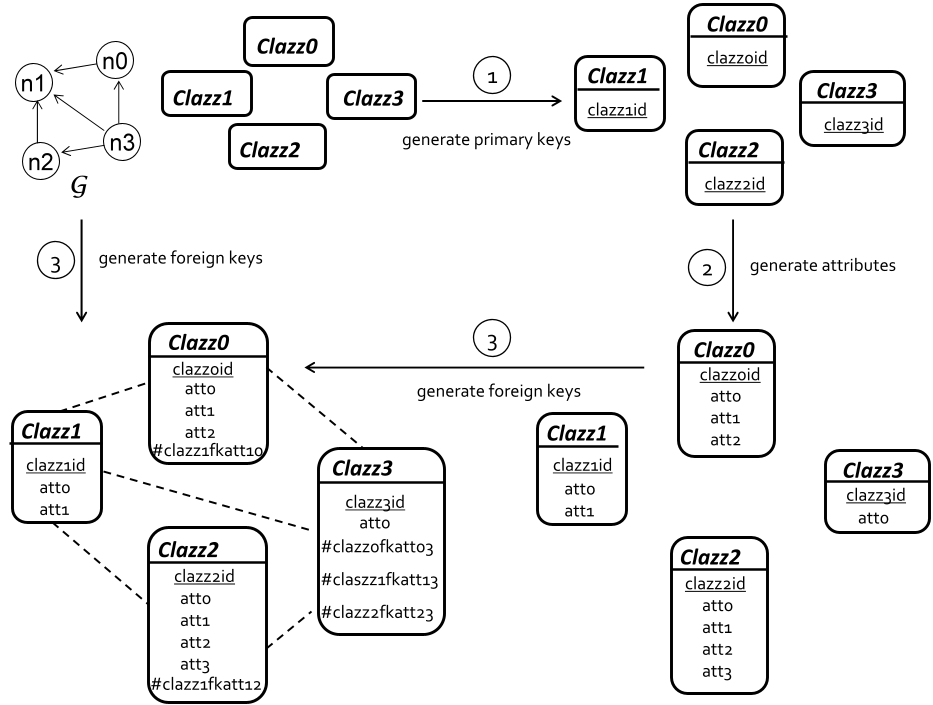 Figure: The transition from a pure graph structure to a PRM with annotated slot chains and aggregators.
3. Population via Ground Bayesian Networks (GBN)
Once the meta-model (PRM) is defined, the authors create a Relational Skeleton (objects and links). This is then "unrolled" into a Ground Bayesian Network, where standard forward sampling techniques produce the final database records.
Experiments & Results: Putting Algorithm to Practice
The implementation using the PILGRIM API demonstrates the ability to generate a 4-class relational schema and populate it with tuples per class in a PostgreSQL environment.
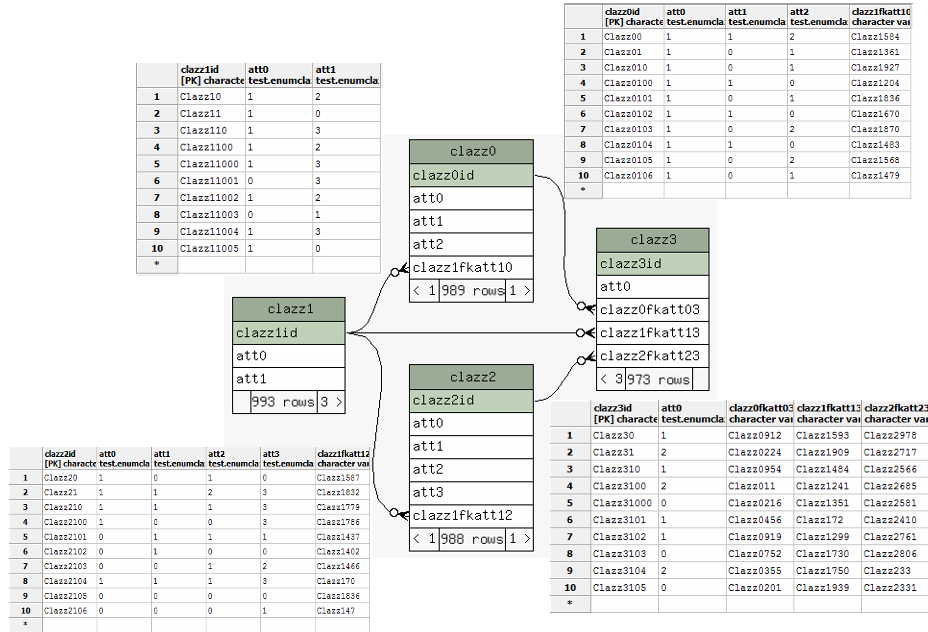 Figure: The final resulting schema (visualized via SchemaSpy) and the corresponding populated SQL tables.
The "toy example" provided in the paper illustrates that the generator can handle:
- Diverse Aggregators: Using functions like
MODEorMEANfor multi-valued dependencies. - Complex Cycles: Managing the difference between referential paths and probabilistic dependency paths to avoid invalid models.
Critical Analysis & Future Outlook
Takeaway: This work provides the "missing link" for Statistical Relational Learning. By treating database generation as a probabilistic sampling task, it allows for more rigorous scientific benchmarking.
Limitations:
- The current approach assumes a Poisson distribution for the number of attributes and objects, which may not capture the "power-law" distributions often seen in real-world "big data."
- While it solves the existence of a generation process, the computational complexity of unrolling a GBN for millions of records remains an architectural bottleneck.
Future Work: The authors aim to release these benchmarks to the community and utilize them specifically to test a new PRM structure learning approach currently under development.