
PRM-Generator: Bridging the Gap Between Relational Databases and Probabilistic Graphical Models
Random Generation and Population of Probabilistic Relational Models and Databases
2014-11-01
Summary
Problem
Method
Results
Takeaways
Abstract
This paper introduces a novel algorithmic approach to the random generation of Probabilistic Relational Models (PRMs) and synthetic relational databases. It bridges the gap between machine learning and database benchmarking by providing a structured framework to generate complex relational schemas, probabilistic dependency structures, and populated database instances from scratch.
## TL;DR
Researchers have long struggled to evaluate **Probabilistic Relational Models (PRMs)** due to a lack of "Gold Standard" benchmarks. This paper presents a systematic algorithmic approach to generate random PRMs and synthetic databases from scratch. By transforming relational schemas into Ground Bayesian Networks, the method allows for the creation of complex, interlinked datasets that reflect real-world probabilistic dependencies, providing a vital tool for both AI researchers and database architects.
## The Benchmarking Vacuum in Relational Learning
In the world of standard **Bayesian Networks (BNs)**, we have established benchmarks like the *Alarm* or *Asia* networks. However, as we move toward **Statistical Relational Learning (SRL)**—where data isn't just a flat table but a web of interconnected entities—we find a significant void.
Current database benchmarks (like TPC-H) focus on functional constraints and transaction speeds, but they treat data within columns as independent. This is a "deal-breaker" for training ML models designed to find hidden correlations across tables. If a researcher develops a new algorithm to learn the structure of a PRM, they have no ground truth to compare it against—until now.
## Methodology: From Schema to Synthetic Data
The authors break down the generation process into three logical layers:
### 1. Relational Schema Generation
The algorithm treats the database schema as a **DAG (Directed Acyclic Graph)** where nodes are tables and edges are foreign key relationships. To ensure the schema is realistic, they use a rejection sampling technique to ensure the graph is a single connected component without referential cycles (a common pitfall in database design).
### 2. Probabilistic Dependency Structure
This is the "brain" of the PRM. Dependencies are divided into:
* **Intra-class**: Attributes within the same table affecting each other.
* **Inter-class**: Attributes in Title 'A' affecting attributes in Table 'B' via **Slot Chains** (e.g., a Movie's *Genre* affecting a User's *Rating*).
The authors use a clever **exponential decay function** ($\exp^{-l}$) to penalize excessively long slot chains, ensuring that the generated models remain computationally feasible while still being complex.
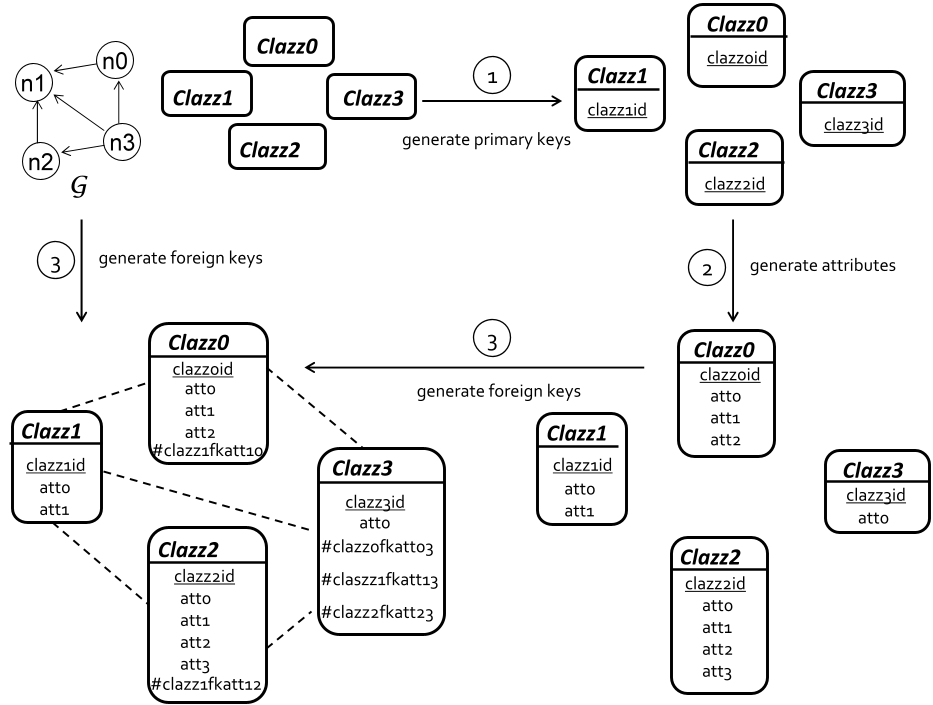
*Fig 1: A generated PRM structure showing both internal dependencies and complex inter-class slot chains.*
### 3. Populating the Database
Once the "Meta-Model" is defined, the algorithm creates a **Ground Bayesian Network (GBN)**. This is a massive graph where each node represents an actual attribute of an actual record in the database. By performing **Forward Sampling** on this GBN, the tool generates rows for a PostgreSQL database that are "aware" of the probabilistic rules defined in the meta-layer.
## Experimental Insights
The authors implemented this framework in the **PILGRIM API** (C++). In their "Toy Example," they demonstrated:
* The generation of 4 distinct classes with varied attribute cardinalities.
* The sampling of 1,000+ tuples per class.
* Integration with **ProbModelXML**, an evolving standard for encoding these complex graphical models.
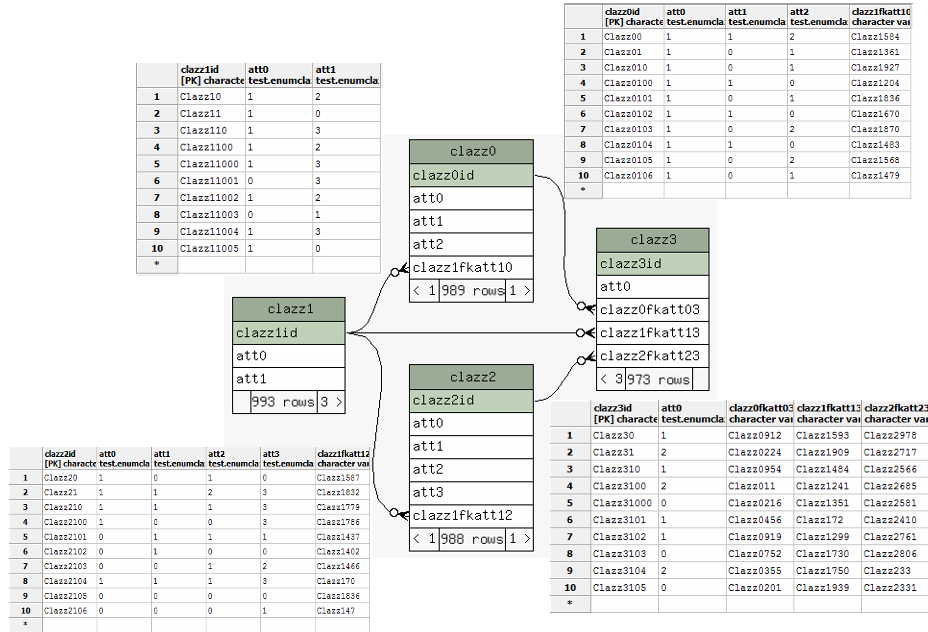
*Fig 2: Visualization of the generated relational schema and the resulting records in a PostgreSQL environment.*
## Critical Analysis & Conclusion
**The Takeaway**: This work is foundational for the evaluation of PRM structure learning. Without a way to generate synthetic "Gold Standards," the field of SRL cannot objectively measure the accuracy of its algorithms.
**Limitations**: While the approach is robust, it currently assumes discrete distributions. In modern data contexts, handling continuous variables and non-linear aggregators (beyond simple MODE or MEAN) would be a significant next step.
For researchers in relational data mining, this generator provides the "synthetic laboratory" needed to stress-test learning algorithms before applying them to messy, real-world relational data.