
Beyond the SIR Model: Decoding Contagion through Social Networks and Stochastic Individual-Based Modeling
Random Modelling of Contagious (Social and Infectious) Diseases: Examples of Obesity and HIV and Perspectives Using Social Networks
This paper presents a stochastic framework for modeling contagious diseases like Obesity and HIV by integrating social network information and Individual-Based Modeling (IBM). The study utilizes homophilic graphs for obesity spread and micro-simulation for HIV to replicate real-world epidemic stability and prevalence trends in specific populations.
TL;DR
Epidemics are not just a matter of biology; they are deeply rooted in our social fabric. This paper bridges the gap between mathematical epidemiology and social science by applying stochastic "micro-chemistry" equations and homophilic graphs to model the spread of both obesity and HIV. The researchers prove that individualized behavior and network structures—rather than just population averages—are the keys to predicting long-term epidemic stability and intervention success.
The Problem with Traditional Models
For centuries, since Daniel Bernoulli first analyzed smallpox, mathematicians have relied on deterministic models that use a simple quadratic term (νIS) to represent interactions between Susceptible (S) and Infected (I) individuals. While useful, these models suffer from the "D'Alembert critique": they assume every contact is equal and random.
The authors argue that this overlooks the variance of interactions. In real life, people choose friends who look like them (homophily) and have sexual contacts based on complex demographic and behavioral constraints. Without accounting for these "micro-shocks," our predictions for diseases like HIV or social pathologies like obesity remain dangerously inaccurate.
Methodology: From Molecules to Men
1. Stochastic Chemistry Framework
The paper derives macroscopic equations from microscopic contact dynamics, treating individuals like molecules in a chemical reaction. They demonstrate that the difference between deterministic and random models lies in the variance of S, which is not negligible in real-world scenarios.
2. Modeling Obesity via Homophilic Graphs
Obesity is treated as a "social contagion." The authors propose a graph where:
- Homophily/Heterophily: Individuals create links with others sharing similar dietary habits and cut links with those who differ.
- Distance Metrics: A multi-level distance (S, Overweight W, Obese O) dictates the probability of connection.
- Network Comparison: They tested four graph types—random, scale-free, small-world, and homophilic—finding that homophilic graphs best mirrored realistic social connectivity.
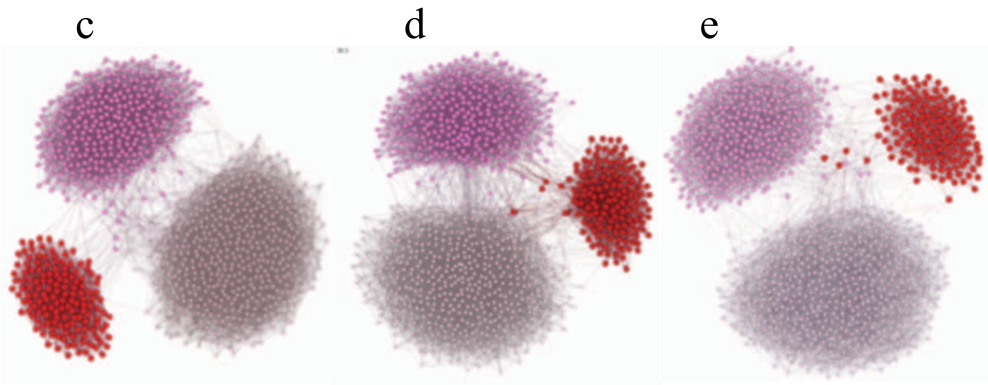 Figure 1: Visualizing the asymptotic states of different network types. Note how homophilic graphs (b) create distinct clustering compared to random models (c).
3. Individual-Based Modeling (IBM) for HIV
The HIV model focuses on the MSM population in France using three modules:
- Demographic: Tracks age-dependent entry/exit.
- Sexual Behavior: Models stable vs. casual partners and the probability of Unprotected Anal Intercourse (UAI).
- Transmission: Incorporates viral load dynamics, including the "primary infection" peak and treatment-induced suppression.
Experimental Results and SOTA Insights
Obesity Clustering
The study confirmed that obesity spread is better explained by "Version 1" of their homophilic network, which emphasizes individual-cultural influence. This suggests that the environment and social imitation are primary drivers in the current obesity epidemic.
HIV Stability and Potential Solutions
The IBM successfully reproduced the 1% annual incidence observed in Paris. Key findings include:
- R0 Stability: The basic reproduction number was found to be approximately 1.5, indicating an ongoing epidemic.
- Intervention Efficacy: A "Test and Treat" strategy (Scenario I2) effectively reduced both incidence and prevalence, bringing R0 below 1—a crucial threshold for stopping an epidemic.
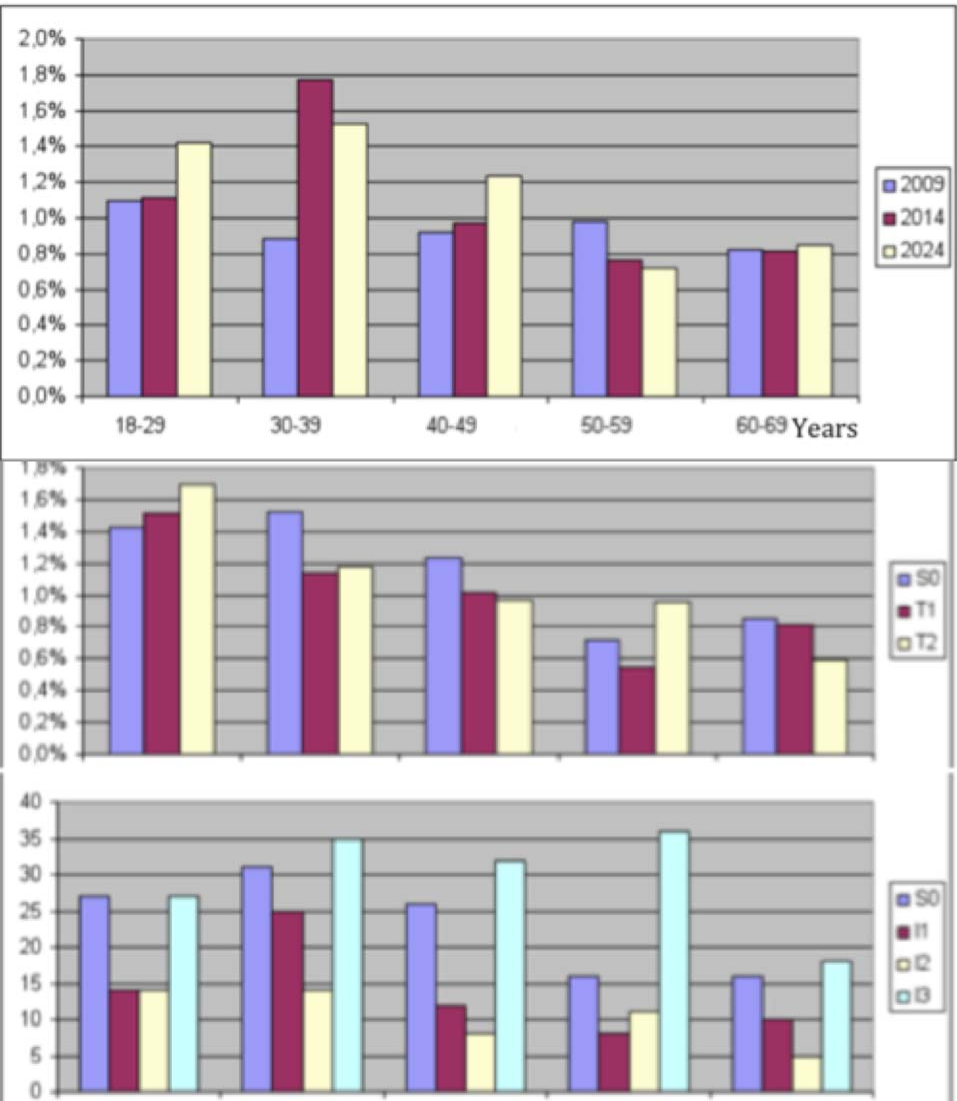 Figure 4: Long-term incidence projections under different strategy scenarios. Scenario I3 (Test and Treat) shows a significant downward trend.
Critical Analysis & Conclusion
The Takeaway: The study demonstrates that modeling "contact" as a simple probability is insufficient. Whether it is the duration of a contact (τ) or the specific location (confinement effects), non-linear interactions are the rule, not the exception.
Limitations: While powerful, these models rely heavily on survey data (like the EPG 2004) which may be subject to self-reporting bias. Furthermore, the "homophily" metrics for obesity remain qualitative—quantifying the "cultural distance" between a salad and a burger remains an open challenge.
Future Work: The authors suggest integrating non-linear effects from enzymatic kinetics (like Hill's partition function) to model how "confinement" in buildings or workplaces saturates contact rates. This could provide a roadmap for more sophisticated urban health planning.