
Inverse Influence: Reversing Random Walks for Smarter Social Recommendations
Random Walk Based Inverse Influence Research in Online Social Networks
The paper introduces the concept of "Inverse Influence" for online social networks, targeting the task of friend recommendation. It proposes a novel ranking metric based on the probability that random walks from all other nodes terminate at a specific personalized node, implemented via an efficient Monte Carlo approximation algorithm that outperforms traditional Personalized PageRank in link prediction accuracy.
TL;DR
In directed online social networks, we usually care more about who influences us than who we influence. This paper challenges the traditional Personalized PageRank (PPR) paradigm by proposing Inverse Influence—a metric that measures the probability of all nodes in a network "landing" on a specific user within limited steps. By using a highly efficient Monte Carlo approximation, the authors demonstrate superior performance in link prediction and friend recommendation over state-of-the-art baselines.
Problem & Motivation: The Directional Gap
Standard influence analysis (like PageRank) treats influence as something that flows away from a source. In a directed graph, if User A is a source, PPR identifies which users A is likely to "reach."
However, the authors identify a critical misalignment in social recommendations:
- Physical Meaning: Users often want to discover content or people that impact them.
- Constraint: In platforms like Twitter or Weibo, you follow your influencers; you cannot force the people you influence to follow you.
- The Gap: Existing similarity metrics like PPR or Preferential Attachment (PA) often ignore this "inward" pull, leading to recommendations that might be popular but aren't personally influential to the target user.
Methodology: The Logic of Inverse Influence
1. Defining the Metric
The core idea is to measure the ability of any node to influence a personalized node . Mathematically, this is the sum of probabilities that a random walk starting at stops at within steps: Essentially, it counts how many "paths of influence" lead back to the user.
2. The Computational Challenge
Calculating this exactly for every node pair is prohibitively expensive ( for matrix-based or for path-based approaches). On a network with millions of users, this is impossible for real-time systems.
3. The Solution: Monte Carlo Approximation
The authors propose Algorithm 1 (MonteCarloInverse). Instead of complex matrix math, they simulate the process:
- Start random walks from every node .
- Track how often these walks hit the target node .
- The ratio of hits to total walks provides a fast, accurate approximation of inverse influence.
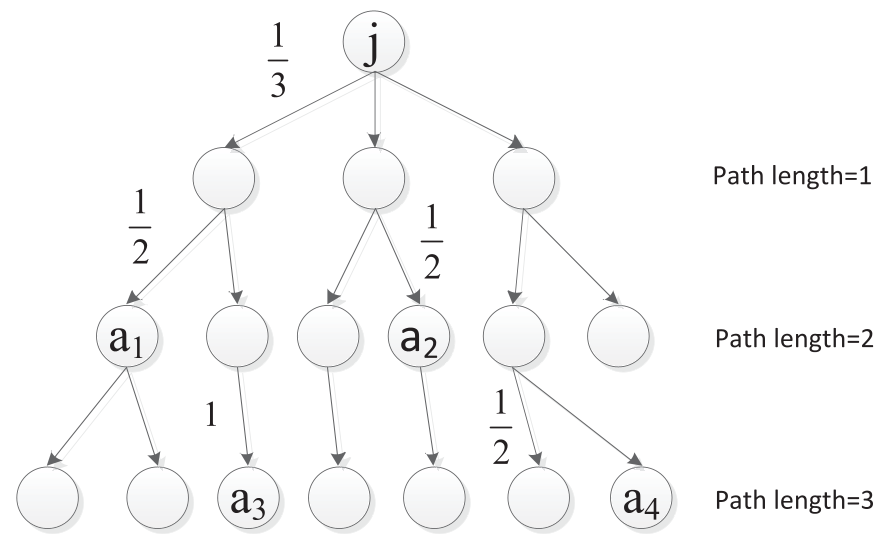 The figure illustrates how a walk from j to i through various paths contributes to the inverse influence score.
Experiments & Results
The authors tested their MCI (Monte Carlo Inverse) algorithm against four major baselines: Preferential Attachment (PA), PageRank (PR), PPR, and Local Random Walk (LRW).
Key Findings:
- Superior Accuracy: MCI consistently outperformed or matched PPR (the toughest baseline) across four real-world datasets (Epinions, Slashdot, Gowalla, Dianping).
- Precision Gains: In the Slashdot dataset, MCI's Precision (top 10) was 0.015, triple that of PPR (0.005).
- The "Small World" Sweet Spot: The experiments verified the "six degrees of separation" theory. The best results occurred when the walk length was kept small (around 5–10). If is too large, the influence signal becomes noisy as the walk approaches a stationary distribution.
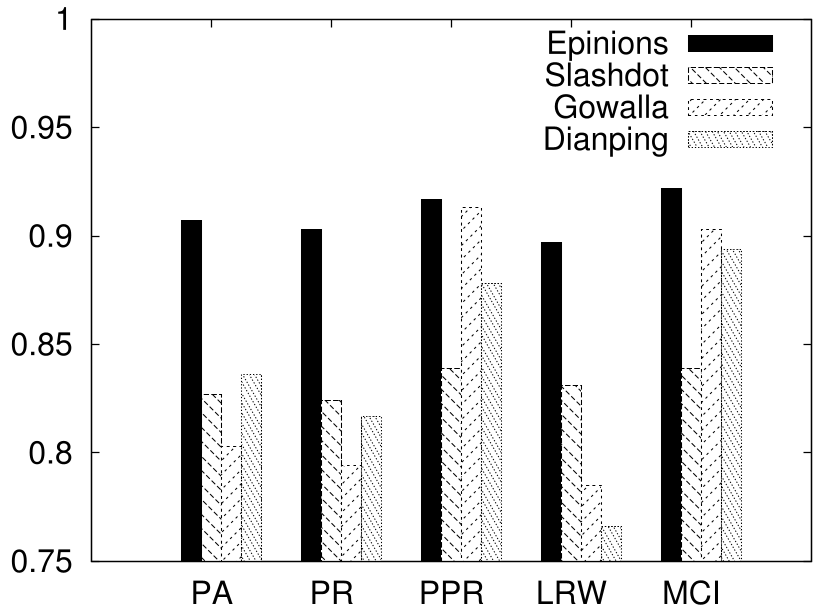 MCI (purple line) shows a clear advantage in AUC metrics across different node degree categories compared to traditional PR and PA.
Critical Analysis & Conclusion
Takeaway
Inverse Influence is a simple yet profound shift in perspective. By flipping the random walk, we capture the receptive capability of a node. This work proves that topology alone, when analyzed with the correct directional intuition, can significantly boost recommendation quality.
Limitations
- Symmetry in Undirected Graphs: The paper notes that on undirected graphs, the "inverse" is less meaningful as edges allow flow both ways; its true power lies in directed social graphs.
- Cold Start: While MCI is great for existing users, it still relies on network structure, meaning it might struggle with brand-new users who have no incoming or outgoing edges.
Future Outlook
The next step for this research is integrating content-based features (what the users are actually saying) with the Inverse Influence topology to create a hybrid "Trust-based" recommendation system.