
RWCAR: Bridging Personal, Social, and Spatial Contexts for Smarter Activity Recommendations
Random walk based context-aware activity recommendation for location based social networks
This paper introduces RWCAR, a Random Walk based Context-Aware Activity Recommendation algorithm for Location-Based Social Networks (LBSN). It models heterogeneous LBSN data (users, locations, and activities) as an undirected graph and utilizes Random Walk with Restart (RWR) to rank and recommend activities.
TL;DR
RWCAR (Random Walk based Context-aware Activity Recommendation) is a novel graph-based framework that predicts what a user wants to do based on where they are, who they know, and what local experts suggest. By abandoning static tensors in favor of dynamic subgraphs and Random Walk with Restart, the system achieves state-of-the-art accuracy on Foursquare data while remaining naturally scalable.
Problem & Motivation: Beyond "Where" to "What"
While Location-Based Social Networks (LBSNs) like Foursquare and Yelp have perfected the art of recommending where to go, the question of what to do (activity recommendation) remains surprisingly difficult.
Existing methods usually fail in three areas:
- Context Misalignment: They look at GPS trajectories but ignore social circles.
- Lack of Expertise: They treat all check-ins equally, failing to distinguish between a "local expert" and a "first-time tourist."
- Static Overhead: Methods like Collaborative Filtering (CF) or Tensor Decomposition require heavy re-calculation every time a new user joins or a check-in is recorded.
The authors' insight was simple yet powerful: LBSN data is inherently a multi-type graph. By building a local "neighborhood" graph for a user on the fly, we can capture the interplay between personal history and social influence without the burden of global model updates.
Methodology: The Power of the Subgraph
The core of RWCAR is the LBSN Model, represented as an undirected, unweighted graph where:
- Nodes (): Users (), Locations (), and Activities ().
- Edges (): Represent friendships, visits, and the ability to perform a specific activity at a specific location.
1. Identifying Local Experts
Before the walk begins, RWCAR identifies "Local Experts" and "Popular Activities" within the user's vicinity using a HITS-based algorithm. Users who visit high-quality activities are hubs; activities performed by many experts are authorities.
2. Random Walk with Restart (RWR)
Instead of walking the entire global graph, RWCAR constructs a Context-Aware Subgraph. This subgraph focuses on the user's current location radius, their friends' activities, and local expert data.
The recommendation follows the RWR formula: Where balances following graph edges () and jumping back to the starting user (, the restart probability). This ensures the recommendations stay highly personalized and don't drift into irrelevant nodes.
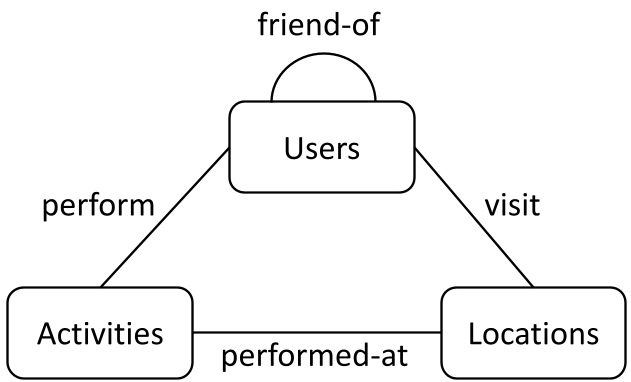 Figure 1: The LBSN Model illustrating the relationships between Users, Experts, Locations, and Activities.
Experiments: Proving the Fusion Advantage
The authors tested RWCAR against three common baselines:
- FBAR: Friend-based (Social)
- EBAR: Expert-based (Authority)
- PBAR: Popularity-based (Global Frequency)
Key Findings:
- Multi-Criteria Superiority: RWCAR outperformed all baselines because it fuses personal preference with social and expert signals.
- The "Popularity" Trap: While PBAR was the strongest baseline, it lacked the nuance of personal history. FBAR (friends-only) performed the worst, suggesting that just because your friend does something doesn't mean you will—physical proximity and personal taste matter more.
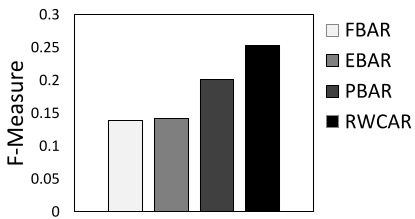 Figure 2: F-Measure@1 comparison showing RWCAR clearly leading over popularity and expert-based methods.
Critical Insight & Conclusion
The true value of RWCAR isn't just a higher Precision score; it is the computational efficiency of dynamic graph construction. In a world where LBSN data grows by the second, we cannot afford to retrain global tensors. By shifting to a "Sub-graph + Random Walk" approach, the authors provide a system that is:
- Online: Ready for new data immediately.
- Context-Aware: Respects the user's physical boundaries.
- Expertise-Aware: Leverages the local "social capital" of power users.
Future Outlook: While RWCAR handles spatial and social context beautifully, adding a temporal dimension (e.g., suggesting coffee in the morning and bars at night) would be the final piece of the puzzle for a truly intelligent activity recommender.