
Deciphering Social Closeness: An Adaptive Ranking Algorithm for OSN Search
A ranking algorithm for online social network search
The paper introduces a customizable ranking algorithm for Online Social Network (OSN) searches, specifically focusing on user-to-user search by name. It proposes the Weighted Association Function, which combines three key metrics—Proximity, Similarity, and Interaction—to rank results based on their relevance to the searching user.
TL;DR
Searching for a "John Smith" on a platform of one billion people is a needle-in-a-haystack problem. This paper presents a ranking framework that moves beyond simple text matching by quantifying "Association" through a blend of graph distance, interest similarity, and the "warmth" of past digital interactions. Its biggest strength is its adaptability, allowing it to mimic the internal logic of giants like Facebook or Google+ through parameter tuning.
The "Context" Problem in Search
In 2013, as Facebook eclipsed a billion users, the academic community realized that search was no longer about identity (finding a name) but about relevance (finding the right person).
The authors argue that a search on a "Classmates" network should prioritize Proximity (who is in my circle?), whereas a "Football Fans" network should prioritize Similarity (who loves the same club?). Most existing SOTA methods at the time were rigid; they lacked the dial-turning flexibility required to serve different types of human connections.
Methodology: The Three Pillars of Association
The core contribution is the Weighted Association Function (), which is calculated using three primary metrics:
1. Proximity ()
This captures the social structure. It uses a shortest-path algorithm to determine how many "hops" separate two users.
- Intuition: You are more likely to be searching for a friend-of-a-friend than a complete stranger.
- Formula:
2. Similarity ()
This captures shared interests. By looking at the cardinality of interest sets in user profiles, the algorithm determines if two users are "cut from the same cloth."
3. Interaction ()
This is the most dynamic piece. It measures the "pulse" of a relationship using Frequency (volume of interaction) and Recency (how long ago was the last contact?).
- It breaks interactions down into types: Comments, Shares, and Likes, each with its own weight.
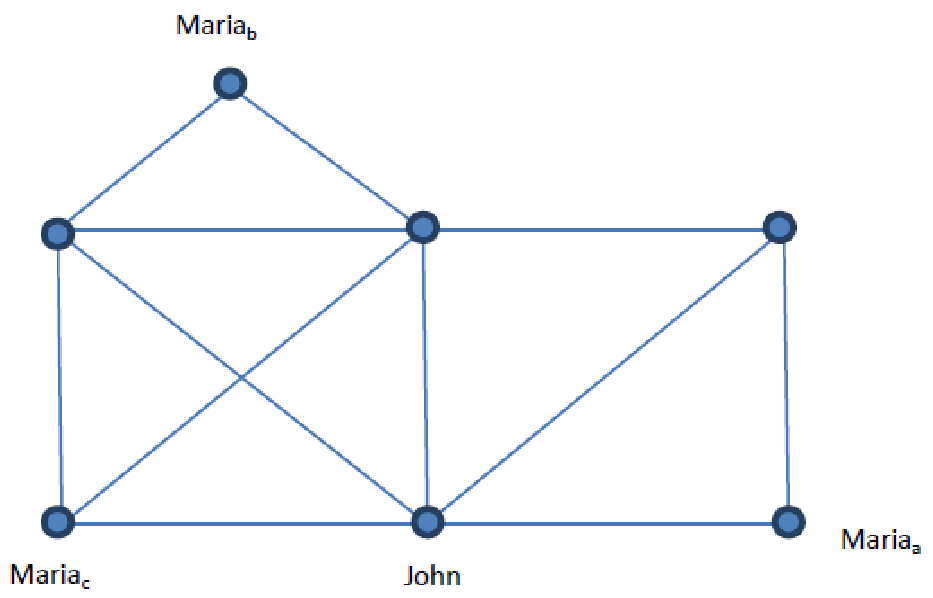 Figure 1: A model social network representing the search context for user 'John' seeking 'Maria'.
Experiments: Performance and Flexibility
The authors validated the algorithm through a simulation that impressively mapped their results to real-world platforms. By setting weights (Proximity) and (Interaction) to 0.5 and Similarity to 0, they could replicate a Facebook-like experience where recent interactions dominate the top results.
Scalability Analysis
A critical concern for any ranking algorithm is latency. The researchers conducted a stress test on record counts:
- 10,000 records: ~61 ms
- 1,000,000 records: ~3,188 ms
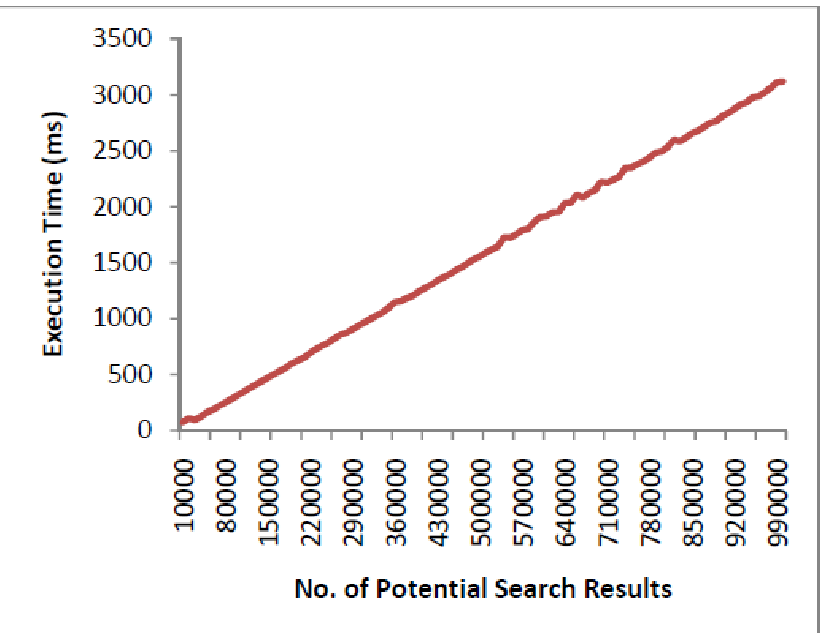 Figure 2: Linear scalability of the association function execution time.
The linear growth (as seen in Figure 2) suggests that for most users (who have roughly 1,000 contacts), calculating associations up to two hops away is computationally efficient enough for live production environments.
Critical Insight: More Than Just Search
The beauty of the "Association Function" is its secondary application:
- Friend Suggestions: By setting a threshold on , the system can automatically suggest new connections.
- Targeted Advertising: Advertisers can use the Similarity component to find prospects and the Interaction component to identify "influencers" within a circle who can drive word-of-mouth conversions.
Conclusion & Future Outlook
While the paper provides a robust foundation, it operates on a "static" logic of profile matching. In today's AI-driven landscape, we might see these manual weights () replaced by latent embeddings learned via Deep Learning. However, the physical intuition remains gold: who you are (Similarity), who you know (Proximity), and what you do (Interaction) are the holy trinity of social relevance.
Limitations: The model assumes users maintain updated profiles and that interaction data is readily available, which may encounter privacy hurdles in modern "Opt-in" data regimes.