
METEORA: Beyond Top-k - Turning RAG into an Interpretable and Robust Selection Process
Ranking Free RAG: Replacing Re-ranking with Selection in RAG for Sensitive Domains
METEORA is a novel RAG framework that replaces traditional, opaque similarity-based re-ranking with a rationale-driven selection mechanism. It utilizes a DPO-tuned LLM for evidence selection and statistical elbow detection for adaptive cutoffs, achieving SOTA performance in sensitive domains like law and finance.
TL;DR
In sensitive sectors like legal and healthcare, the "black box" nature of AI is a deal-breaker. METEORA introduces a paradigm shift by replacing traditional similarity-based re-ranking with rationale-driven selection. By using a DPO-tuned model to explain why evidence is relevant and a statistical engine to decide how much evidence is enough, it slashes noise by 80% while significantly boosting accuracy and security.
The Interpretability Crisis in RAG
Most current RAG pipelines suffer from two major flaws:
- Arbitrary Top-k Limits: Why pick 5 chunks? Why not 3 or 10? Fixed heuristics often include irrelevant noise or miss vital context.
- Opacity: Similarity scores (like Cosine Similarity) tell us that two vectors are close in space, but they don't explain the semantic necessity of a document. In a courtroom or a hospital, "because the vectors matched" is not an acceptable justification.
Moreover, this opacity is a playground for attackers. Data poisoning—where malicious actors insert semantically similar but factually wrong data—easily bypasses traditional re-rankers.
Methodology: The Three Pillars of METEORA
METEORA treats retrieval as a reasoning task rather than a math problem.
1. The DPO-Tuned Rationale Generator
Instead of human labeling, the authors used Direct Preference Optimization (DPO) to train the LLM. It learns by comparing rationales that led to a correct answer vs. those that didn't. This creates a model that doesn't just find text; it finds justifications.
2. Evidence Chunk Selection Engine (ECSE)
This is where the math meets the logic. Instead of a fixed , ECSE uses statistical elbow detection.
- It embeddings all rationales and calculates their similarity to retrieved chunks.
- It calculates the "Drop-off" in similarity using z-scores.
- When the similarity hits a "cliff" (the elbow), the system stops selecting. This allows the model to adaptively pick 2 chunks for simple questions and 20 for complex ones.
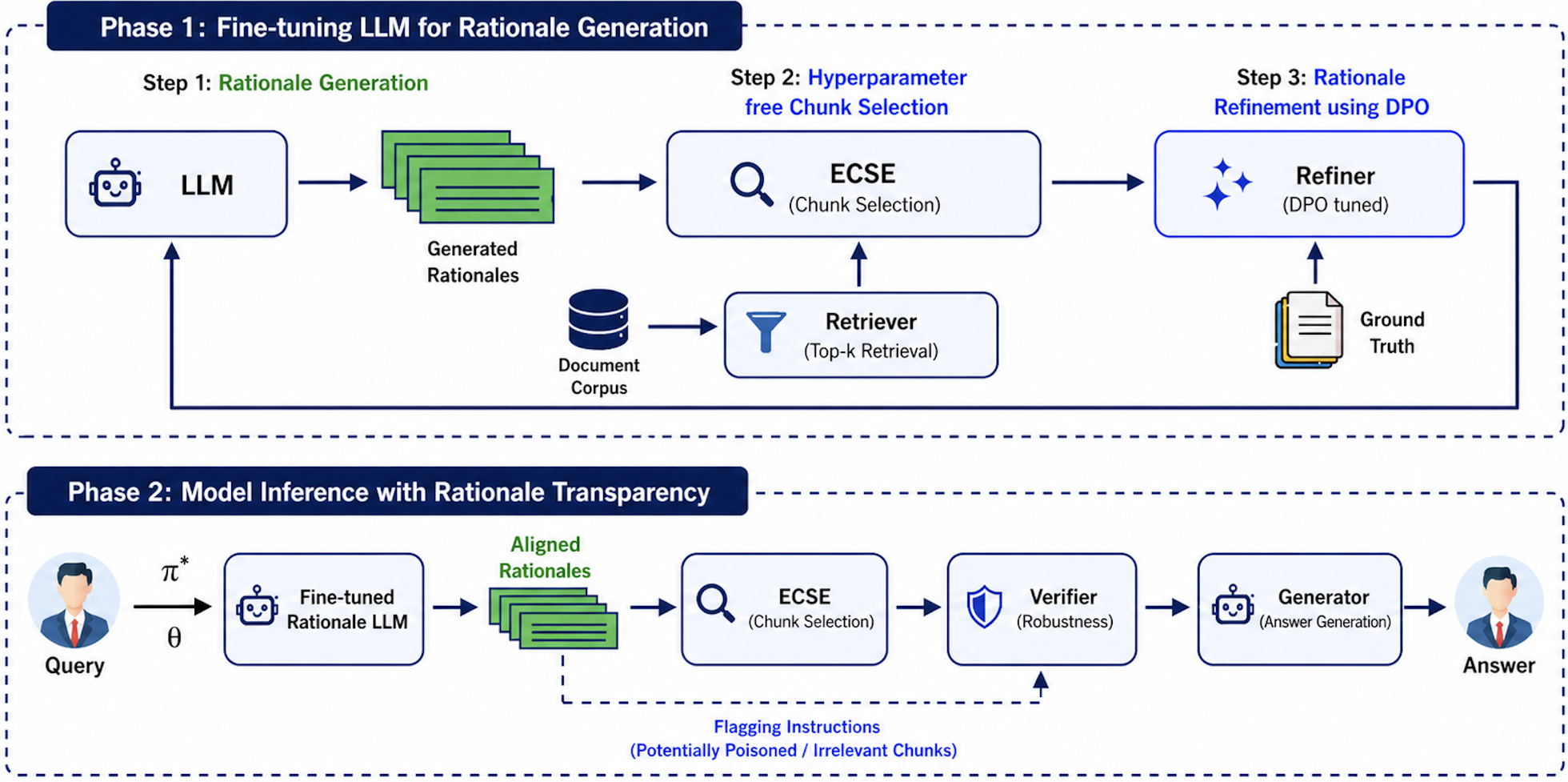 Figure 1: The unified pipeline showing how rationales drive both selection and verification.
3. The Verifier LLM
Before the final answer is generated, a Verifier checks the selected chunks against the generated rationales. If a chunk contradicts the reasoning or the facts, it is discarded. This "zero-trust" approach is what leads to the massive 4.4x jump in adversarial robustness.
Experimental Performance
The system was tested on high-complexity datasets like MAUD (Merger Agreements) and QASPER (Scientific Papers).
| Metric | Improvement |
|---|---|
| Evidence Volume | 80% Reduction (Less Noise) |
| Answer Accuracy | +33.34% |
| Adversarial Robustness | 4.4x Increase |
| Recall (MAUD) | +41.17% |
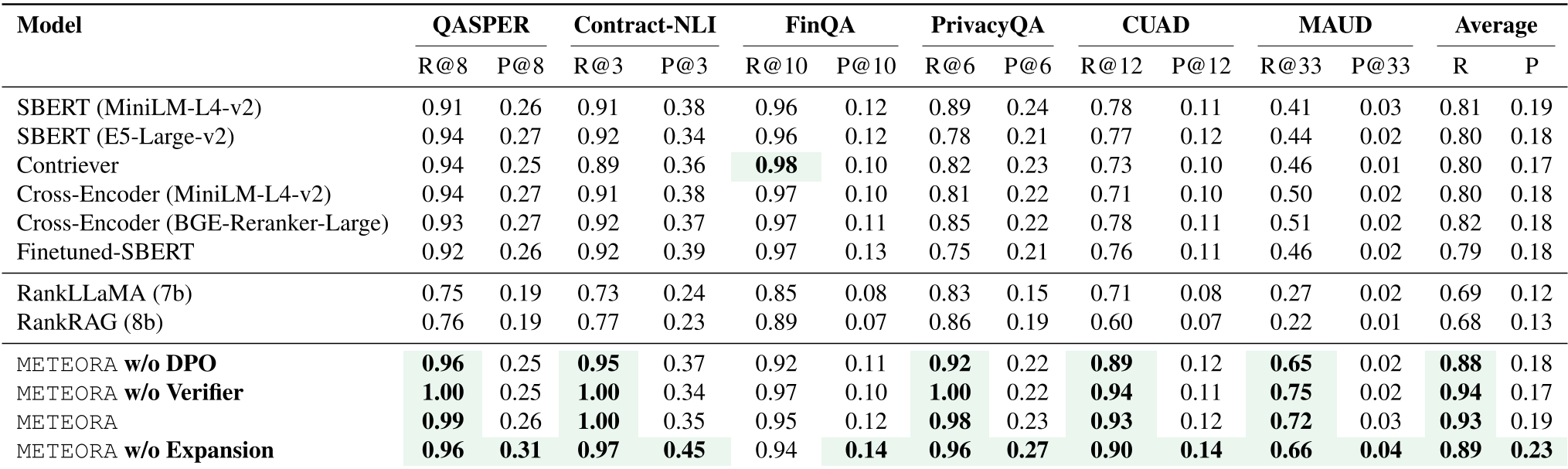 Figure 2: Performance comparison across diverse domains, showing METEORA's dominance in complex legal tasks.
Why It Works: The Insight
The core "Aha!" moment of this paper is that transparency is a feature, not a tax. By forcing the model to explain itself, we actually make it more efficient. In the MAUD dataset, which contains merger agreements of over 350k tokens, METEORA outperformed LLM-rerankers simply because it wasn't overwhelmed by context window limits—it knew exactly what to look for and where to stop.
Critical Analysis & Limitations
While METEORA is a breakthrough for sensitive domains, it has trade-offs:
- Latency: The multi-step process (Rationale -> Selection -> Verification) adds sequential overhead, though the authors argue the reduction in input tokens for the final generation compensates for this.
- Neurosymbolic Gap: The current system relies on LLM "common sense." Integrating structured knowledge graphs (Neurosymbolic RAG) could further ground the rationales in hard facts.
Future Outlook
METEORA proves that "Explainable AI" isn't just about trust—it's about performance. As RAG moves into regulated industries, we can expect "Selection Engines" to replace "Re-rankers" as the standard for professional-grade AI systems.