
SocialRank: Leveraging Human Interaction Patterns for Efficient DTN Routing
A Ranking Information Forwarding Algorithm with Social Characteristic in Mobile Delay Tolerant Network
The paper introduces SocialRank, a ranking-based information forwarding algorithm for Mobile Delay Tolerant Networks (DTNs) that leverages social characteristics. It utilizes a weighted metric of contact regularity, frequency, and intensity to calculate node importance, achieving a SOTA delivery rate of nearly 90% in simulated urban environments.
TL;DR
The paper proposes SocialRank, a novel routing algorithm for Mobile Delay Tolerant Networks (DTNs). Unlike traditional protocols that struggle with unpredictable node movements, SocialRank treats mobile users as nodes in a social graph. By calculating a "Social Rank" value based on contact regularity, frequency, and intensity, the system identifies the most reliable "brokers" for message delivery, pushing the delivery rate to nearly 90%.
Problem & Motivation: Beyond Random Walks
In the world of Delay Tolerant Networks—where disconnections are the norm—getting a packet from point A to point B is a game of probability. Early protocols like Epidemic routing simply flooded the network, wasting massive amounts of cache and bandwidth. Later improvements like PROPHET used contact history, but they often missed the "social" nuance.
The authors argue that human movement is not random. People follow routines: they go to work, meet friends, and visit the same shops. This social regularity is the "hidden signal" that can make routing efficient. The core challenge addressed here is: How can we mathematically quantify "social importance" to select the best next hop?
Methodology: The Social Metric Engine
The heart of SocialRank lies in its definition of the social relationship measure (). Instead of just counting how many times two people meet, the authors prioritize three metrics in a specific weight hierarchy:
- Contact Regularity (): The predictability of the interval between meetings. (Highest Weight)
- Contact Frequency (): How often nodes meet relative to other contacts.
- Contact Intensity (): The total duration of contact.
Theoretical Framework
The algorithm adapts Google’s PageRank logic for a mobile environment. The SocialRank value () of a node is calculated as follows:

The inclusion of a time variable () ensures that the network adapts to new users, while the interest label prevents nodes from carrying data they (or their common social circles) aren't interested in.
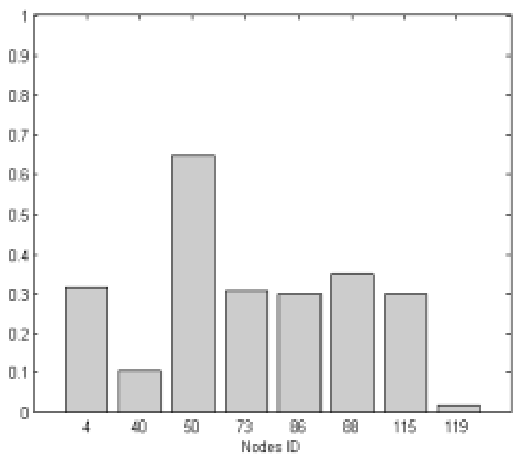 Fig 1: Quantification of social metrics across different nodes proves that regular contact leads to distinguishable high-rank nodes.
Experiments & Results: Stability Wins
Using the ONE (Opportunistic Network Environment) simulator with a map of Jinan City, the authors compared SocialRank against Epidemic, PROPHET, and Spray-and-Wait (SAW).
1. Delivery Rate Dominance
After an initial "training phase" (set to 7 days to capture a full weekly cycle of human routine), SocialRank's performance spikes. While Epidemic suffers as the network grows crowded, SocialRank scales efficiently.
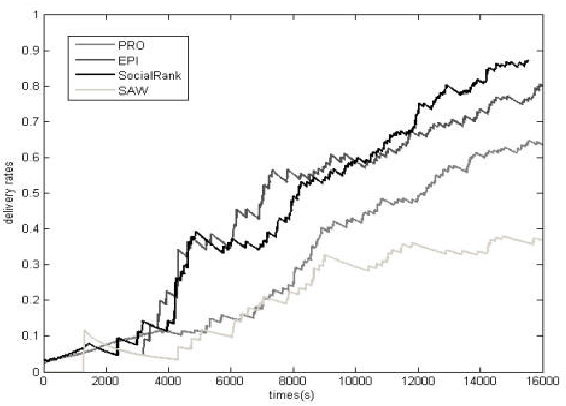 Fig 2: SocialRank achieves a higher delivery rate (~90%) compared to traditional probabilistic models after the training period.
2. Buffer Management
One of the standout results is SocialRank's resilience to limited memory. Because it only forwards messages to nodes with higher social status (ranking), it avoids the buffer congestion that plagues Epidemic routing.
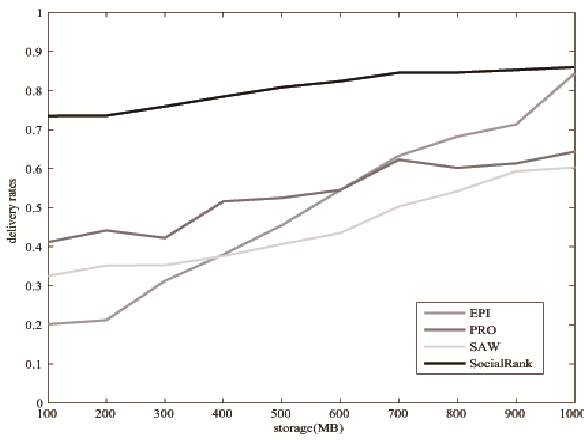 Fig 3: Efficiency in different buffer memory conditions proves the algorithm's robustness for low-resource devices.
Critical Analysis & Conclusion
The Takeaway: SocialRank proves that "who you know" and "how regularly you see them" are better routing metrics than simply "how many people you pass by."
Limitations:
- Warm-up Latency: The algorithm requires a training period (7 days in this study). In highly dynamic or emergency scenarios where nodes are first-time participants, the delivery rate is initially low.
- Privacy: Calculating these social metrics requires nodes to share contact history, which raises significant privacy concerns for real-world mobile users.
Future Outlook: Integrating this social ranking with modern privacy-preserving techniques (like Federated Learning) could make SocialRank a viable standard for decentralized, community-based mesh networks.