
TDP: Revolutionizing Secure D2D Pairing for Mobile Crowdsourcing
Rapid, User-Transparent, and Trustworthy Device Pairing for D2D-Enabled Mobile Crowdsourcing
This paper introduces Trustworthy Device Pairing (TDP), an efficient scheme for establishing secure, autonomous, and user-transparent D2D connections in Mobile Crowdsourcing Systems (MCS). By integrating a Certificate-Less Public Key Cryptography (CL-PKC) framework with a dynamic trust management system, it achieves SOTA results in pairing speed and resistance to traffic-oriented attacks.
TL;DR
Mobile Crowdsourcing Systems (MCS) rely on devices talking to each other (D2D), but how do you trust a stranger's phone in a split second? This paper introduces Trustworthy Device Pairing (TDP), a system that allows phones to pair securely without user intervention (user-transparent) while weeding out malicious actors using a sophisticated, link-layer-aware trust management system.
The "Trust" Bottleneck in D2D
In a typical crowdsensing task—like collaborative urban sensing—your phone might need to offload data to a nearby participant. Current protocols like Bluetooth or WiFi Direct are either clunky (requiring you to click "Pair" manually) or vulnerable (susceptible to "Traffic-Oriented" attacks where users lie about their reliability to get more rewards).
The authors identify two fatal flaws in prior work:
- Lack of Transparency: Users don't want to click buttons every time their phone finds a peer.
- Trust Blindness: Most systems only look at whether a connection is encrypted, not whether the peer is behaving honestly at the traffic level.
Methodology: The TDP Framework
TDP strikes a balance between security and speed using two core engines: a CL-PKC Credential System and an Online Trust Estimator.
1. Certificate-Less Public Key Cryptography (CL-PKC)
Instead of relying on heavy certificate authorities, TDP uses a partial key system. The Backend Server (BS) provides a partial key, and the device generates its own secret. This ensures that even if the server is "curious," it cannot decrypt private D2D conversations.
2. The Trust Estimation Logic
At the heart of TDP is a mathematical model for trust. It doesn't just ask "Did the transaction finish?" It measures Link-Quality QoS (delay, data rate) and Credibility (consistency of the peer's history).
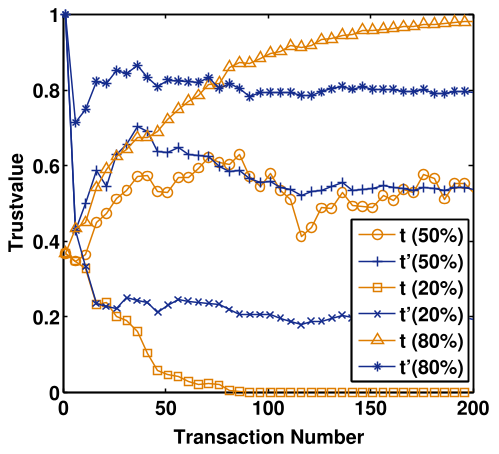 Figure: The global procedure of TDP, from registration to trust-adjusted pairing.
The trust value is adjusted using the Gompertz function, which ensures that trust is earned slowly through consistent good behavior but can be lost quickly if anomalies are detected.
Experimental Validation
The researchers didn't just stay in the lab; they implemented TDP on Google Nexus 5 devices and ran intensive simulations using real mobility traces from Infocom and Sigcomm.
Speed & Stability
Compared to standard Bluetooth, which often hangs during manual confirmation, TDP's autonomous negotiation is both faster and more consistent.
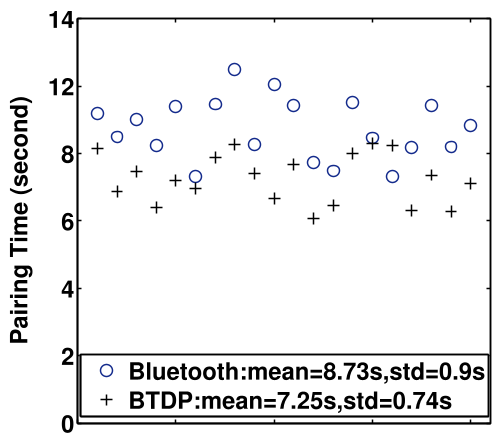 Figure: Comparison of pairing times. Note the significantly lower variance in BTDP (TDP over Bluetooth).
Resisting the "Traffic Mob"
The most impressive results come from the Collusive Attack (TO3) simulations. Even when 10-15% of the network participants conspired to boost each other's reputations and downgrade others, TDP's damping factor (which looks for "suspiciously frequent" contacts) successfully isolated the attackers.
Critical Insight: Why This Matters
The breakthrough here isn't just the encryption—it's the integration of link-layer metrics into the trust layer. By forcing the trust score to depend on physical QoS (like RSSI or packet loss), TDP makes it much harder for an attacker to "spoof" a high reputation without actually providing high-quality service to the network.
Conclusion
TDP effectively solves the "Trust vs. Friction" paradox in mobile crowdsourcing. It removes the user from the loop, making device pairing invisible, while simultaneously deploying a rigorous mathematical shield against both connection-level hackers and behavior-level cheaters.
Future Outlook: As we move toward 6G and massive IoT, autonomous trust frameworks like TDP will be the backbone of "Zero-Touch" networks where devices must negotiate, trade, and verify each other purely through silicon and math.