
Decoding the Aesthetic Brain: Functional Networks of the Nine Rasas
Characterizing functional brain networks and emotional centers based on Rasa theory of Indian aesthetics
This study characterizes functional brain networks elicited by the nine "Rasas" (aesthetic sentiments) of Indian Natyasastra using 128-channel EEG recordings of Bollywood movie clips. By employing coherence measures and graph theory, the authors identified distinct neural signatures, modular organizations, and information hubs specific to these complex emotional states across multiple frequency bands.
TL;DR
Researchers have mapped the brain's functional connectivity in response to the "Nava Rasas" (nine aesthetic sentiments) defined in ancient Indian aesthetics. Using 128-channel EEG and graph theory, the study reveals that these complex emotions—ranging from the erotic to the heroic—trigger specific modular reorganizations of neural wiring, primarily mediated by hubs in the parietal cortex.
Background: Beyond the "Big Six" Emotions
For decades, affective neuroscience have been dominated by the Western "Basic Emotion" model (Happiness, Sadness, Anger, Fear, Disgust, Surprise). However, the Indian Rasa theory, originating from the Natyasastra (2nd Century AD), offers a more sophisticated "constructionist" view. It suggests that aesthetic experiences (Rasas) are not just singular states but an orchestration of dominant, transitory, and temperamental states. This paper marks a pioneering attempt to bridge this ancient aesthetic theory with modern network science.
Methodology: The Architecture of Feeling
The authors exposed 20 subjects to Bollywood film clips curated to evoke specific Rasas. To capture the brain's "social and emotional gossip," they utilized:
- Coherence Measures: To build a weighted adjacency matrix (the "who's talking to whom" map).
- Multi-Band Analysis: Breaking data into and bands.
- Leverage Centrality: A metric that identifies nodes that hold significant influence over their neighbors.
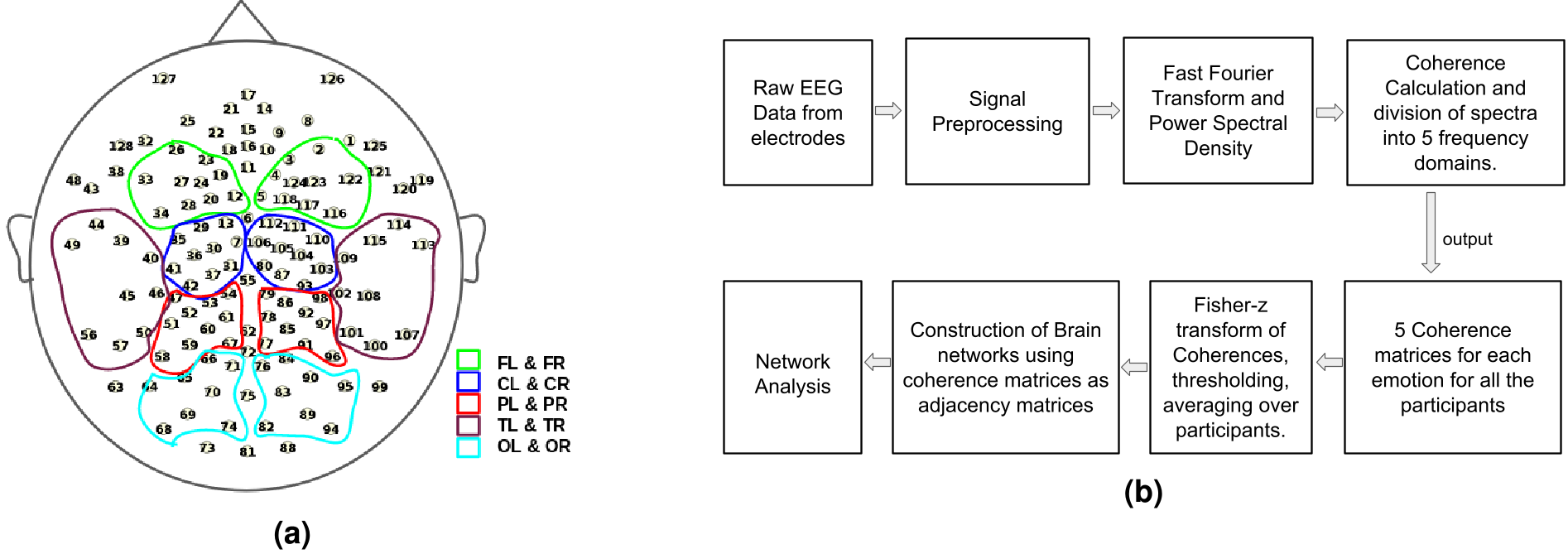 Figure 1: The workflow from high-density EEG recording to graph-theoretic network analysis.
Key Insights: Topological Signatures of Emotion
1. The Small-World Efficiency
Regardless of the Rasa, the brain maintains a "Small-World" topology. This means the brain is highly economical: it allows for local specialization (clustering) while maintaining short "path lengths" to ensure information can travel from the visual cortex to the frontal lobes rapidly.
2. Frequency-Dependent Suppression
A fascinating finding was the suppression of functional connectivity in high-frequency bands ( and ). While lower frequencies () showed strong synchronization, high-frequency waves exhibited a more sparse, localized wiring, suggesting a specialized "high-speed" processing mode for detailed emotional nuances.
3. Community Reorganization
Using modularity optimization, the study identified consistently localized communities:
- C1: Frontal (Executive control)
- C2/C3: Parietal (Integration)
- C4: Occipital (Visual processing)
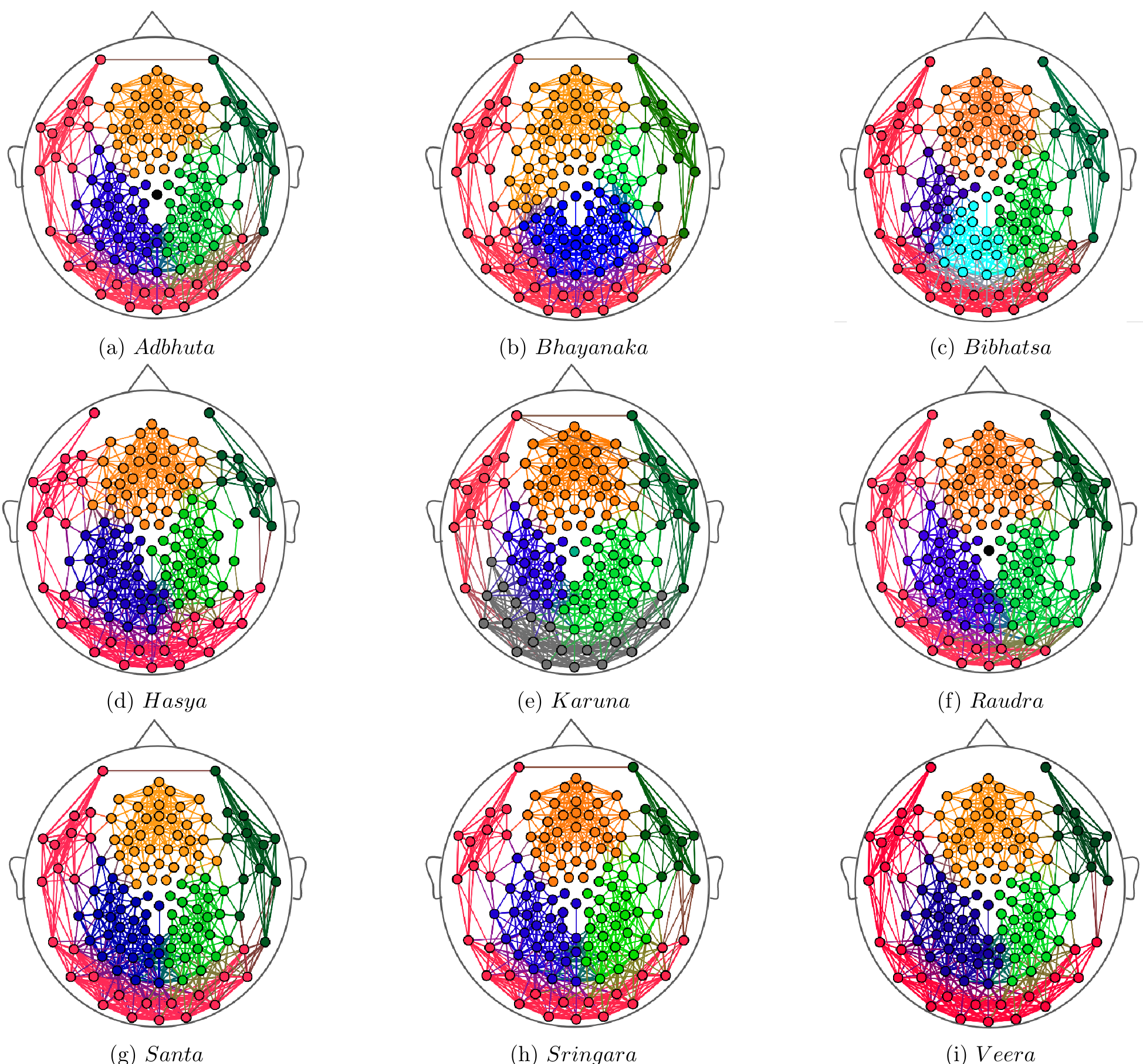 Figure 2: Modular organization of the brain across the nine Rasas, showing functional segregation into specialized clusters.
Results & Statistical Distances
By using Variation of Information (VI), the authors measured the "distance" between different emotional states. For instance, Adbhuta (Marvelous) and Bhayanaka (Terrible) were found to be topologically distant in the band, implying completely different neural recruitment strategies.
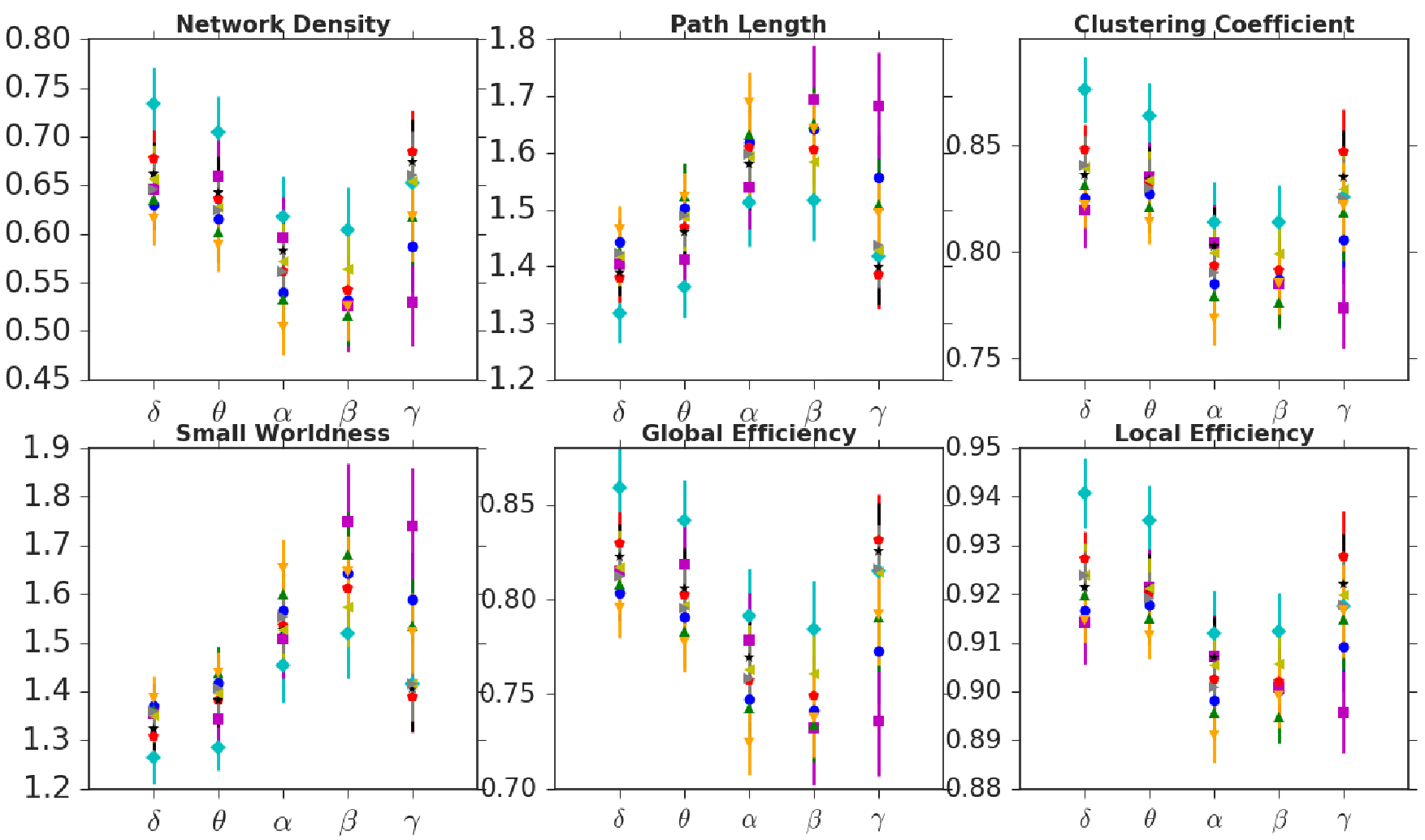 Figure 3: Comparison of network metrics across frequency bands. Note how the γ band (green line) often flips the trend of other frequencies.
The "Parietal Hub" Discovery
Perhaps the most significant finding is the identification of consistent hubs. Using Leverage Centrality, the researchers found that the parietal regions serve as the "grand central station" for Rasa perception. These nodes relay information across the various specialized modules, acting as the bridge between raw visual stimulus and subjective aesthetic experience.
Critical Analysis & Future Outlook
While the study successfully identifies signatures in "signal space" (scalp level), a limitation remains the lack of "source space" localization (deep brain mapping).
The Takeaway: This research moves us away from the "locationist" view (finding a single "fear center") and toward a "network" view. It suggests that human emotion is not a localized spark but a dynamic, wide-scale reorganization of neural modularity. For future AI developers, this implies that "AIAffect" should perhaps be modeled as a shift in system-wide connectivity rather than just a classification label.
Reference: Tripathi, R., Mukhopadhyay, D., et al. "Characterizing functional brain networks and emotional centers based on Rasa theory of Indian aesthetics." (2026).