
Reading the Correct History? Modeling Temporal Intention in Resource Sharing
18290_Reading the correct history modeling temporal intention in resource sharing.
The paper introduces a framework to model "Temporal User Intention" in social media resource sharing, specifically addressing the gap between the time a link is shared (ttweet) and the time it is clicked (tclick). It utilizes a novel Temporal Intention Relevancy Model (TIRM) and a Random Forest classifier to determine whether a user should be served the current live version or an archived version of a resource.
TL;DR
When you click a link in a three-year-old tweet, are you seeing what the author intended, or just what happens to be at that URL today? This paper explores the "Temporal Discrepancy" in social media sharing and introduces a machine-learning model to detect Temporal User Intention, ensuring that the historical context of a post isn't lost to the web's "perpetual now."
Background Positioning: This work is a seminal piece in the intersection of Web Archiving and Digital Libraries, moving from the technical problem of link rot to the semantic problem of content drift.
The Problem: The Web’s "Perpetual Now"
Authors of social media posts (like tweets) create a static narrative, but the resources they link to are dynamic. A tweet about a specific live news event might point to a homepage that, three hours later, covers something entirely different. This creates a mismatch between:
- ttweet: The state of the resource when shared.
- tclick: The state of the resource when the reader finally follows the link.
The authors argue that if social media is the "first rough draft of history," we are losing that history because we lack a mechanism to serve the intended version of a page.
Methodology: Mapping Intention to Relevancy
Quantifying "intention" is notoriously difficult. The authors initially found that humans (even experts) struggled to agree on an author's temporal intent. To solve this, they created the Temporal Intention Relevancy Model (TIRM).
The TIRM Logic
Instead of asking "What did the author intend?", they asked "Is this current page still relevant to the tweet?".
- Changed & Relevant: Intention was likely for the current state (e.g., a link to a "Live Scores" page).
- Changed & Non-Relevant: Intention was clearly for the past state (e.g., a link to a specific breaking news story that has since been replaced).
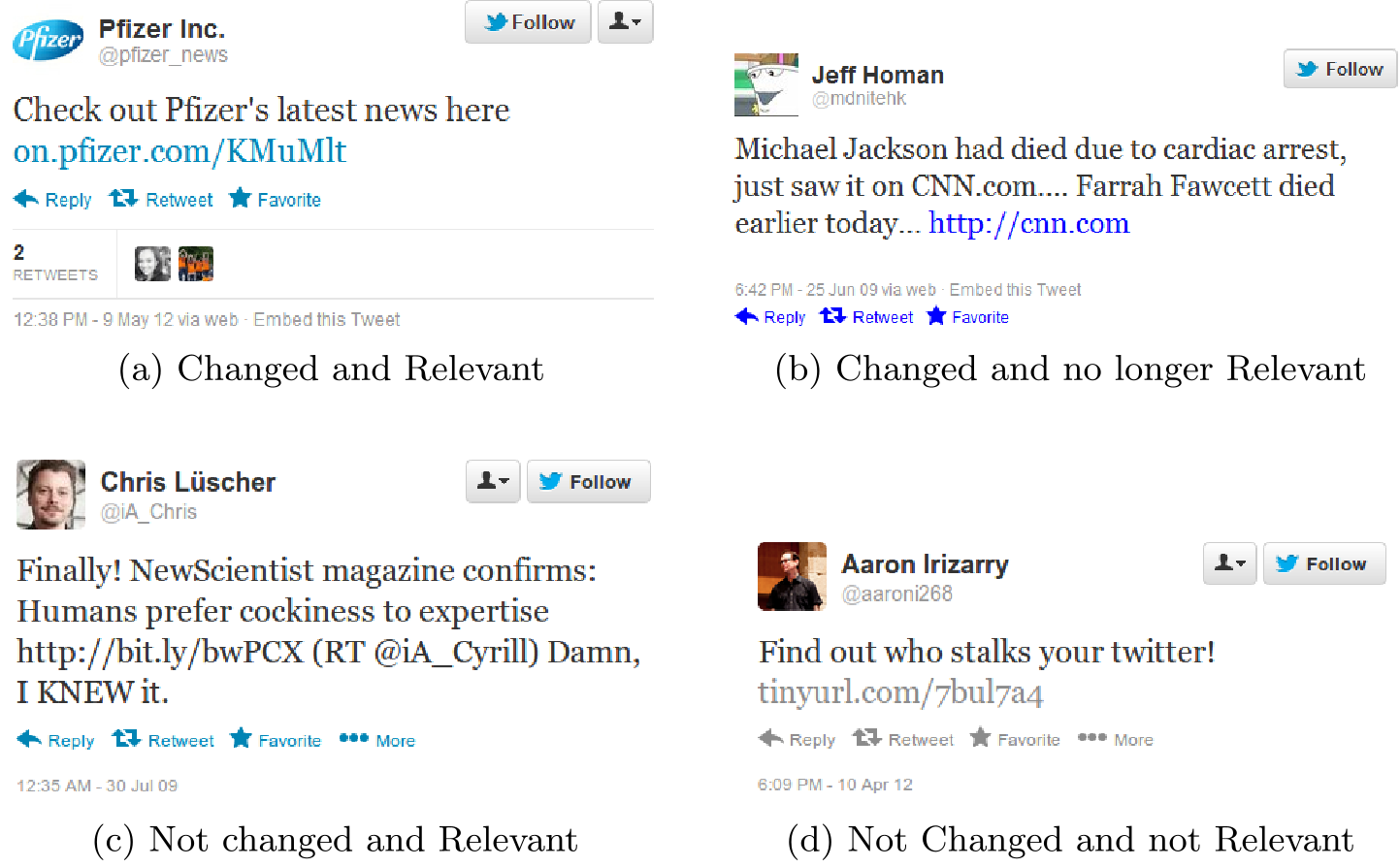
Feature Engineering
The model uses 39 features to predict intention, categorized into:
- Link Analysis: URI depth and Bitly metadata.
- Social Context: Total tweets, influential shares, and "tweet flocks" surrounding a link.
- Archival Coverage: The number of mementos available in public archives.
- Semantic/Sentiment: NLTK-based sentiment scores and celebrity entity detection.
Experiments & Results
The authors utilized a Cost-Sensitive Random Forest classifier. One of the most fascinating findings was the feature hierarchy: relevance to celebrities and archival density (number of mementos) were the strongest predictors of whether a link was meant to be a permanent historical record vs. a transient update.

The model achieved over 90% accuracy. When applied to historical datasets (like Michael Jackson’s death or the Syrian Uprising), the model identified significant "drift." In the Syrian Uprising dataset, nearly 25% of live links were deemed non-relevant to the original tweets, meaning readers were literally "reading the wrong history."
Critical Insight: Why This Matters
The value of this research lies in its potential for Proactive Archiving. If a system can detect—at the moment of sharing—that a user's intent is "Past-oriented" and the resource is "High-drift," it can automatically trigger a crawl to save that exact state.
Limitations
- Archive Sparsity: The model relies on the existence of mementos. If no archive exists near , the model's "Past" comparison is weakened.
- Language: The study is limited to English-language tweets and specific shorteners (Bitly).
Conclusion
This paper provides a robust framework for preserving the "aboutness" of the web. By distinguishing between links intended to be dynamic and those intended to be snapshots, we can build smarter browsers and archives that respect the temporal context of human communication.