
Predictive Synergy: Decoding Movie Investments via Social Networks and Real Options
2731_Using Real Option Model to Evaluate Movie Investments Based on Social Network.
This paper introduces a quantitative framework to predict movie box office performance and evaluate investment value by integrating Social Media Word-of-Mouth (sWOM) from Weibo and Douban. It utilizes a Vector Autoregression (VAR) model for revenue forecasting and the Black-Scholes (B-S) option pricing model to determine the strategic value of movie projects.
TL;DR
Can a movie's success be predicted before the final credits roll? This research argues that the answer lies in the digital chatter of social media. By combining Vector Autoregression (VAR) with the Black-Scholes (B-S) model, the authors transition movie valuation from "static guessing" to "dynamic calculation," treating film projects as financial options to better quantify risk and strategic flexibility.
The Motivation: Why Historical Data Fails
The film industry is notoriously volatile. Traditional investment models are often static, relying on historical box office records. However, movies are "non-standard" products; a director’s past success does not guarantee a future hit.
The authors identify a critical gap: Social Media Word-of-Mouth (sWOM). In the Chinese market, platforms like Weibo (analogous to X/Twitter) and Douban (analogous to IMDb/Rotten Tomatoes) act as real-time barometers of audience interest. The missing link was a mathematical framework that could ingest this dynamic data to refine financial valuations.
Methodology: The VAR + B-S Framework
1. Capturing the Social Pulse (VAR Model)
The researchers collected data from 131 movies, tracking daily box office, Weibo volume/valence, and Douban volume/ratings. They employed a Vector Autoregression (VAR) model to understand the endogenous relationships between these variables.
The core logic is captured in the following system:
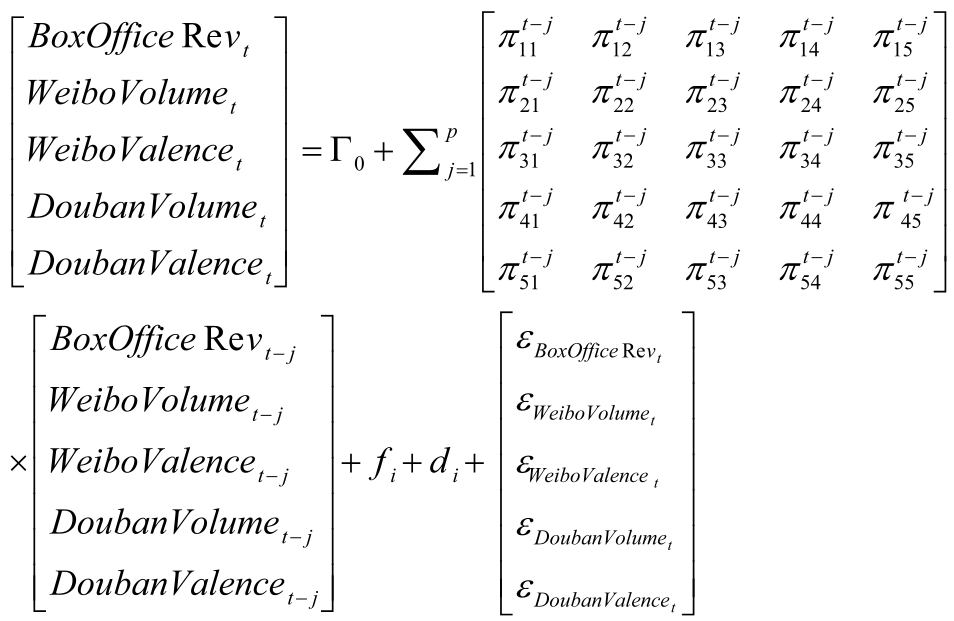
Key Insights from the VAR analysis:
- Weibo Volume is a Lead Indicator: There is a significant positive correlation between Weibo buzz and box office revenue, typically with a 2-day lag.
- Platform Specialization: Weibo drives "mass awareness" (Volume), whereas Douban ratings are more critical for "less-popular" or indie films where quality perception is the main driver for attendance.
2. The Movie as a "Real Option"
Perhaps the most innovative part of this paper is the application of the Black-Scholes Model. Usually reserved for stock options, the authors treat a movie project as a call option. If a movie performs well in its early stages (driven by positive sWOM), the investor has the "option" to expand marketing or extend the theatrical run.
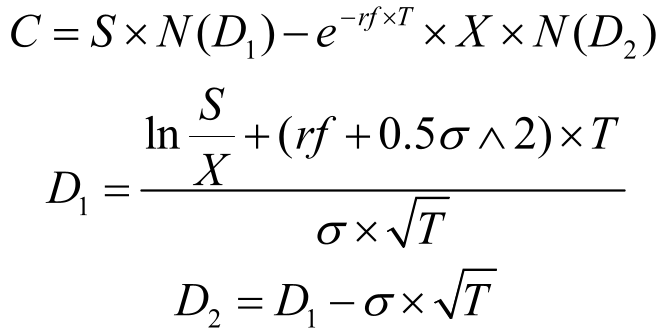
By calculating the Total Value (TV = NPV + Option Value), investors can justify backing "risky" projects that might have a negative traditional NPV but carry high strategic upside due to market uncertainty ().
Experimental Evidence
The study utilizes a dataset of 131 films with a sentiment analysis accuracy of 85.39%.
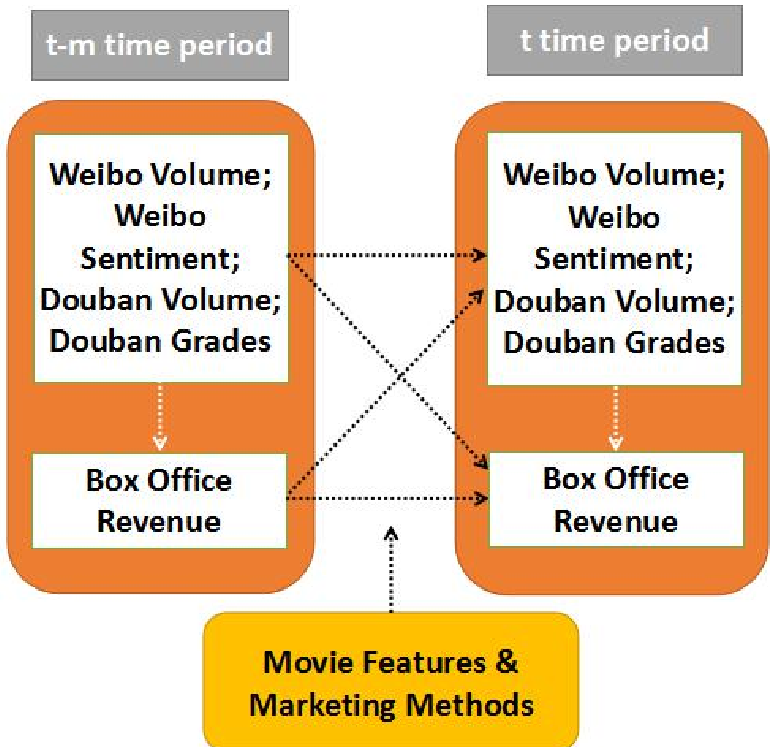 Figure 1: The Research Framework integrating sWOM with Financial Modeling.
The empirical results (Table 2 in the paper) confirm that box office revenue at time significantly impacts both Weibo and Douban volumes, creating a feedback loop. Interestingly, valence (sentiment) on Weibo was found to be less impactful than volume, suggesting that for blockbusters, "any publicity is good publicity."
Critical Analysis & Conclusion
Takeaway
This paper moves the needle by proving that social media is not just noise—it is a financial asset. By integrating VAR-based forecasting with Real Options pricing, the authors provide a toolkit for investors to quantify the "flexibility" of a project.
Limitations
- Platform Bias: The study is localized to the Chinese market (Weibo/Douban). Global applicability would require integrating X, TikTok, and Rotten Tomatoes data.
- Linear Assumptions: The VAR model assumes linear relationships, which may struggle with "black swan" viral events or sudden censorship impacts.
Future Outlook
As AI-driven sentiment analysis becomes more granular (detecting irony, sarcasm, and niche subcultures), these financial models will become even more precise. The next step is moving from descriptive analysis to prescriptive intervention—using the model to tell studios exactly when to "inject" marketing spend to maximize their Real Option value.
Main Contribution Summary: A robust bridge between social media analytics and advanced financial engineering for the media industry.