
Intelligent Load Shifting: A Context-Aware Multi-Agent DRL Approach to Smart Home Energy Management
4228_A Real-time Demand-side Management System Considering User Behavior Using Deep Q-Learning in Home Area Network.
This paper introduces a real-time multi-agent Deep Reinforcement Learning (DRL) framework for Demand-Side Management (DSM) in smart homes. By integrating a Context Recognition Engine (CRE) with decentralized Deep Q-Network (DQN) agents, the system optimizes appliance scheduling and energy storage to reduce electricity costs and peak demand while preserving user comfort.
TL;DR
Researchers from National Taiwan University have developed a decentralized energy management system that uses Deep Reinforcement Learning (DRL) to solve the "smart home efficiency vs. user comfort" tradeoff. By splitting appliances into conflict-based categories and utilizing a Context Recognition Engine (CRE), the system reduces energy costs by over 50% without requiring manual user intervention.
The "Comfort vs. Cost" Conflict
In the era of Smart Grids, Demand-Side Management (DSM) is the holy grail of energy efficiency. By shifting loads (like running a dishwasher at 2 AM instead of 6 PM), we can flatten the Peak-to-Average Ratio (PAR) and save money under Real-Time Pricing (RTP).
However, most existing systems fail because they are either:
- Too Rigid: Rule-based systems can't adapt to changing user habits.
- Too Intrusive: Optimization algorithms might turn off your AC while you're in the room just to save a few cents.
- Too Complex: Treating every lightbulb and battery as a single giant state-space makes Reinforcement Learning models fail to converge.
The Methodology: Divide and Conquer
The authors' core "Insight" is Category-Based Decomposition. Instead of one "God Agent," they use four specialized DQN agents.
1. Appliance Categorization
The system divides the world into:
- Heavy Conflict (HC): Low-wattage, high-impact items like lights or fans.
- Possible Conflict (PC): High-wattage items that shouldn't be switched frequently (e.g., Air Conditioners, TVs).
- Less Conflict (LC): Delayable tasks like washing machines.
- Battery: The Energy Storage System (ESS) that acts as a buffer.
2. Context Recognition Engine (CRE)
Before the agents act, the CRE (an unsupervised framework) fuses data from motion sensors and smart sockets. It determines the user's "Context"—are you cooking? sleeping? working? This generates a "preference weight" , ensuring the RL agents don't turn off a light while you are actually using it.
3. Architecture: LSTM meets DQN
For the LC and Battery agents, the authors realized that energy usage is a time-series problem. They modified the standard DQN architecture to include LSTM cells, allowing the agent to "remember" the last 24 hours of energy consumption to make better future predictions.
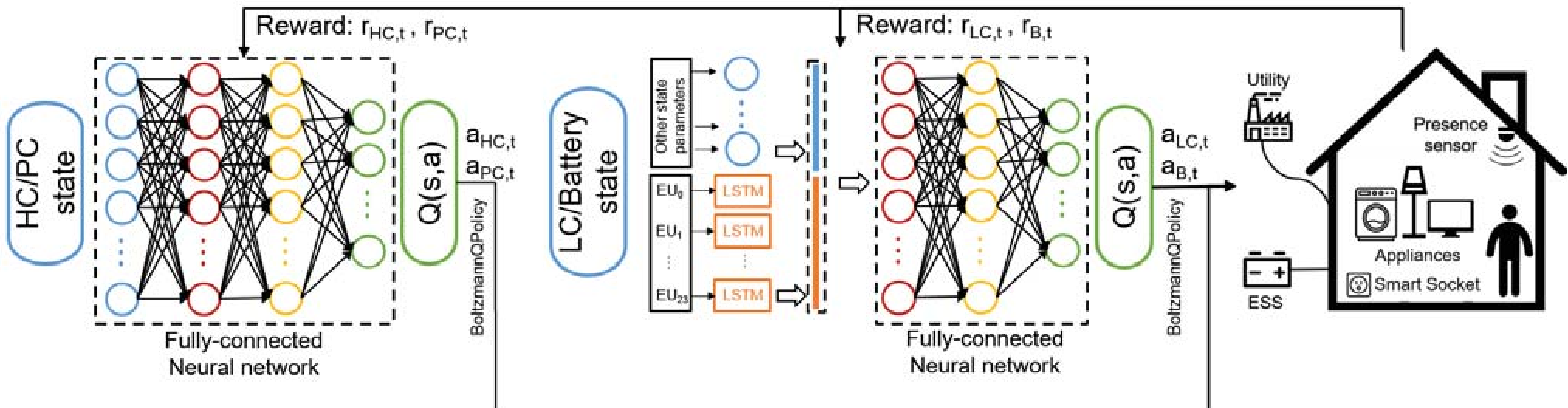 Figure 3: The Multi-agent DQN structure showing the integration of LSTM for energy-sensitive agents.
Experimental Results: Real-World Gains
The system was tested against a baseline without DSM. The most impressive result was found in "Resident #2," where the energy usage curve was dramatically smoothed out.
- Peak Reduction: ~37.5% average (up to 56% in some scenarios).
- Cost Savings: ~53% average reduction in electricity bills.
- Generalization: On the REDD Dataset, even with user behavior sensors disabled, the system still saved 33% on costs, proving the robustness of the LC and Battery scheduling agents.
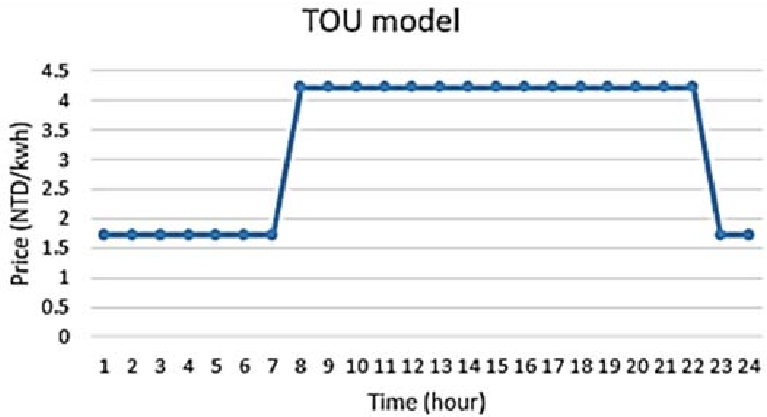 Figure 6: The energy usage curve shows the system (red) successfully shifting high-load LC appliances to off-peak hours compared to the original demand (blue).
Critical Insight & Future Outlook
The brilliance of this work lies in its Inductive Bias. By manually structuring the agents based on "Conflict levels," the authors reduced the complexity of the action space. This makes the system "Plug-and-Play"—you could theoretically add a new appliance category or a "V2G (Vehicle-to-Grid)" agent without retraining the entire house.
Limitations: The system currently assumes sensors are 100% accurate. In real-world IoT deployments, "sensor noise" is a significant hurdle. Furthermore, while PAR reduction was targeted, the paper notes that PAR occasionally rose because the average energy usage dropped faster than the peak usage—a mathematical quirk that suggests we may need even more sophisticated "peak-shaving" reward functions.
The Takeaway: Future Smart Homes won't just be "connected"; they will be autonomously negotiated. This multi-agent DRL framework provides a scalable blueprint for that future.