
Real-Time Emotion Perception: Decoding Children's Body Language in Robot Interaction
Real-Time Emotion Recognition from Natural Bodily Expressions in Child-Robot Interaction
This paper introduces a real-time framework for spontaneous emotion recognition in Child-Robot Interaction (CRI) using 3D skeletal bodily expressions. The authors utilize Online Recursive Gaussian Processes (GP) to achieve continuous dimensional emotion prediction (Arousal and Valence), demonstrating SOTA-level trend tracking in naturalistic, non-acted scenarios.
TL;DR
Researchers at Vrije Universiteit Brussel have developed a framework capable of "reading" a child's emotional state in real-time by analyzing 3D body movements. By combining a naturalistic game-based elicitation protocol with Online Recursive Gaussian Processes, the system can predict continuous emotional dimensions (Arousal and Valence) directly from skeletal data, bypassing the limitations of facial-only recognition.
Academic Positioning: This work moves beyond the "acted emotion" datasets commonly used in the field, addressing the "Spontaneous Emotion" gap in the context of Child-Robot Interaction (CRI).
The "Naturalism" Gap in Affective Computing
For assistive robots to be truly effective, they must interpret social cues as humans do. Historically, 95% of research has focused on the face. However, in real-world interactions—especially with children—facial expressions can be fleeting or occluded.
The core challenge is two-fold:
- Data Authenticity: Acted emotions (where an actor "pretends" to be sad) do not capture the subtle, continuous dynamics of real human behavior.
- Temporal Complexity: Emotions aren't static; they are a flow. Current models often fail to account for the fact that a "jump" in the 10th second is related to the "excitement" in the 9th.
Methodology: From Skeleton to Affective State
The authors used a dual-Kinect setup to reconstruct 3D skeletons even during occlusions. This "physicalist" approach translates movement into 38 mathematical features.
1. Feature Engineering: The Physics of Emotion
The study doesn't just look at joint positions; it calculates the Physics of Movement:
- Postural (Low-level): Spatial distances between hands, elbows, and spine.
- Kinematic (High-level): Using ergonomic mass definitions to calculate Force, Kinetic Energy, and Momentum of body segments.
- Spatial Extension: How much space the child occupies (expanding when happy/aroused, contracting when sad/bored).
2. The Recognition Model: Sparse Online Recursive GP
To achieve real-time performance without "forgetting" the past, the authors used a Gaussian Process (GP) with a Recursive Kernel.
- Why GP? It provides a measure of uncertainty (), which is vital for robots making social decisions.
- Sparsity: By keeping only the most "novel" 300 samples (Basic Vectors), the model avoids the complexity of standard GPs, allowing it to run on standard hardware during interaction.
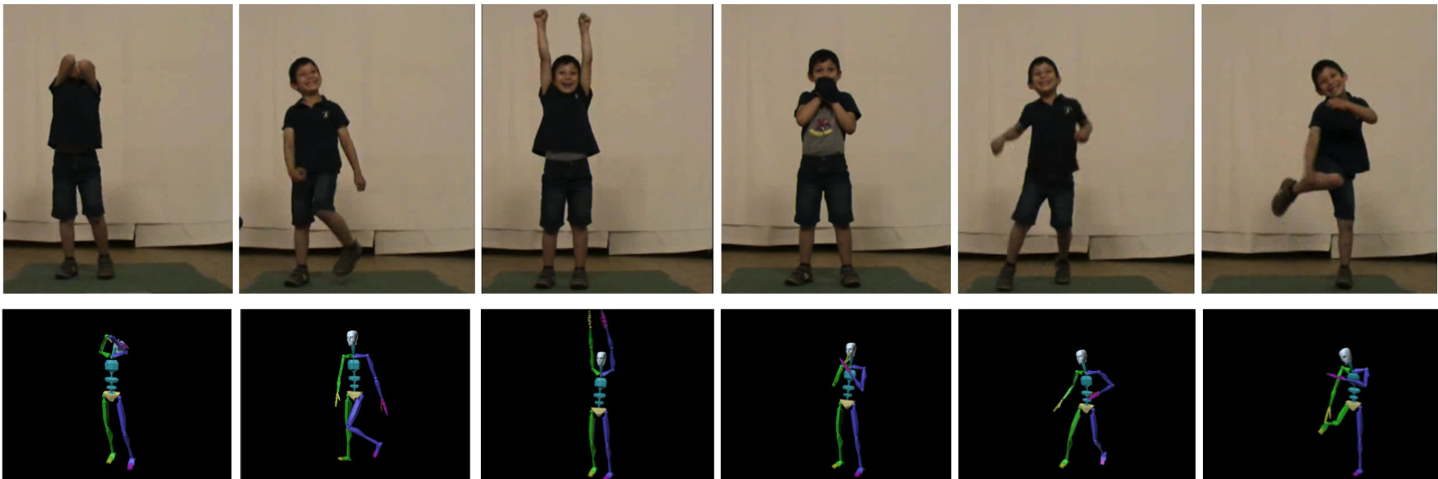 Caption: The three-view annotation and recording setup, ensuring high-fidelity ground truth for spontaneous expressions.
Experimental Insights: Arousal vs. Valence
The results confirm a persistent trend in affective computing: Arousal (intensity) is easier to detect than Valence (positivity/negativity).
- Arousal Success: The model tracked excitement levels with high precision. Kinetic energy and limb extension are strong correlates for arousal.
- The Valence Challenge: At Point D in the tests, a child's "jump and turn-around" was predicted as positive, but the ground truth was negative. Why? Because the body movement alone looked like a "happy jump," while the facial expression and context (losing the game) indicated frustration.
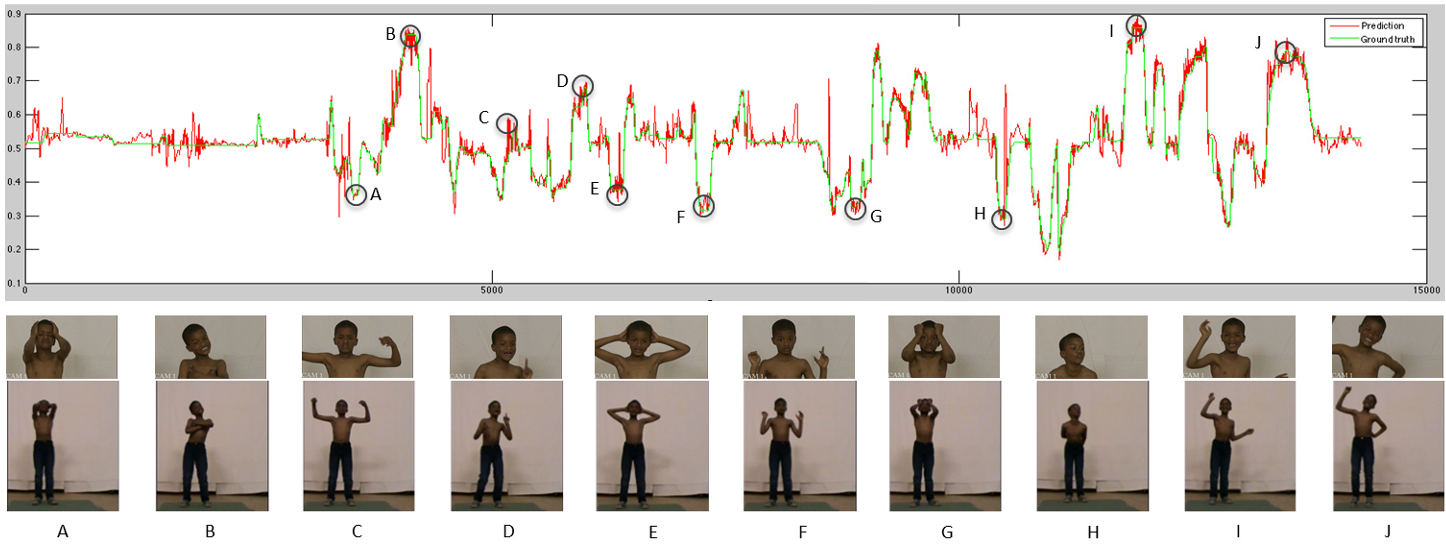 Caption: The top graph shows the model (solid line) following the annotation (dashed line) for Arousal. Note the high correlation in trend tracking.
Critical Analysis & Future Outlook
This work proves that bodily cues are a powerful, standalone channel for emotion recognition, especially for Arousal. However, the "Valence confusion" confirms that body language can be ambiguous.
Key Takeaways for Future Research:
- Multi-Modal Necessity: To distinguish a "angry jump" from a "happy jump," we must fuse body skeletons with facial Action Units (AUs) and vocal prosody.
- Relative vs. Absolute: The authors suggest modeling emotional changes (delta) rather than absolute values, which might account for individual differences in expressiveness (e.g., a shy child vs. an exuberant one).
As robots enter our homes and schools, the ability to sense child emotion in the "messy" reality of play is no longer a luxury—it is a requirement for safety and trust.