
Turbocharging Social Media Analytics: Real-Time Sentiment Processing via GPU Acceleration
Real-time GPU-accelerated social media sentiment processing and visualization
This paper presents a foundational system for real-time social media sentiment processing and visualization, leveraging NVIDIA CUDA for GPU acceleration and OpenGL for rendering. By parallelizing string matching and sentiment scoring, the system achieves a throughput of ~43,000 tweets per second, comfortably handling the global Twitter velocity of ~6,000 tweets per second.
TL;DR
In an era where Twitter generates over 6,000 tweets every second, CPU-bound analysis pipelines are becoming the bottleneck for real-time decision-making. This paper introduces a high-performance system that utilizes NVIDIA CUDA to parallelize textual sentiment analysis and OpenGL for immediate visualization. Reaching a processing speed of ~43,000 lines per second, the system offers a blueprint for monitoring global trends in politics and marketing with zero latency.
Problem & Motivation: The Velocity Wall
While numerical data processing has long enjoyed GPU acceleration, textual processing has historically remained a CPU-centric task. The authors identify a critical pain point: the sheer "velocity" of social media data. With 500 million tweets per day, a single-threaded CPU approach fails to extract structured information quickly enough for live dashboards.
The core challenge lies in the nature of string data. Unlike floating-point math, string matching involves irregular memory access and lack of native support for high-level string libraries in GPU kernels. The authors' insight was to bypass these limitations using native CUDA char-array operations to achieve massive parallelism.
Methodology: The Parallel Pipeline
The system architecture bifurcates the workload between a Tesla K80 (processing) and a GTX 750 Ti (visualization).
1. GPU Textual Processing
Each tweet is treated as a line of data distributed across a grid of CUDA threads. The kernel performs:
- Attribute Extraction: Locating commas to isolate time, text, and location.
- Sentiment Comparison: Each word is compared against positive (290 words) and negative (271 words) dictionaries.
- Score Aggregation: Scores are stored in intermediate device arrays before being copied back to the host via
cudaMemcpy().
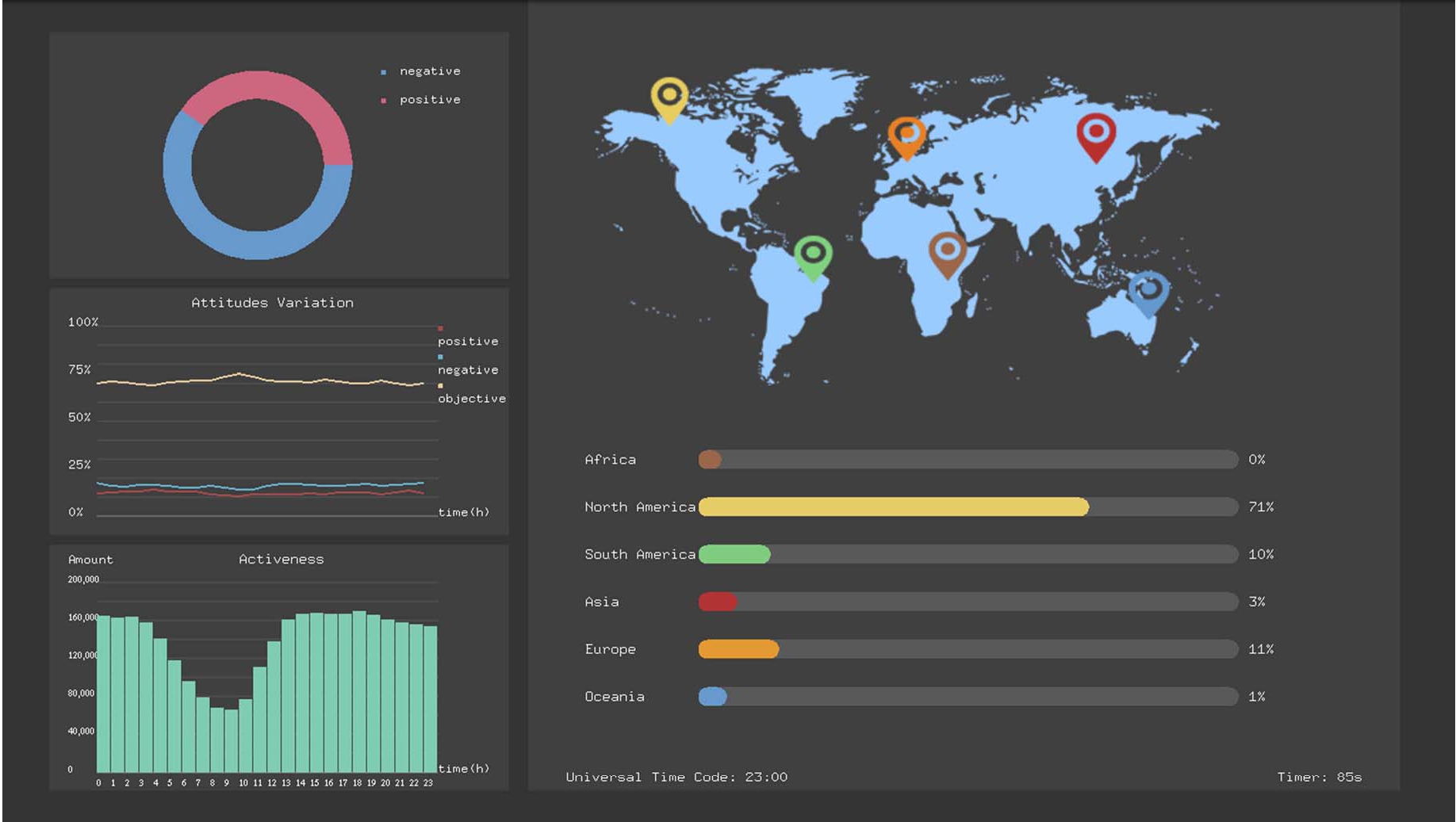 Fig 1: The data flow from Twitter Streaming API through the CUDA kernel to the OpenGL frontend.
2. Real-Time Visualization
The frontend uses OpenGL to create a five-compartment dashboard:
- Sentiment ratios (Positive vs. Negative).
- Temporal variations of attitudes.
- Activity intensity histograms.
- Geographical distribution maps of the #election hashtag.
Experiments: Breaking the CPU Bottleneck
The researchers conducted a rigorous comparison between a 12-core Intel Xeon CPU and the Tesla K80 GPU.
The Crossover Point
A vital finding of this study is the Crossover Point Analysis. Because moving data from Host (CPU) to Device (GPU) memory incurs a "tax" (latency), the GPU is actually slower for small datasets. However, as shown in the results, once the data exceeds 5,000 lines, the GPU's parallel throughput eclipses the CPU entirely.
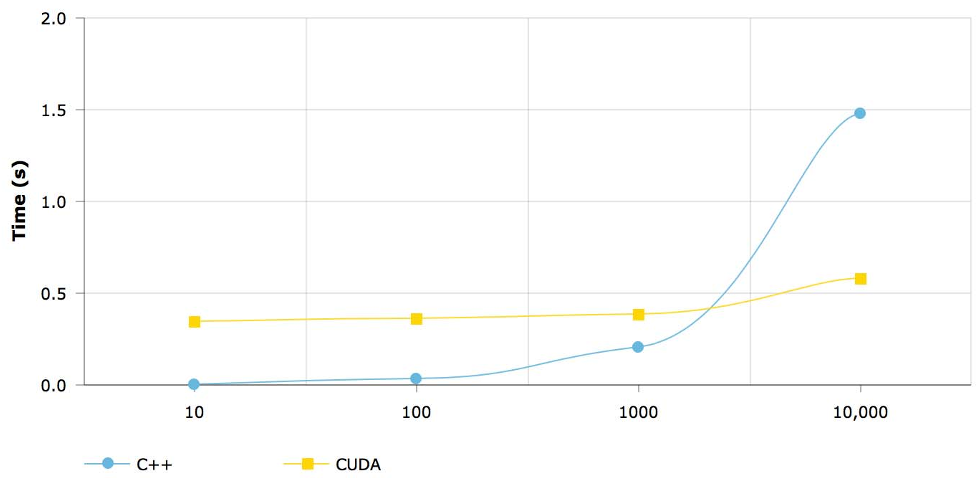 Fig 2: The intersection point where GPU throughput justifies the memory transfer overhead.
Scalability
As data volume increases by orders of magnitude, the CPU processing time scales linearly (and eventually uncontrollably), whereas the GPU processing time remains remarkably flat. This stability proves that GPGPU architectures are the only viable path for "Big Data" social analytics.
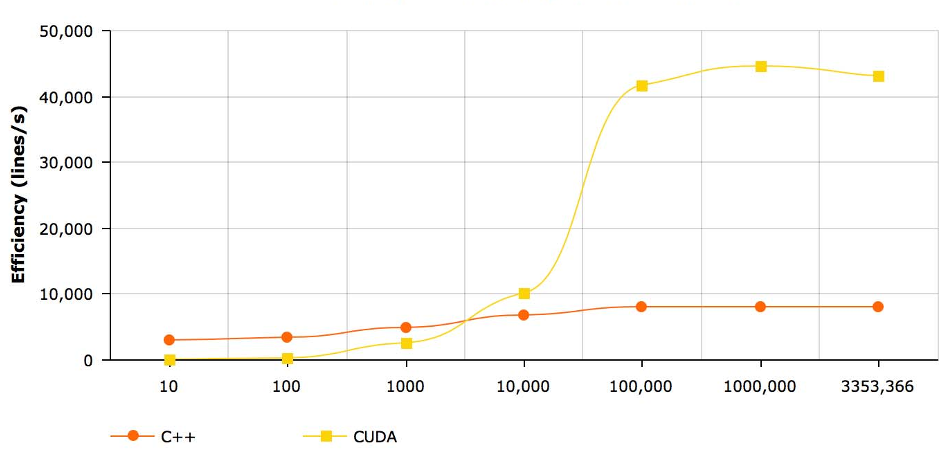 Fig 3: Comparison of performance stability showing the GPU's resilience to data volume spikes.
Critical Analysis & Conclusion
Takeaway: This work demonstrates that even "simple" sentiment analysis (keyword matching) can be a high-performance cornerstone for complex visual analytics when moved to the GPU. It successfully bridges the gap between raw data ingestion and human-readable visualization.
Limitations:
- Keyword Simplicity: The current model uses single-word lists, missing nuances like sarcasm or multi-word context (e.g., "not bad").
- Memory Bottleneck: The reliance on
cudaMemcpyfor every batch suggests that further optimizations (like Unified Memory or GPUDirect) could push the crossover point even lower.
Future Outlook: By replacing the basic keyword matcher with more sophisticated Large Language Models (LLMs) or BERT-based kernels, this real-time architecture could evolve from simple sentiment counting to deep semantic understanding of global discourse.