
CES: Unlocking Weekly Arbitrage through Cryogenic Innovation
12132_Real-Time Optimal Dispatch and Economic Viability of Cryogenic Energy Storage Exploiting Arbitrage Opportunities in an Electricity Market.
This paper introduces a Real-Time Optimal Dispatch (RTOD) algorithm for Cryogenic Energy Storage (CES) systems, leveraging its low-cost reservoir capacity to enable weekly energy shifting. By utilizing a Mixed-Integer Linear Programming (MILP) framework, the study demonstrates that CES can achieve superior profitability through weekly arbitrage in the Ontario electricity market compared to traditional daily scheduling.
TL;DR
Cryogenic Energy Storage (CES) is stepping into the spotlight as a powerful alternative to batteries. This paper presents a Real-Time Optimal Dispatch (RTOD) framework that shifts the paradigm from daily energy cycles to weekly scheduling. By leveraging CES’s unique "inexpensive reservoir" trait and a novel Price Modulation subsidy, the researchers demonstrate how this technology can finally bridge the gap between technical potential and financial profitability in markets like Ontario.
Problem & Motivation: The Efficiency Gap
Large-scale energy storage is essential for balancing intermittent renewables and nuclear baseloads. However, the private sector remains hesitant. Why? Because the "Energy Arbitrage" (buying low, selling high) rarely covers the massive capital expenditures (CAPEX) and operating expenses (OPEX) due to narrow price spreads and energy losses.
The authors identify a specific "sweet spot" for CES: unlike batteries, where doubling the storage time doubles the cost, CES stores energy in liquid air. Increasing the storage capacity simply means building a larger vacuum-insulated tank—a relatively cheap endeavor. This allows for long-duration energy shifting, such as storing cheap wind power over an entire weekend to sell during peak weekday afternoons.
Methodology: RTOD and Price Modulation
The core of the paper is a Mixed-Integer Linear Programming (MILP) model.
1. Model Architecture
The RTOD algorithm operates on a rolling horizon (24h for daily, 168h for weekly). It monitors the State of Charge (SoC), energy dissipation (approx. 0.15% per day), and conversion efficiencies to decide the optimal charging/discharging set-points.
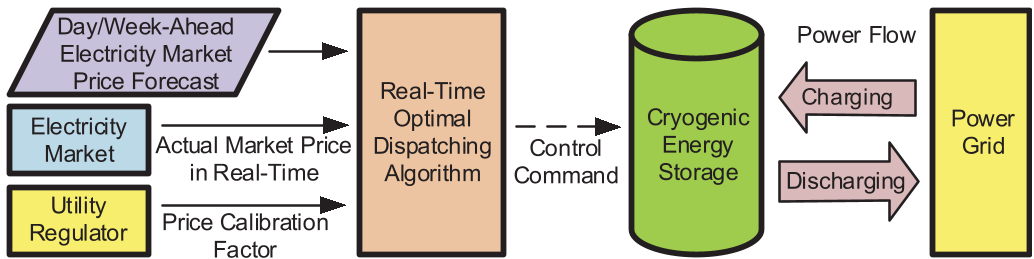
2. The Subsidy Innovation: Modulation Factor (I)
Instead of a flat check from the government, the authors propose multiplying market prices by a factor . This "Price Modulation" virtually stretches the volatility. If , a 20 spread in the eyes of the optimizer. This encourages the storage unit to act precisely when the grid needs it most (peak shaving), while ensuring the investor hits their 8.34% annual expected ROR.
Results: Weekly vs. Daily Performance
The comparison is startling. Under identical cost structures, the "Weekly" CES outperformed the "Daily" model significantly.
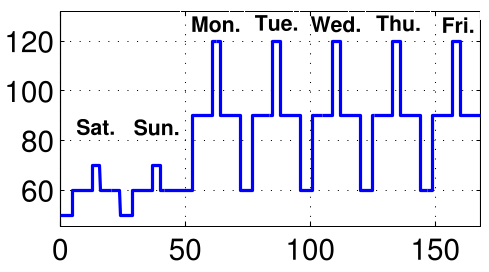 In the chart above, note how the daily usage (c) resets every 24 hours, whereas weekly usage (f) allows the State of Charge (SoC) to build up over the weekend, capturing much deeper arbitrage cycles.
Key Findings:
- Revenue Boost: Weekly scheduling provides a ~11% revenue lift over daily scheduling just by being "smarter" about low-price weekend windows.
- Break-even Point: For a CES in Ontario, a modulation factor of 3.2 to 5.0 is typically required to make the investment "net-zero" or profitable, depending on the accuracy of price forecasts.
- Efficiency Sensitivity: As round-trip efficiency moves from 30% toward 70% (possible with waste heat integration), the need for subsidies drops sharply.
Deep Insight: Why Why Weekly Matters
The "Efficiency Breakpoint" is a critical concept introduced here. If the price spread isn't high enough to cover the energy lost during conversion, the ESS shouldn't operate at all. Daily schedules often hit this wall on weekends. Weekly schedules bypass it by treating the weekend as one giant "recharge" phase for a five-day "discharge" campaign.
Conclusion & Future Outlook
The paper proves that the economic viability of CES is not just a hardware problem (efficiency) but an operational and regulatory problem. By shifting to weekly horizons and adopting performance-linked subsidies through price modulation, utility regulators can foster a stable environment for private storage investment.
Limitations: The study assumes the CES unit is a "price taker" (it doesn't affect market prices), which might not hold true if multiple gigawatt-scale units are deployed simultaneously. Future work should explore the "price maker" impact of massive cryogenic deployment on market equilibrium.