
REAL-TIME PRIVACY PROTECTION: SMART OBSCURATION THROUGH CAPTURE INTENTION
Real-time privacy protection system for social videos using intentionally-captured persons detection
This paper introduces a real-time privacy protection system for social videos that distinguishes between Intentionally-Captured Persons (ICPs) and non-ICPs. Utilizing a Markov Random Field (MRF) framework combined with inertial sensor data, the system selectively obscures only those unexpectedly framed in the scene, achieving an AUC of 0.92 in person classification.
TL;DR
This paper presents a breakthrough in mobile video privacy by answering a simple question: "Who did the cameraman mean to film?" By distinguishing Intentionally-Captured Persons (ICPs) from accidental bystanders (non-ICPs) using an MRF-based model and IMU sensors, the system protects privacy without ruining the story of the video—all in real-time at over 22 FPS.
Problem & Motivation: The "All-or-Nothing" Privacy Trap
In the era of YouTube and TikTok, our videos are filled with strangers. Current privacy systems are "blind"—they either blur everyone, making the video unwatchable, or they blur no one, risking privacy lawsuits.
The technical bottleneck has been Capture Intention. Identifying the subject of a video requires understanding the relationship between camera movement and person movement. Previous attempts relied on optical flow and complex motion estimation, which are too slow for mobile real-time processing. This paper tackles this by leveraging the sensors already in your pocket: the accelerometer and gyroscope.
Methodology: The MRF-based ICP Model
The core innovation lies in a Markov Random Field (MRF) that fuses three distinct "intuitions" to decide if a person is a subject or just a passerby.
- Observation Model: Uses Marginal Fisher Analysis (MFA) to reduce the dimensionality of spatial features and IMU data, then feeds them into an SVM to get an initial "subject likelihood."
- Spatial Constraints: Based on the insight that if multiple people are the "subject" (like a group of friends), they usually occupy a similar scale in the frame.
- Temporal Consistency: This is the paper's key addition. It assumes that a person's status (ICP vs. non-ICP) doesn't change every microsecond. This "memory" prevents the flickering blur effect.
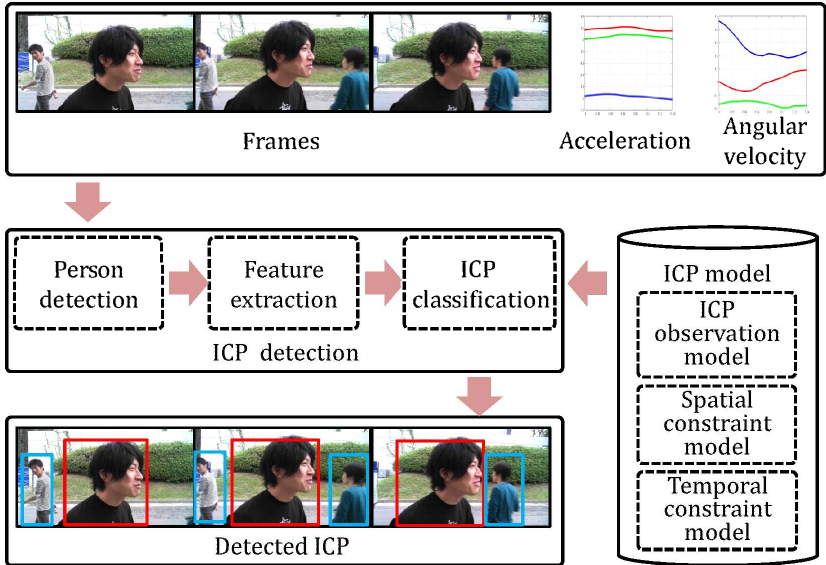 Figure 1: The system workflow—from skin detection and IMU feature extraction to the MRF-based classification.
Experiments & Results: Real-Time Performance
The researchers tested their prototype on 16 real-world social videos. By adding the Temporal Constraint Model, they boosted the classification accuracy (AUC) significantly.
- Baseline (No Temporal Memory): 0.85 AUC
- Proposed Method: 0.92 AUC
The system is remarkably lean. While skin color detection (used for speed) has some limitations in diverse lighting, the logic layer—deciding who is who—is highly robust.
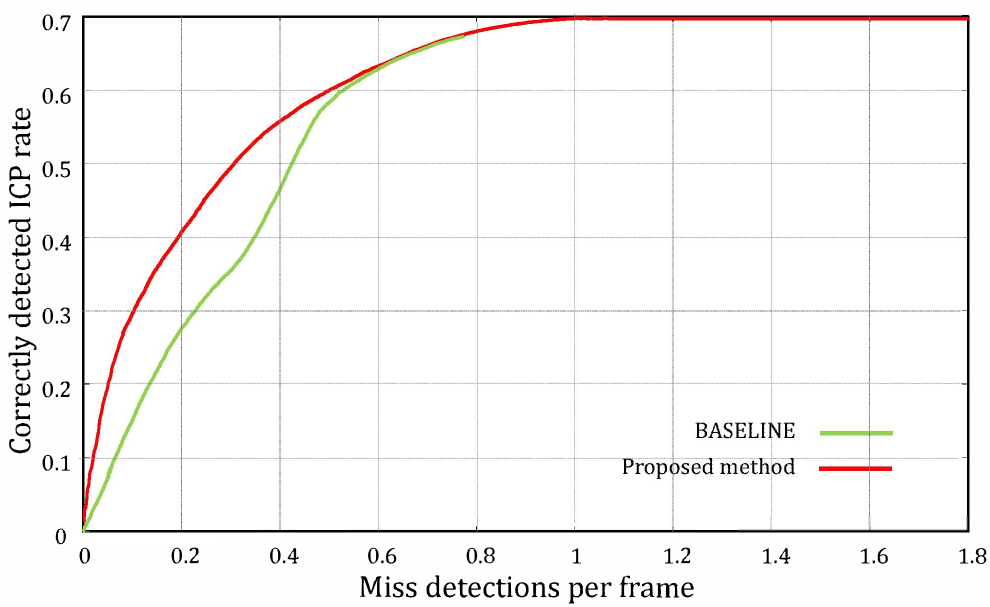 Figure 2: ROC curve showing the superior performance of the proposed temporal MRF (solid line) over the previous baseline.
Visual Results
As seen in the frame comparisons below, the system successfully keeps the "protagonists" clear while turning the "background people" into unrecognizable pixels.
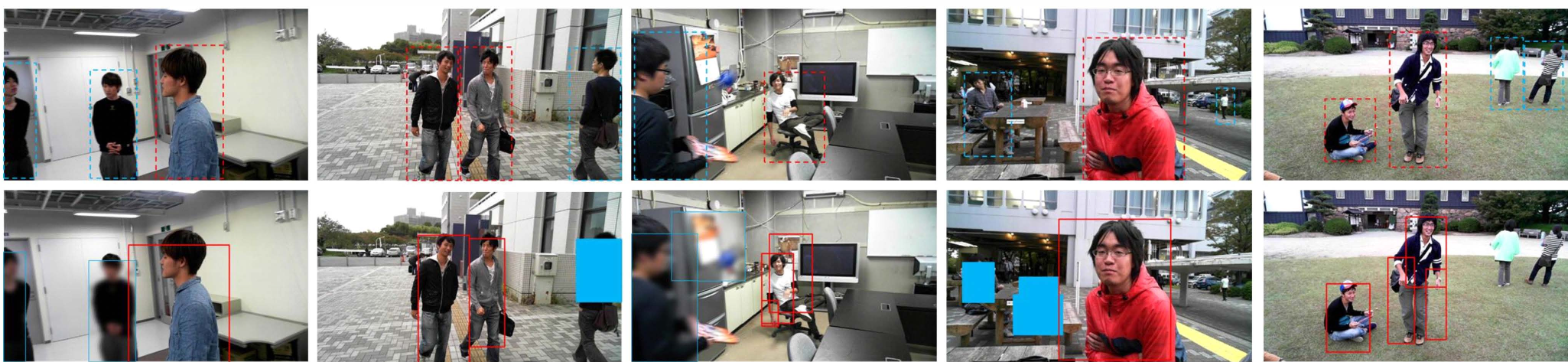 Figure 3: Red boxes (ICPs) remain visible; blue boxes (non-ICPs) are automatically obscured.
Critical Analysis & Conclusion
Takeaway: This work proves that "context-aware" privacy is possible. By using IMU data to approximate camera motion, the authors bypassed the most expensive part of the computer vision pipeline.
Limitations: The reliance on Skin Color Detection for person localization is the system's Achilles' heel. While fast, it fails when people turn their backs or in low light. However, the MRF framework itself is "detection-agnostic"—meaning it could be upgraded with modern, lightweight YOLO or MediaPipe detectors as mobile hardware improves.
Future Outlook: We can expect future SNS apps to integrate this "Intention-Aware" layer, allowing users to live-stream from public spaces while automatically respecting the privacy of everyone in the background.