
APT-Logic: Predicting Cyber-Attacks by Parsing the Socio-Technical Pulse of the Darkweb
Reasoning About Future Cyber-Attacks Through Socio-Technical Hacking Information
The paper introduces an AI tool based on the Annotated Probabilistic Temporal (APT) logic framework to predict future cyber-attacks. By mining discussions from 56 Darkweb hacking forums and correlating them with real-world enterprise incidents, the system generates predictive rules that outperform baseline models by up to 138% in F1 score.
TL;DR
Researchers have developed an AI framework that doesn't just look at what software is broken, but who is talking about breaking it. By using Annotated Probabilistic Temporal (APT) Logic, the system monitors Darkweb forums to correlate hacker behavior with imminent cyber-attacks, yielding a massive 138% improvement in prediction accuracy over traditional baseline methods.
Context: Beyond the Vulnerability Scan
In the cat-and-mouse game of cybersecurity, defenders are drowning in a sea of vulnerabilities (CVEs). However, only a tiny fraction of these flaws are ever actually used in real-world attacks. Most predictive models fail because they ignore the human element: the hackers.
The authors argue that a vulnerability mentioned by a "script kiddie" is far less dangerous than one discussed by a high-reputation "key hacker." Their insight is that hacker intent + hacker capability + technical exploitability = high attack probability.
Methodology: The Logic of Hacking
The core of this work is the use of APT Logic to formalize "socio-technical" indicators. The framework generates rules following this intuition:
"If a high-expertise actor discusses CVE-X, which has a recent patch, there is a probability p of an attack on Enterprise-Y within T days."
1. The Socio-Technical Feature Set
The model extracts features across four categories:
- Discussion Content: Specific mentions of CVEs.
- Socio-Personal Indicators: Hacker reputation, "PageRank" in the forum network, and expertise measured by "Knowledge Provision" (e.g., sharing tutorials).
- Technical Indicators: Whether a official patch was recently released or if a Proof-of-Concept (PoC) exploit exists.
- Real-world Incidents: Ground truth data from enterprise logs.
2. Architecture and Rule Extraction
The authors use an algorithm called EFR-APTRule-Extract to mine temporal relationships.
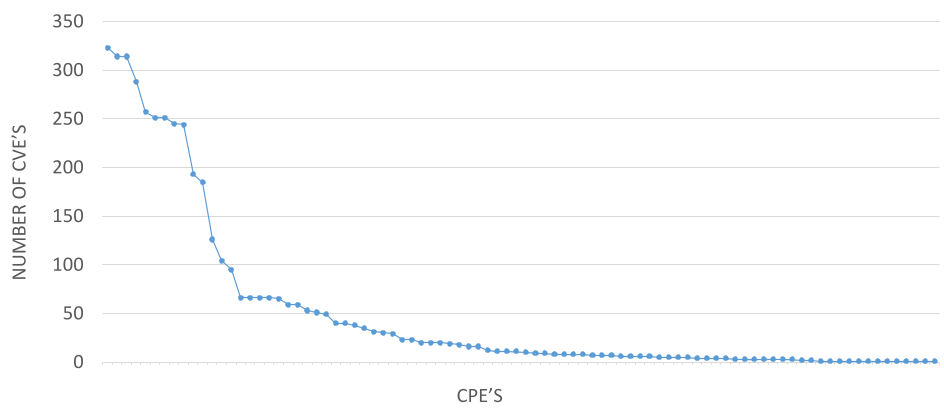 Fig 1: The mapping of CVEs to specific software products (CPE) to group technical data for logic rules.
Experiments & Results: A Significant Leap
The training involved mining over 32,900 APT rules. The most successful rules were those that included 4 to 7 predicates—meaning the most accurate predictions required a complex mix of both social and technical data.
Performance Gains
The results were categorized by attack types: Malicious Email (m_e), Malicious Destination (m_d), and Endpoint Malware (e_m).
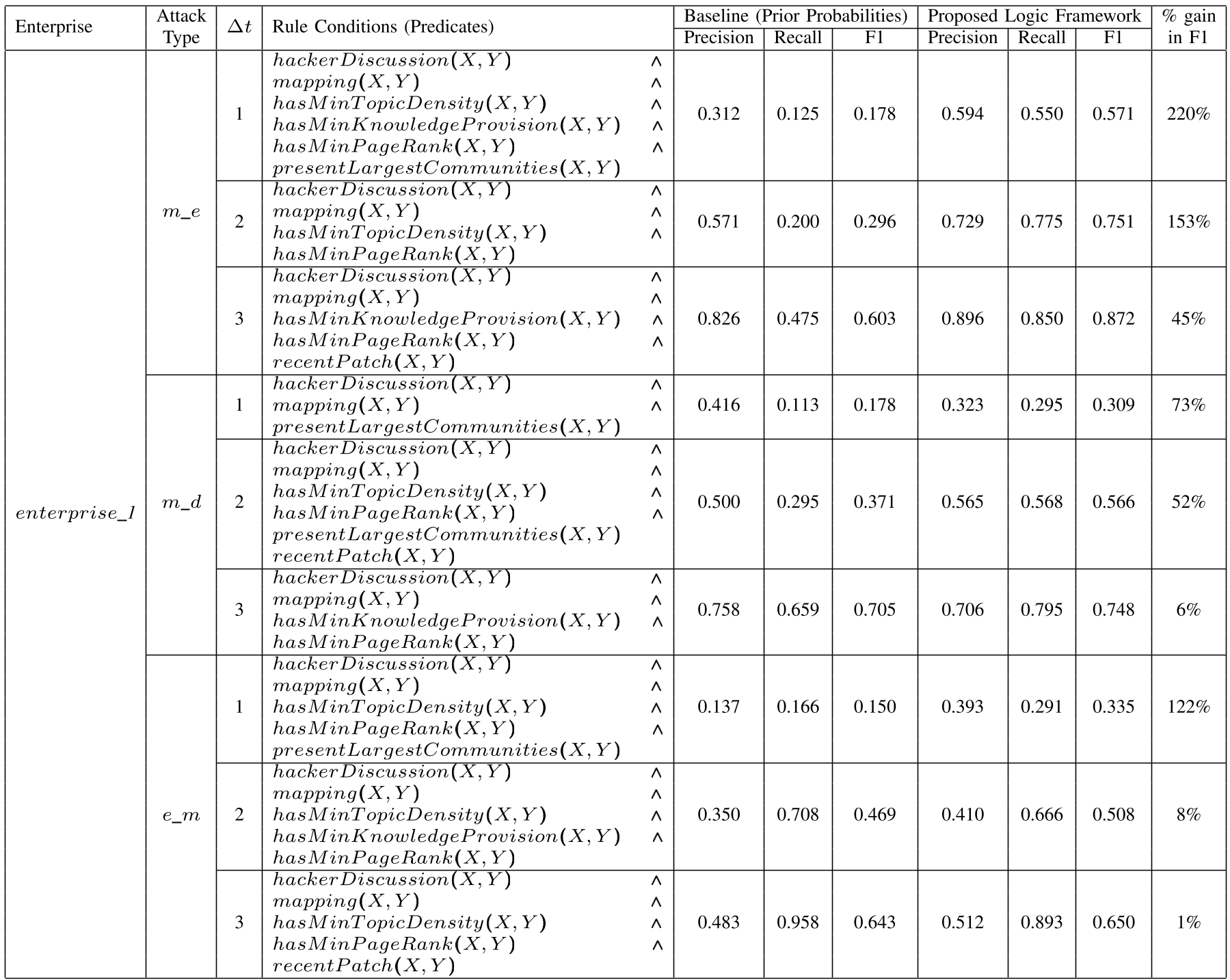 Fig 2: Comparison of the Logic Framework against the baseline, showing massive gains in F1 scores across different time intervals (Δt).
Key Findings:
- The Power of PageRank: In 88% of the most successful rules, the
hasMinPageRankpredicate was present. This confirms that the social centrality of a hacker is a primary signal of a credible threat. - Window of Opportunity: The system is most effective at very short-term prediction (1-day window), where it achieved a 220% F1 gain for malicious email attacks.
Critical Analysis & Conclusion
Takeaway
The study proves that socio-personal indicators are not just "fluff"—they are statistically significant predictors. Security teams should prioritize patching vulnerabilities not just based on "severity scores" (CVSS), but on the specific social dynamics of the communities discussing them.
Limitations
- Anonymity vs. Attribution: While the model tracks "actors," it relies on forum usernames. Sophisticated attackers may use multiple aliases or stay silent in public forums.
- Label Noise: The ground truth is limited to one enterprise's logs; broader datasets would improve generalizability.
Future Outlook
As cyber-warfare becomes more professionalized, merging logical frameworks with Deep Learning (like Graph Embeddings of Darkweb networks) will likely be the next frontier in proactive defense.