
DiRL: Steering LLM Reinforcement Learning via Direction-Aware Exploration
Reasoning or Memorization? Direction-Aware Diversity Exploration in LLM Reinforcement Learning
The paper introduces DiRL (Direction-Aware Reinforcement Learning), a framework designed to enhance reasoning in LLMs by anchoring exploration to a specific internal "reasoning-memorization" direction. It integrates with Group Relative Policy Optimization (GRPO) and achieves SOTA results on math (MATH500, AIME) and general reasoning (GPQA) benchmarks.
Executive Summary
TL;DR: DiRL (Direction-Aware Reinforcement Learning) is a novel framework that optimizes LLM reasoning by distinguishing between "thinking" and "reciting." By anchoring exploration to a specific vector in the model's residual stream, DiRL rewards trajectories that exhibit genuine reasoning novelty while penalizing those that simply iterate on memorized shortcuts.
Academic Context: This work moves beyond generic diversity-seeking RL (like Entropy bonuses or EVOL-RL). It is a SOTA-improving methodology that bridges mechanistic interpretability—specifically the discovery of reasoning "directions" in latent space—with practical Policy Optimization (GRPO).
The "Blind Spot" of Diversity
In the quest to elicit reasoning in LLMs, Reinforcement Learning (RL) relies heavily on exploration. If a model only samples what it already knows, it never discovers the logic required for "frontier" problems.
However, previous methods had a fundamental flaw: they rewarded all diversity. If a model produced a weird, novel response because it hallucinated a memorized fact (memorization) or because it tried a new logical derivation (reasoning), both were treated as "good exploration." This results in models that are "diverse" but not necessarily "smarter."
Methodology: The Geometry of Thinking
DiRL's brilliance lies in its use of the Linear Representation Hypothesis. The authors discovered that reasoning and memorization are not just abstract concepts but are linearly separable directions within the model's hidden states.
1. Extracting the Compass
The authors first define a "Reasoning-Memorization Direction" () by subtracting mean activations of memory-intensive tasks (like PopQA) from reasoning-intensive tasks (like GSM8K). This vector acts as a static compass for the entire RL process.
2. Direction-Weighted Gradients
Instead of using raw gradients, DiRL calculates direction-weighted gradient features.
- Token Weighting: Each token is weighted by how much its hidden state aligns with the reasoning direction .
- Feature Aggregation: The final gradient feature emphasizes tokens that contribute to the reasoning process.
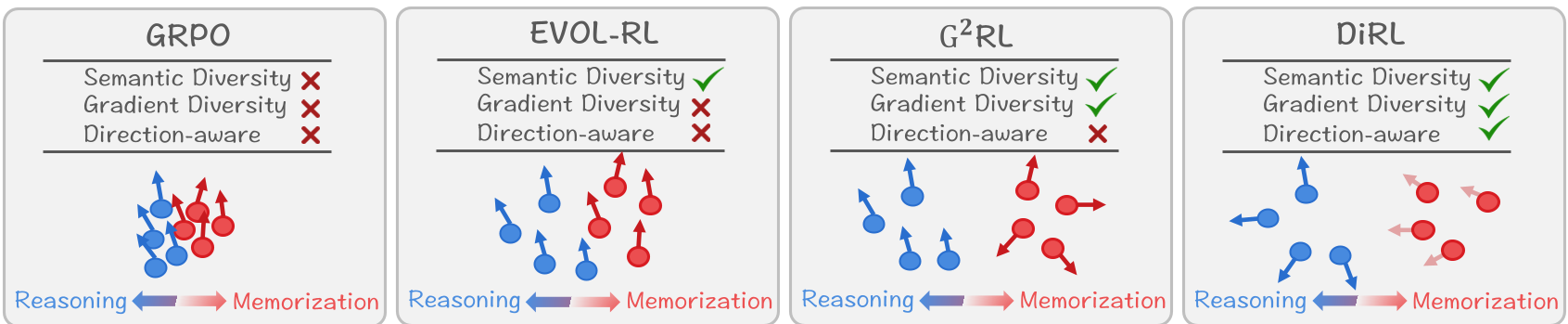 Figure 1: Unlike G2RL or Entropy-based methods, DiRL selectively amplifies reasoning-aligned novelty.
3. Reward Shaping
DiRL partitions responses into two groups: Reasoning-aligned () and Memorization-aligned (). It then shapes the reward :
- For : Adds a bonus for novelty.
- For : Subtracts a penalty for novelty (suppressing "hallucinated" shortcuts).
Experimental Breakthroughs
The framework was tested on Qwen3-1.7B and 4B models. The results are striking across benchmarks like MATH500 and the ultra-hard AIME25.
| Benchmark | GRPO (Baseline) | DiRL (Ours) | Improvement |
|---|---|---|---|
| AMC (pass@1) | 53.0 | 61.0 | +8.0 |
| AIME25 (pass@16) | 32.8 | 45.8 | +13.0 |
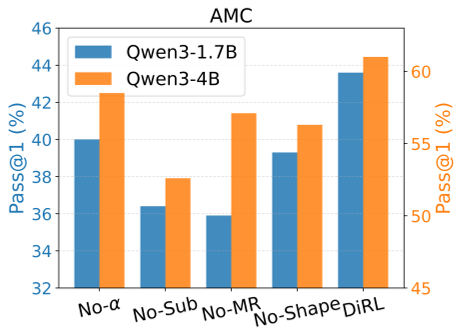 Figure 2: Ablation studies confirming that separating the groups (subgroups) and using the reasoning direction is vital for performance.
Beyond accuracy, the authors evaluated GSM-Symbolic. Many LLMs fail when you change names or numbers in a math problem (showing they just memorized the original). DiRL models showed much higher robustness, indicating they learned the underlying logic rather than the surface text.
Deep Insight: Why This Matters
The most profound takeaway is the stability of the reasoning direction. The authors found that even as the model grows significantly smarter during RL, the geometric direction of "what constitutes reasoning" remains almost constant (drifting less than 6 degrees).
This suggests that "Reasoning" is a structural feature of the pre-trained weight manifold. RL's job is not to invent reasoning, but to navigate the model toward the reasoning-aligned regions of its own latent space.
Conclusion & Future Work
DiRL proves that "meaningful diversity" is better than "maximum diversity." By using internal activations as a filter, we can train models that are more logical and less prone to memorization-induced shortcuts.
Limitations: The method currently uses a single global direction. Future research might explore multiple dimensions (e.g., separating planning from symbolic logic) to provide even finer-grained guidance for the RL process.