
REBUILD: Bridging the Gap Between Sparse Telecom Data and Social Role Identity
REBUILD: Graph Embedding Based Method for User Social Role Identity on Mobile Communication Network
The paper introduces REBUILD, a graph embedding-based framework for identifying user social roles in mobile communication networks. By combining a modified LINE embedding approach with label-informed sampling and subspace projection, it achieves SOTA performance in identifying roles even with sparse and noisy telecom data.
TL;DR
Identifying whether a mobile user is a student, a civil servant, or a potential fraudster is a high-value task for targeted marketing and financial security. However, mobile communication networks are notoriously "data-poor" compared to social media. REBUILD solves this by injecting label information directly into the graph embedding process and using Subspace Projection to filter out the noise inherent in sparse telecom records.
The "Data Poverty" Problem in Mobile Networks
On platforms like Twitter or Facebook, user roles are easily inferred via text analysis (NLP) or image recognition. In contrast, researchers working with mobile operators only have access to "meta-communication" patterns:
- The Attributes: Call frequency, SMS counts, and call durations.
- The Challenges: The data is highly sparse (most users only call a few people) and noisy (users often provide false profile information to banks or operators).
Previous methods using probabilistic models or simple label propagation fail because they cannot capture the complex, non-linear relationships between a user's local network structure and their social identity.
Methodology: Engineering Robustness into Embeddings
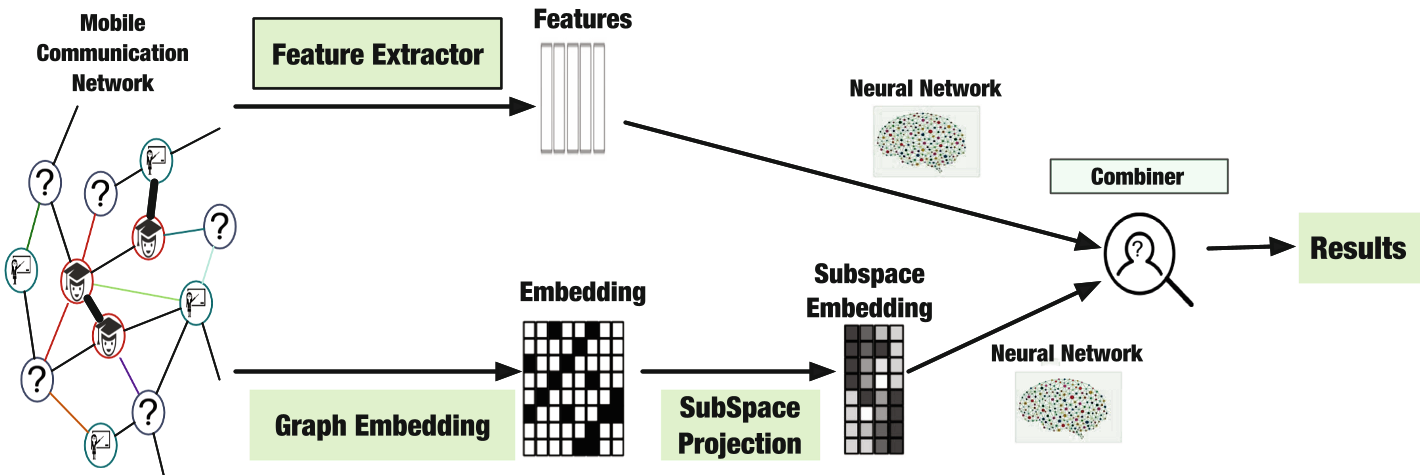
The REBUILD framework consists of three main stages: Feature Extraction, Label-Informed Graph Embedding, and Subspace Projection.
1. Label-Informed Context Sampling
Standard graph embedding methods like LINE are unsupervised—they only care if two nodes are connected. REBUILD modifies this: if two nodes share the same label, they are treated as a "positive sample" even if their connection is weak. This forces the latent space to cluster users with similar social roles together.
2. The Power of Subspace Projection
The most striking insight of this paper is the use of a projection matrix . Instead of using a raw -dimensional embedding, the model projects it into a much smaller subspace .
Why does this work? In a sparse and noisy environment, high-dimensional spaces allow the model to "memorize" the noise (overfitting). By forcing the representation into a bottleneck (subspace), the model is compelled to keep only the most robust structural features that correlate with the social labels.
Experiments: Real-World Validation
The authors tested REBUILD on a massive dataset from a Chinese mobile operator involving 15 million users and 140 million call records.
Robustness to Noise
A critical test involved intentionally mislabeling data to simulate real-world noise. As shown in the study, even when 40% of the training labels were incorrect, the subspace projection method maintained an accuracy of over 80%. Specifically, a subspace size of was found to be the "sweet spot" for balancing capacity and noise filtration.
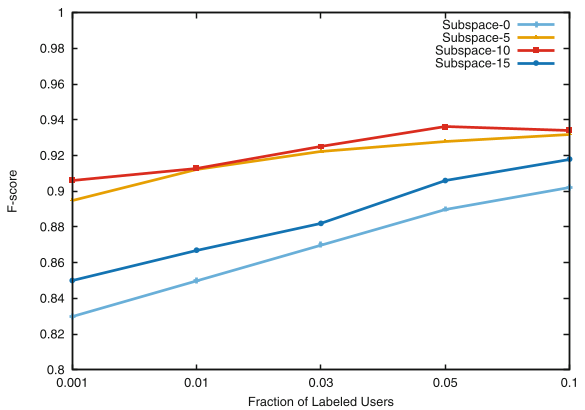 (The figure illustrates how F-score evolves with different subspace dimensions under varying label ratios.)
SOTA Comparison
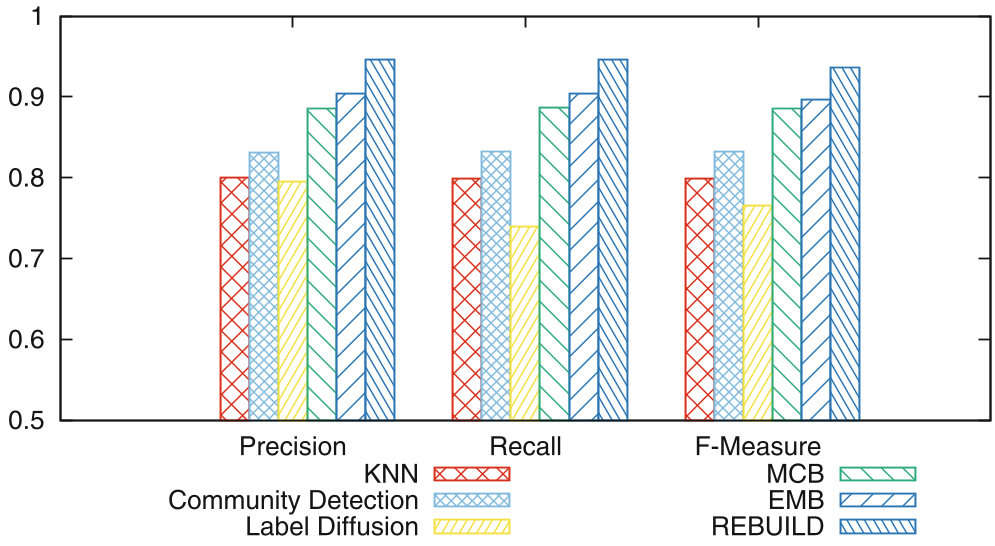
REBUILD was compared against community detection and traditional feature-based logistic regression (MCB).
- Precision Boost: REBUILD achieved over 95% precision, a 10% absolute improvement over previous state-of-the-art methods.
- Significance: Regular methods struggled to break the 90% barrier due to the inherent sparsity of the communication graph.
Critical Insight & Conclusion
The success of REBUILD suggests that for specialized domains like telecommunications, standard "off-the-shelf" embeddings are insufficient.
Takeaways:
- Label Guidance: Unsupervised embeddings should be "nudged" by label information during the sampling phase to make them task-aware.
- Subspace Regularization: When dealing with noisy, real-world labels, dimensionality reduction isn't just for efficiency—it's a powerful tool for generalization.
Future Work: The authors admit that graph embedding is computationally expensive compared to simpler heuristic methods. The next frontier for REBUILD is moving toward an online learning manner where the model can update user roles in real-time as new call records arrive.