
Beyond Swiping: Decoding Taste and Attractiveness in Reciprocal Social Networks
User recommendation in reciprocal and bipartite social networks -- a case study of online dating
The paper introduces a novel Collaborative Filtering (CF) hybrid model for user recommendation in reciprocal and bipartite social networks, specifically targeting online dating. By integrating both "taste" (who a user likes) and "attractiveness" (who is likely to respond to a user), it achieves superior performance in matching users compared to traditional unilateral CF and content-based methods.
TL;DR
In online dating, it's not enough to find someone you like; they have to like you back. This paper presents a Hybrid Collaborative Filtering (CF) model specifically for bipartite, reciprocal networks. By shifting the focus from static profiles to dynamic behavioral interaction (the "How" of messaging and responding), the model significantly boosts the chances of a "mutual match."
The Problem: The One-Sided Fallacy
Most recommender systems operate on a unilateral logic: Amazon suggests a book, and the book doesn't have to agree to be bought. However, in reciprocal networks—such as online dating, job hunting, or college admissions—the "item" is another human being with their own agency and preferences.
The authors identify two fatal flaws in existing approaches:
- Structural Blindness: Methods like "Friends of Friends" fail in bipartite networks (e.g., in heterosexual dating, men don't connect to men).
- Reciprocity Neglect: Basic CF only tracks "Taste" (who you pick). Content-based models (CCR) rely on profiles (e.g., height, age) which are often inaccurate or inconsistent.
Methodology: The Taste-Attractiveness Duality
The core innovation lies in the Hybrid Contact Matrix. Instead of a binary 0/1 (clicked/not clicked), the authors utilize a vector-based representation of interactions:
- Taste: Captured by the initial contacts a user sends.
- Attractiveness: Captured by the responses a user receives.
- Unattractiveness: Crucially, the model also learns from rejections—if many users similar to User A reject User B, the system recognizes a mismatch in "attractiveness-taste" alignment.
The Mathematics of Attraction
The authors define a similarity function that compares two users based on their shared history of success and failure. As shown in the formula below, it normalizes these interactions against the user's total activity (degree centrality) to ensure hyper-active users don't skew the results.

To rank partners, they introduce a penalty factor . If a potential partner matches your taste but is statically unlikely to respond to someone like you, their rank is penalized, steering recommendations toward higher "success probability."

Experiments & Results: Real-World Dating Data
The researchers tested their model on a 196-day dataset from a major dating site.
Key Findings:
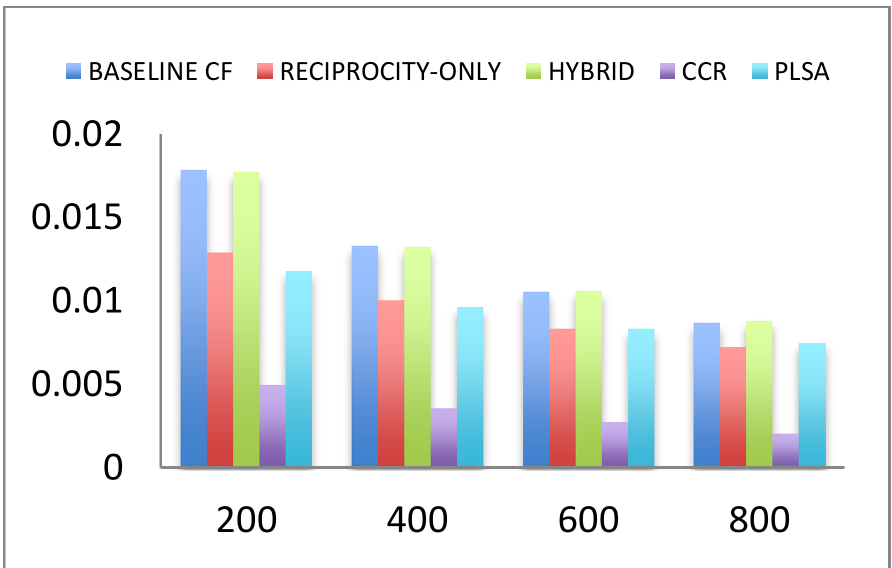
- Superior Accuracy: The Hybrid model consistently beat the CCR (Content-based) and pLSA (Latent Semantic) models.
- The Gender Gap: Male users initiate 79.8% of contacts but only get a 21.4% response rate. Female users are more selective but see a 41.7% response rate.
- Individual Impact: Using "Individual-level evaluation," the authors proved that the hybrid model isn't just good on average; it provides better experiences for the majority of users, not just the "power users."
Critical Insight: Behavioral Truth vs. Profile Lies
The most striking takeaway is that the Hybrid model outperformed the CCR model, which had access to user attributes (age, height, smoking habits).
Why? Because in dating, people often lie on their profiles or don't actually know what they want until they start interacting. Behavioral data—who you actually message and who actually replies to you—is a "ground truth" that profiles cannot match.
Looking Forward
While this study focuses on dating, the logic of "Taste + Attractiveness" is a massive unlock for other bipartite industries:
- HR Tech: Recommending jobs that an applicant is qualified for and likely to be interviewed for.
- Education: Matching students with universities where they both fit the culture and meet the admission criteria.
Limitations
The model still struggles with the Cold-Start problem. If a new user hasn't messaged anyone yet, the model has no "Taste" data to work with. Future iterations may need to bridge the gap by combining these behavioral insights with initial (validated) profile data.
Final Takeaway: In the world of reciprocal networks, the best recommendation isn't just a "match" on paper—it's a match in action.