
ReHeLP: Decoding the Logic of Mutual Attraction in Heterogeneous Social Networks
Reciprocal and Heterogeneous Link Prediction in Social Networks
The paper introduces ReHeLP, a novel supervised learning framework for link sign prediction in heterogeneous and reciprocal social networks. It targets environments like online dating where nodes belong to disjoint groups (e.g., male/female) and link formation requires mutual consent, achieving a 78.1% accuracy on a large-scale commercial dating dataset.
TL;DR
Predicting a link in a social network is hard; predicting whether that link will be positive (a match) or negative (a rejection) in a reciprocal environment like online dating is even harder. ReHeLP (Reciprocal and Heterogeneous Link Prediction) is a machine learning framework that moves beyond simple "who-knows-who" logic. By introducing the Tetrad—a 4-node structural motif—it successfully captures the subtle interplay of "taste" and "attractiveness" in heterogeneous networks, outperforming traditional baselines by significant margins.
The "Bipartite" Blind Spot in Link Prediction
Most link prediction research treats social networks as homogeneous masses where anyone can link to anyone (like Twitter followers). However, many of the most valuable networks are Heterogeneous and Reciprocal:
- Heterogeneous: Links only form between disjoint groups (e.g., Male-to-Female in dating, Worker-to-Job in recruitment).
- Reciprocal: A link isn't just an action; it's a mutual agreement. A "negative link" occurs when one party rejects the other.
Conventional algorithms often rely on "triadic closure" (if A knows B and B knows C, A likely knows C). In a dating site, this is topologically impossible—if a man links to a woman, they cannot both link to the same third person in a heterosexual context. This creates a "structural gap" that standard SOTA methods struggle to fill.
Methodology: The Power of the Tetrad
To capture the "Collaborative Filtering" intuition—that we like what people similar to us like—the authors propose the Tetrad.
The Tetrad Structure
A Tetrad is a three-step path involving:
- Source (): The initiator.
- Target (): The recipient.
- Similar nodes (): Nodes that help establish the "taste" profile of the initiator and the "attractiveness" profile of the target.
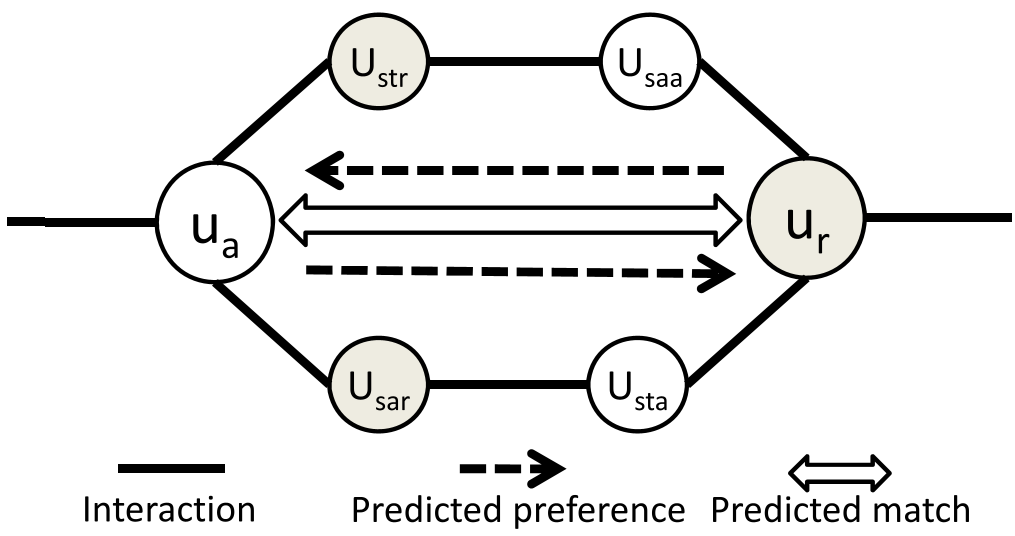
The authors extract 64 distinct dyadic features from these tetrads, categorized by:
- Typical CF: Capturing standard user-item-user preferences.
- Inverted CF: Analyzing recipient-based similarity.
- Transmissible CF: Modeling the "flow" of preference across the network.
These are combined with Monadic features (out-degree/in-degree as measures of activity and popularity) and fed into a Logistic Regression model to predict the probability of a positive edge.
Experimental Results: Real-World Dating Success
The framework was tested on a massive dataset from a commercial online dating site (over 1.7 million interactions).
SOTA Comparison
Comparing ReHeLP to the baseline established by Leskovec et al. (a high-water mark for sign prediction), the results show a clear edge:
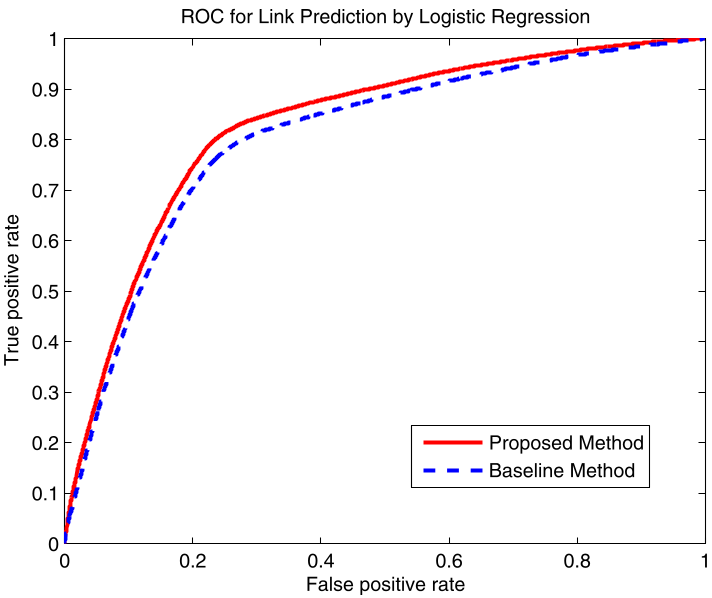
- Accuracy: 78.1% (vs 75.6% baseline).
- Precision: 74.9% (a 3.14% improvement).
- AUC: 0.827.

The ROC curve illustrates that ReHeLP consistently maintains a higher true positive rate across various thresholds compared to standard approaches.
Critical Insight: Why it Works
The "magic" of ReHeLP isn't just in the classifier, but in the structural inductive bias. By forcing the model to look at 4-node paths, the authors are essentially teaching the machine the concept of "social proof" and "compatibility."
If many men similar to have been rejected by women similar to , the model correctly infers a high probability of a negative link. This specific "heterogeneous collaborative" logic is the key to unlocking performance in bipartite-style social graphs.
Conclusion & Future Outlook
ReHeLP proves that link prediction in role-based networks requires a different structural lens than "friendship" networks. While the current model uses Logistic Regression for interpretability, the Tetrad feature set provides a perfect foundation for more complex models.
Future Directions:
- Integrating these tetrad features into Graph Neural Networks (GNNs) to learn deeper embeddings.
- Applying the framework to Talent Acquisition (matching recruiters and candidates) where reciprocity is equally vital.
- Addressing the "Cold Start" problem for new users who don't yet have enough interactions to form a Tetrad.