
Stacked Autoencoders and Overlapped Meshing: Pushing the Limits of Chinese Bank Check Recognition
Recognition of Handwritten Characters in Chinese Legal Amounts by Stacked Autoencoders
This paper introduces a deep learning framework for the Recognition of Isolated Handwritten Chinese Legal Amounts using Stacked Sparse Autoencoders (SAEs). By combining hierarchical feature learning with a unique Overlapped Elastic Meshing strategy and a committee-based decision architecture, the method achieves a state-of-the-art error rate of 0.64% on a large-scale real-world bank check dataset.
TL;DR
Recognizing handwritten Chinese legal amounts on bank checks is a mission-critical task for financial automation. In this paper, researchers from Tsinghua University present a deep learning approach using Stacked Sparse Autoencoders (SAEs) combined with a novel Overlapped Elastic Meshing strategy. By training a committee of 25 neural networks on different character regions, they achieved a remarkable 0.64% error rate, significantly outperforming traditional HOG/SVM and even standard Convolutional Neural Network (CNN) committees.
Problem & Motivation: The Check Processing Challenge
Despite the rise of digital payments, bank checks remain a staple of commerce, requiring manual preprocessing for "legal amounts" (the written-out Chinese characters). This is difficult because:
- Complex Backgrounds: Check textures interfere with character extraction.
- Structural Variation: Hand-written styles vary wildly between individuals.
- Information Loss: Traditional hand-crafted features (like HOG or SIFT) often discard nuances that the human eye uses for disambiguation.
The authors' insight was simple yet powerful: Chinese characters are redundant. If a human can recognize a character by seeing only a portion of it, a machine should be trained to leverage these local "sub-views" to build a more robust consensus.
Methodology: The Core Architecture
The proposed system relies on two main pillars: Unsupervised Feature Learning and the Overlapped Meshing committee.
1. Stacked Sparse Autoencoders (SAE)
Instead of manually designing features, the authors use SAEs to learn hierarchical representations.
- Layer 1: Captures low-level primitives like strokes and edges.
- Layer 2: Captures higher-level abstractions resembling character components (radicals).
- Sparsity Constraint: By forcing only a small fraction of neurons to fire (mimicking the human brain), the model learns more efficient, discriminative features.
2. Overlapped Elastic Meshing
This is the paper's key innovation. Rather than feeding the whole image into a single net, they divide the character based on foreground pixel density (Elastic Meshing) into four overlapping zones (UL, UR, DL, DR) plus the global image.
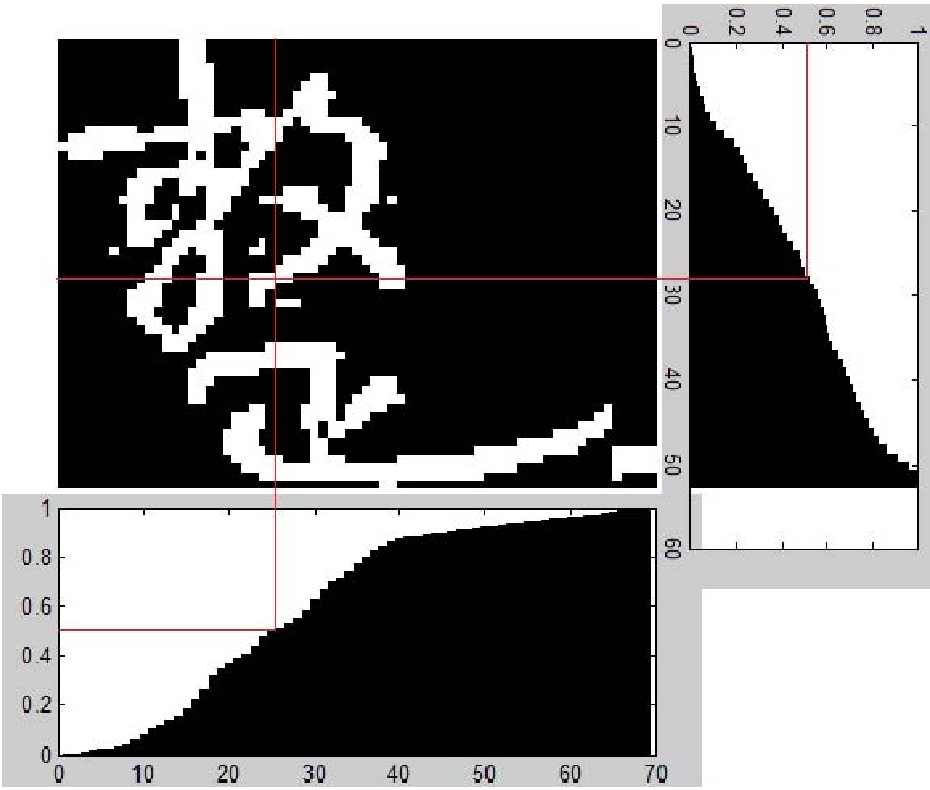 Fig 1. Elastic Meshing adapts to the character's ink distribution rather than using a rigid grid.
3. The Committee Decision
The final architecture is a "Committee of 25":
- 5 image versions (Global + 4 local regions).
- For each version, 5 networks are trained with different initializations.
- The final result is a weighted average based on each network's validation performance.
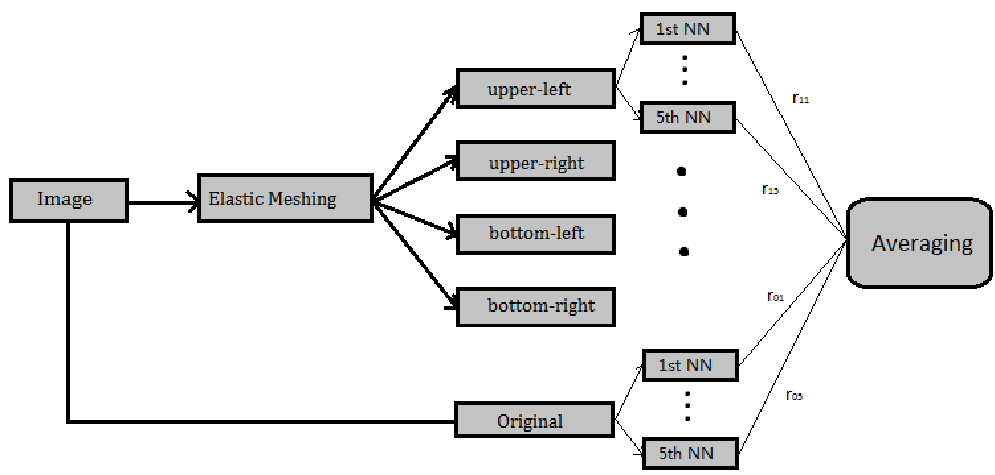 Fig 2. The 25-net decision ensemble.
Experiments & Results
The model was tested on a massive dataset of 69,967 real-world bank check samples.
Performance Comparison
The results show a clear "Deep Learning" advantage. While a single SAE net is comparable to traditional methods, the 25-net committee crushes the competition.
| Method | Error Rate (%) |
|---|---|
| Shape Context + KNN | 13.81 |
| HOG + SVM | 4.89 |
| CNN Committee | 2.58 |
| Char-SIFT + MQDF | 1.10 |
| This Paper (Committee SAE) | 0.64 |
Depth and Parameter Tuning
The authors found that "deeper isn't always better." Performance peaked at 2 hidden layers. Adding layers 3 through 5 actually increased the error rate, likely due to vanishing gradients or the limited size of the training set (approx. 52k training samples) failing to saturate larger models.
Critical Analysis & Conclusion
Why does it work?
- Inductive Bias: The elastic meshing provides a form of "attention" to local details (like the right-hand radicals) which are often the deciding factor in distinguishing similar Chinese characters.
- Robustness: By averaging 25 nets, the system ignores the "noise" or "confusion" of any single flawed network.
Limitations
Despite the high accuracy, the system still struggles with "blurred local areas" or "strange strokes" (see Fig. 3 list of failures). Furthermore, while 5,000 chars/sec is fast, the requirement to run 25 passes (or use parallel hardware) increases the computational footprint compared to a single optimized CNN.
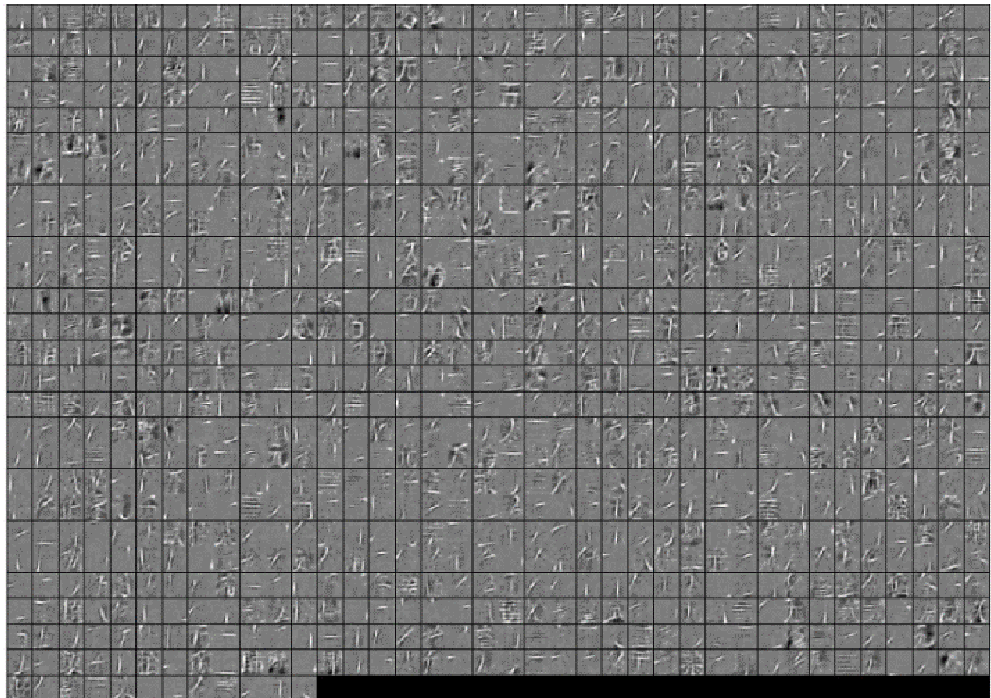 Fig 3. Examples of character instances that escaped the committee's logic.
Future Outlook
This work demonstrates that for domain-specific OCR (like finance), combining deep unsupervised pre-training with a structural understanding of the target language (meshing) is a winning formula. Future iterations could likely replace the SAEs with modern Vision Transformers (ViT) while keeping the "Committee of Regions" logic.