
NLMC: Decoding the Soul of Abstract Art via Non-Linear Matrix Completion
Recognizing Emotions from Abstract Paintings Using Non-Linear Matrix Completion
The paper introduces Non-Linear Matrix Completion (NLMC), a novel transductive multi-label framework designed to recognize emotions and techniques in abstract paintings. By extending classical matrix completion into the kernel space, the method achieves SOTA performance on the MART and devArt datasets, effectively handling the subjective and noisy nature of artistic annotations.
TL;DR
Can a machine feel the "internal truths" of a Kandinsky? This paper moves us closer by introducing Non-Linear Matrix Completion (NLMC). Unlike traditional linear models, NLMC leverages the power of kernels within a transductive framework to predict emotions and artistic techniques in abstract paintings, even when labels are sparse or noisy.
Context & Motivation: The Subjectivity Gap
Abstract art is a unique challenge for Computer Vision. Unlike object detection where a "cat is a cat," abstract art relies on non-figurative cues—color, texture, and shape—to elicit subjective emotions.
The authors identify three primary hurdles:
- Data Scarcity: Human annotation for emotions is time-consuming and inconsistent.
- Latent Interdependencies: Emotions are often correlated with the artist's technique or style (e.g., Oil vs. Lithography).
- Non-Linearity: The mapping from visual pixels to human "feeling" is rarely linear.
While Matrix Completion (MC) is a favorite for "filling in the blanks" (transductive learning), previous iterations were strictly linear. This paper breaks that barrier.
Methodology: Beyond the Linear Constraint
1. Feature Engineering: The "Itten" Logic
Instead of relying solely on generic CNN features (which the authors show are less effective for this specific task), they use features inspired by Johannes Itten’s color theory. This includes color co-occurrence and patch-based combinations that capture how colors interact within a composition.
2. The Non-Linear Extension
The core innovation is the mathematical leap from a finite feature matrix to an implicit feature space via the "Kernel Trick."
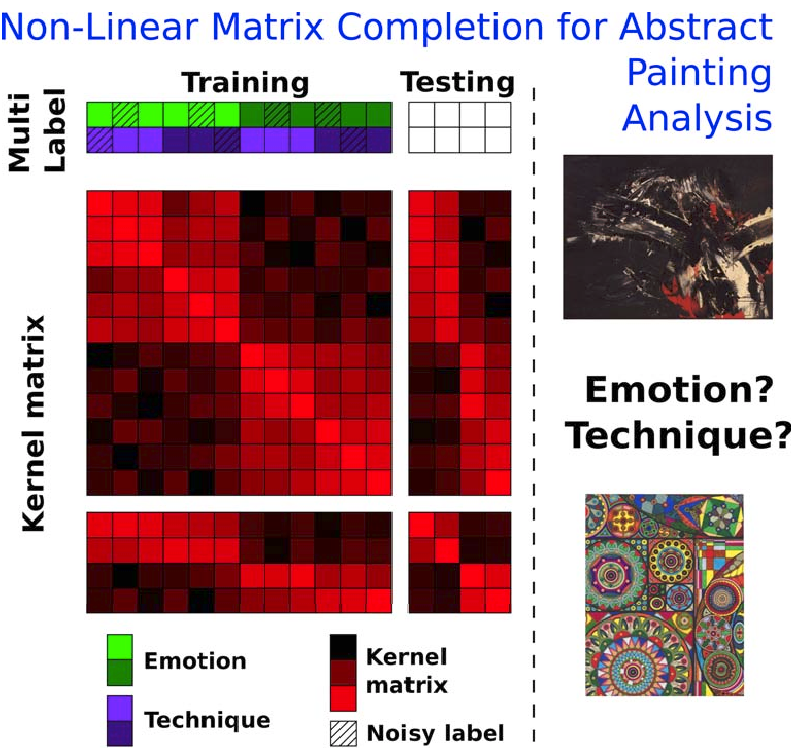 Figure: The NLMC framework estimates labels from the kernel matrix in a transductive setting.
The authors treat the joint label-feature matrix as a low-rank entity. By defining the rank and nuclear norm for matrices with an infinite number of rows (infinite-dimensional features), they prove that the optimization can still be solved using only the finite kernel matrix .
3. Solving the Optimization
The objective function balances:
- Label Fidelity: How well the predicted labels match known training labels.
- Feature Consistency: How well the low-rank structure identifies the visual manifold.
- Regularization: To prevent overfitting.
They utilize an interior-point algorithm to solve this, ensuring the method remains computationally competitive despite the added complexity of the non-linear kernel.
Empirical Evidence: Winning on "Emotion"
The method was tested on two critical datasets: MART (Professional Art) and devArt (Amateur Art).
SOTA Comparison
In terms of pure emotion recognition (Positive vs. Negative), NLMC consistently beat traditional Transductive SVMs and Linear Matrix Completion.
| Method | MART Accuracy (%) | devArt Accuracy (%) |
|---|---|---|
| Linear MC | 71.8 | 72.5 |
| Group Lasso | 70.5 | 72.1 |
| NLMC (Ours) | 72.8 | 76.1 |
Multi-label & One-shot Performance
One of the most impressive results is the One-Shot Learning test. When only a single sample per category (Emotion + Technique) was provided, NLMC maintained a significant edge over other transductive methods.
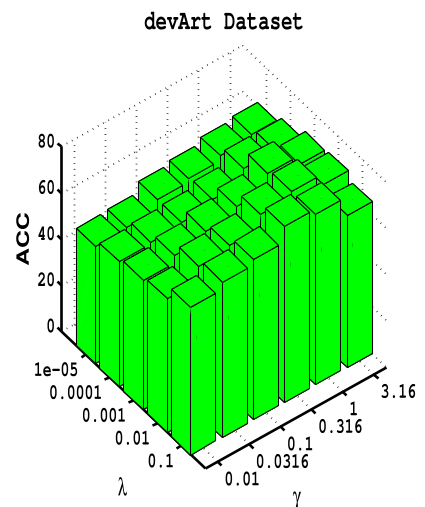 Figure: Accuracy remains robust even as training data size decreases.
Critical Insight & Conclusion
The success of NLMC lies in its Inductive Bias. By assuming that related paintings (in the kernel-defined feature space) should share similar multi-labels (emotions and techniques), the model effectively "transports" knowledge from a few annotated samples to the rest of the dataset.
Limitations:
- The method currently relies on handcrafted features. Integrating this with End-to-End Deep Kernel Learning could provide even more expressive power.
- Multi-modal integration (e.g., using the painting's title) is suggested as future work.
Takeaway: NLMC isn't just for art; it's a powerful framework for any domain where data is scarce, labels are multi-faceted, and the underlying relationships are non-linear.