
Decoding the Anonymous Author: Grammatical Gender Recognition in Russian Confessions
Recognizing Preferred Grammatical Gender in Russian Anonymous Online Confessions
The paper introduces a novel dataset and methodology for recognizing the Preferred Grammatical Gender (PGG) of authors in anonymous Russian online confessions. By leveraging syntax-aware models and a new "Bag-of-Arcs" approach with GBDT, the authors achieve a SOTA macro-F1 score of 0.773 on the complex task of self-reference gender detection.
TL;DR
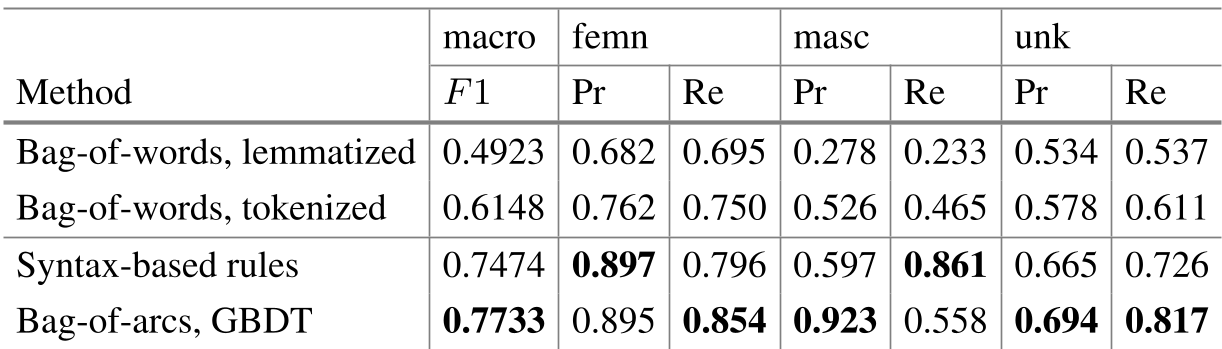
Researchers from the Samsung-PDMI Joint AI Center have tackled the elusive problem of identifying the "Preferred Grammatical Gender" (PGG) of anonymous posters in the Russian social network VKontakte. By moving beyond simple word-matching and utilizing dependency syntax trees, they developed a "Bag-of-Arcs" model that achieves an F1-score of 0.773, outperforming standard NLP baselines by focusing on how authors structurally refer to themselves.
The Challenge of Anonymity and Morphology
In the "Overheard" (Podslushano) community, users share intimate life stories anonymously. Without metadata like profiles or ages, the only clue to the author's identity lies in the text itself. In Russian, this is particularly interesting because verbs in the past tense and certain adjectives are gender-inflected.
However, the problem is deeper than it looks. A simple keyword search for "wife" (жена) might suggest a male author, but it doesn't prove the author uses masculine grammar for themselves. Previous SOTA methods often fell into this "semantic trap," confusing themes with grammatical self-identification.
Methodology: From Words to Arcs
The authors argue that syntax is the key. They compared three primary approaches:
- Bag-of-Words (BoW): The baseline, which unfortunately learns biases (e.g., associating the word "husband" with a female author label).
- Rule-Based Syntax: A manual algorithm that navigates dependency trees to find the "nsubj" (nominal subject) of gendered verbs.
- Bag-of-Arcs (BoA) + GBDT: The sophisticated winner. This model breaks down sentences into syntactic relationships (arcs).
Why Bag-of-Arcs (BoA) Works
Instead of looking at the word "arrived" in isolation, BoA looks at the relationship: (Subject: "I") -> (Verb: "arrived" [Feminine morphology]). By encoding these "arcs" into a multiset for a Gradient Boosted Decision Tree (LightGBM), the model learns the structure of self-reference rather than just the vocabulary of the confession.
Experimental Insights: Explaining the Bias
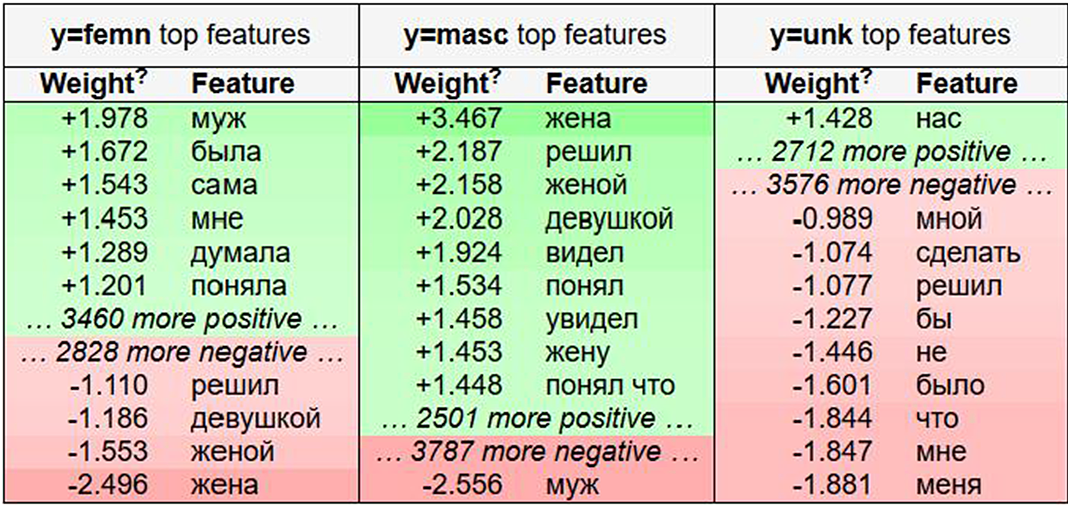
The researchers used ELI5 to visualize what the models were learning. The results were revealing:
- BoW models heavily weighted words like "husband" (муж) for the feminine label.
- Syntax-aware models ignored these topical distractions, focusing instead on the actual morphological agreement.
Critical Analysis & Conclusion
This paper highlights a critical lesson in NLP: Morphology matters. While large-scale Transformers often "brute force" understanding, for specific linguistic tasks like gender recognition in Slavic languages, explicit syntactic features remain incredibly powerful.
Limitations: The model currently struggles with the "masculine" class recall (0.558) and can be confused by "reported speech" (where an author quotes someone else's gendered reference to them).
Future Outlook: The "Bag-of-Arcs" approach presents a lightweight, interpretable alternative to massive LLMs for specialized author profiling tasks. Future work could integrate these syntactic constraints directly into neural architectures to create more linguistically-aware encoders.
Takeaway: When anonymity masks the person, the grammar reveals the self.