
Breaking the Silence: Recognizing Social Gestures with Minimalist Wearables
Recognizing social gestures with a wrist-worn smartband
This paper explores fine-grained social gesture recognition using a single wrist-worn smartband equipped with a tri-axial accelerometer. By applying a Logistic Regression model with L1 regularization to a dataset of 12 distinct social gestures performed by 32 participants, the study achieves a promising average classification accuracy of 86%.
TL;DR
In an era where social isolation is a growing public health risk, the ability for our devices to "understand" our social interactions is more critical than ever. Researchers from the University of North Carolina at Charlotte have demonstrated that a simple smartband—using just a single accelerometer—can identify 12 distinct social gestures (like high-fives and handshakes) with up to 92% accuracy using efficient Logistic Regression.
The Motivation: Beyond Steps and Heartbeats
Most smartbands excel at counting steps or monitoring sleep, but they are "socially blind." Prior research in Activity Recognition (AR) typically either:
- Required "Body Armor": Multiple sensors strapped to different limbs.
- Lacked Fidelity: Only recognized "macro" movements like running vs. standing.
The authors argue that if a wearable can distinguish a Fist Bump from a Handshake, it can power apps that encourage social behavior or serve as "social eyes" for the blind, translating non-verbal cues into haptic feedback.
Methodology: Efficiency Meets Precision
The choice of algorithm was driven by the computational constraints of wearable hardware. While Deep Learning is popular, the authors opted for Logistic Regression with LASSO (L1 regularization).
Why Logistic Regression?
- Memory Footprint: Unlike SVMs, which require storing support vectors, Logistic Regression only needs to store a few weights per class.
- Speed: Classification is a simple dot product operation, ideal for real-time processing on low-power ARM processors.
Data Acquisition and Feature Engineering
The team collected data from 32 participants using the Axivity AX3 Watch. They extracted two specific feature sets from 128-point windows:
- Time Domain: Mean, Std Dev, Skewness, Kurtosis, etc. (Low overhead).
- Frequency Domain: Signal Energy and the first 8 DFT coefficients (Captures periodic patterns like waving).
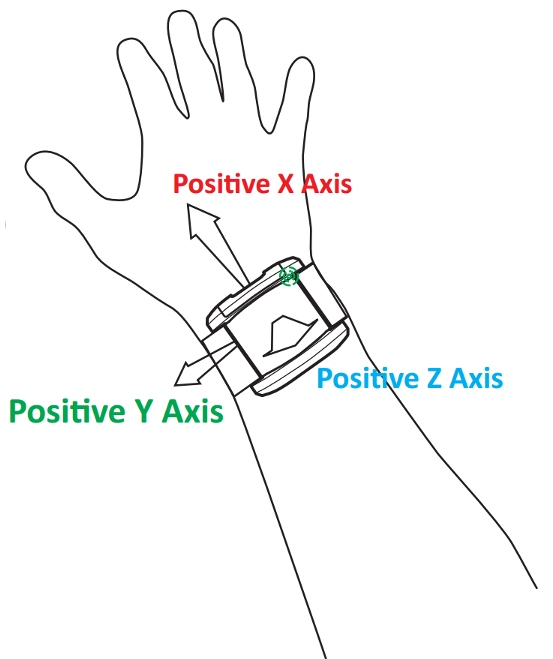 Figure: The AX3 sensor orientation and the gesture list utilized in the study.
Experimental Results: Fine-Grained Success
Using Leave-One-Subject-Out (LOSO) cross-validation—the gold standard for proving a model works on people it hasn't "met" before—the results were impressive.
| Feature Set | Accuracy |
|---|---|
| Time Domain Only | 83.7% |
| Frequency Domain Only | 74.2% |
| Combined (All Features) | 86.5% |
The "Pointing" Challenge
The model struggled slightly to distinguish between Pointing Left vs. Pointing Right. However, for many social apps, simply knowing the user is "pointing" is enough. By merging these into a single "Point" class, the overall accuracy jumped to 92.2%.
 (Note: Image placeholder for Table V and Confusion Matrix summary)
Critical Insights & Future Outlook
The Power of Simplicity: This paper is a masterclass in "appropriate technology." By choosing a linear classifier over a complex neural network, the authors proved that high accuracy doesn't always require massive compute—a vital lesson for the Edge AI community.
Limitations: The data was collected in a controlled laboratory setting ("scripted gestures"). As any researcher knows, "in the wild" data is messier. Real-world movement dynamics (like drinking coffee or typing) might trigger false positives for social gestures.
What's Next?: The next frontier is deploying this entire pipeline—from raw signal to classification—directly on a commercial smartwatch (like an Apple Watch or WearOS device) to see how it handles the "noise" of daily life. This work moves us one step closer to a world where our technology doesn't just track our fitness, but helps us stay connected to each other.
Senior Editor's Note: This research represents a significant pivot from "posture detection" toward "interaction detection," highlighting the shift in pervasive computing toward social-context awareness.