
SocLaKE: Boosting Knowledge Discovery Through Social Recommendation
Recommendation Boosted Query Propagation in the Social Network
The paper introduces SocLaKE (Social Latent Knowledge Explorator), a system designed to improve expert finding within organizations by propagating queries through social networks. It leverages an enhanced Social Query Model (SQM) that integrates recommendation strategies to optimize the path a query takes through a chain of acquaintances.
TL;DR
Finding the right expert in a large organization is more about social routing than simple database indexing. This paper introduces SocLaKE, a system that uses a Social Query Model (SQM) boosted by recommendation strategies to navigate the "latent knowledge" of an organization. The core finding? Recommending people based on their responsiveness (willingness to answer) is more effective than just recommending the top expert.
Background: The "Official Way" is Broken
In most companies, when you have a niche problem, you go to the help desk or search the intranet. This is the "official way," and it's often a dead end. The "unofficial way" is asking a friend. While humans naturally use their social networks, we are limited by our local knowledge—we don't know what our friend's friend knows.
SocLaKE aims to bridge this gap by turning the informal "ask a friend" process into a semi-automated, recommendation-driven system.
Methodology: Mathematically Modeling the "Ask a Friend" Chain
The authors build upon the Social Query Model (SQM). The probability of an asker finding an answer is defined recursively. It isn't just about whether knows the answer, but the sum of probabilities that their friends respond and either know the answer or pass it to someone else who does.
The Core Innovation: The Recommendation Influence
The researchers introduced a recommendation factor into the routing policy. They modified the traditional policy (the probability of asking person ) using a susceptibility coefficient :
This formula adjusts the "social path" based on the system's suggestions. If a user is highly susceptible (), they are more likely to follow the system's advice on who to ask next.
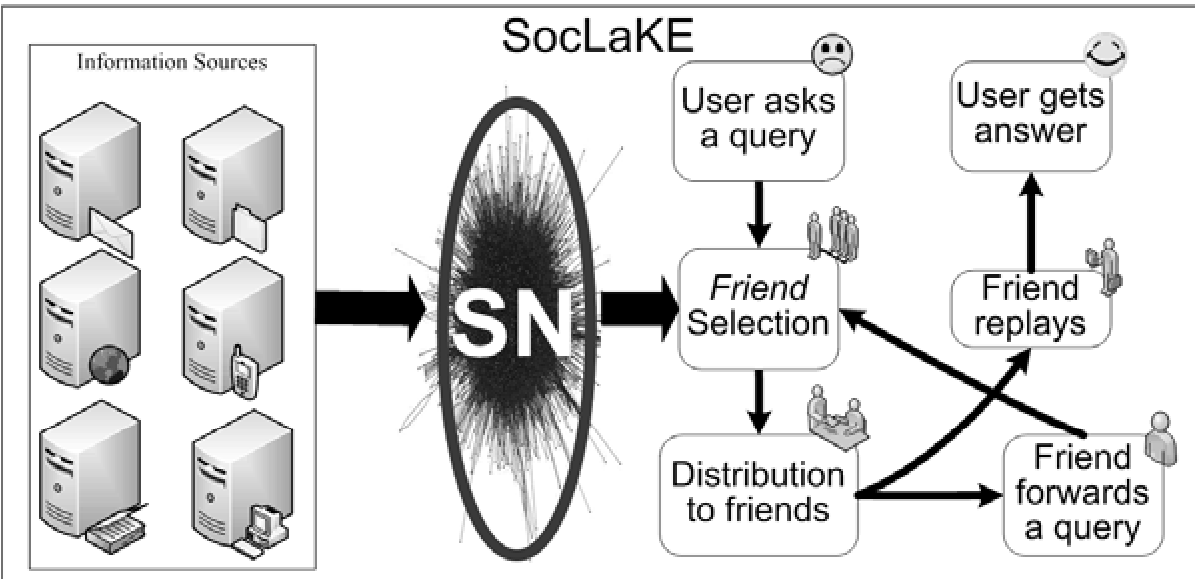 Figure 1: The SocLaKE conceptual framework integrating social network data and expertise extraction.
Experiments: Why the "Best Expert" Isn't Always the Best Choice
The authors tested several strategies, including:
- Expert Recommendation: Suggesting the person with the highest domain knowledge.
- Best Relation: Suggesting people with the strongest social ties.
- Best Answering: Suggesting people who are most likely to respond (high responsiveness ).
Key Findings
- The Power of Responsiveness: The "Best Answering" strategy (st=2) was the winner, yielding a 6.5% improvement in answer probability.
- The Expert Paradox: Pure "Expert" strategies performed poorly. Why? In a social network, an expert you don't know is a stranger, and strangers are less likely to react to your query than an acquaintance.
- Bad Recommendations Hurt: Some strategies (like recommending only one "best relation") actually performed worse than having no system at all, as they created bottlenecks in the network.
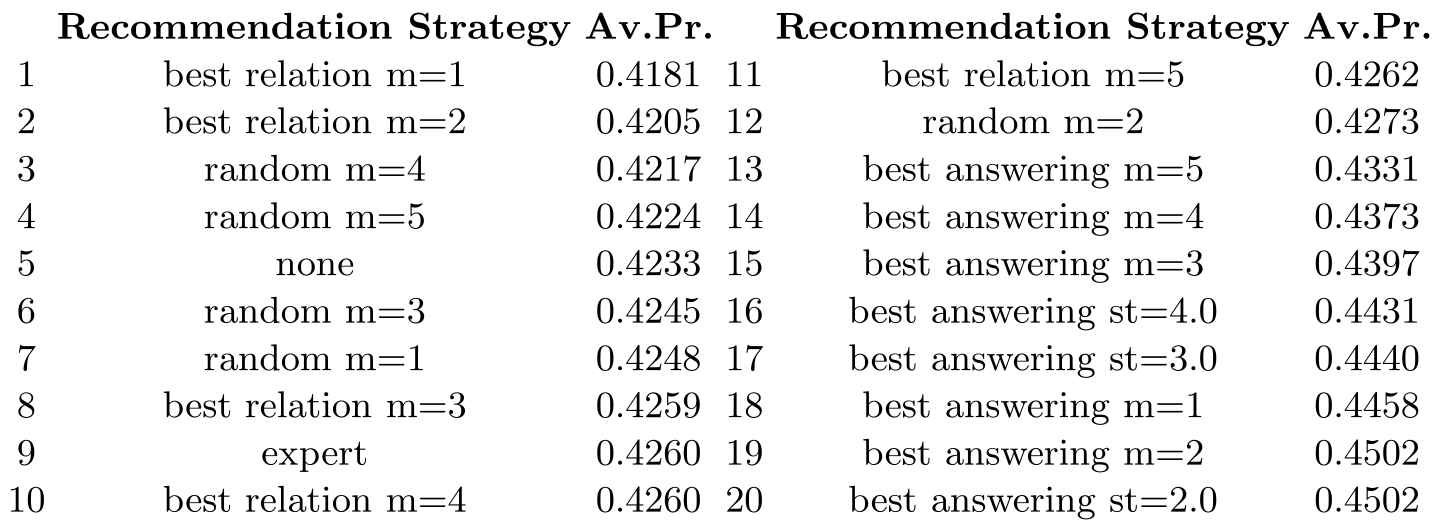 Table 1: Comparison of different recommendation strategies and their average probability of success.
Critical Analysis & Conclusion
SocLaKE provides a vital insight for modern Knowledge Management: Social Capital > Information Capital.
Takeaways for the Future
- Responsiveness is King: When building an expert-finding tool, don't just look for PhDs or high-ranking titles; look for "helpful" nodes who act as bridges.
- Transparency and Privacy: The authors admit that "sniffing" emails and phone logs to build these networks raises massive privacy concerns. Future iterations would need to use opt-in data or differential privacy.
- Load Balancing: One risk of the "Best Answering" strategy is that helpful people might get "spammed" by the system, eventually lowering their responsiveness—a phenomenon known as "collaborative overload."
Ultimately, SocLaKE demonstrates that mathematical models can capture the nuance of human social behavior to unlock the "latent knowledge" hidden within corporate silos.