
Beyond Swiping: Decoding the Mathematics of Mutual Attraction in Online Dating
Recommendation in Reciprocal and Bipartite Social Networks–A Case Study of Online Dating
This paper proposes a novel Collaborative Filtering (CF) framework for bipartite social networks characterized by reciprocity, such as online dating. By introducing a "Hybrid Model" that explicitly factors in both a user's "taste" (who they pick) and "attractiveness" (who picks them), the system significantly enhances the success rate of reciprocal connections.
TL;DR
In the world of online dating, it's not enough to find someone you like; they have to like you back. This paper tackles the "reciprocity problem" in bipartite social networks (networks with two distinct groups, like Men and Women). The researchers moved beyond traditional recommendation algorithms to create a Hybrid Collaborative Filtering model that treats "Taste" and "Attractiveness" as two sides of the same coin, increasing successful matches by over 17%.
The Problem: Why Traditional Recommenders Fail at Dating
Standard Collaborative Filtering (CF)—the tech behind Amazon and Netflix—treats people like movies. In those systems, "items" are passive. If you like Inception, the system recommends Interstellar.
However, in a reciprocal bipartite network, the "item" is another autonomous person. This presents two unique challenges:
- Bipartite Constraints: In heterosexual dating networks, edges only exist between different types (Male Female). Common neighbor algorithms meant for Facebook (where friends of friends become friends) break down here.
- The Reciprocity Barrier: An initial contact is only successful if it's returned. Traditional CF only models what you want (Taste), ignoring whether you are what the other person wants (Attractiveness).
Methodology: Taste meets Attractiveness
The core insight of this paper is that every interaction in a dating network contains two bits of information. The authors represent the contact matrix not with simple 1s and 0s, but with 1×2 vectors .
1. The Similarity Score
Instead of just looking for users who messaged the same people, the authors' custom similarity function calculates how much two users overlap in:
- Who they are interested in.
- Who is interested in them.
- Who rejects them (critical for defining "league" or niche attractiveness).
2. The Success Score with Penalty Factor
To rank potential partners, the model uses a success score that includes a penalty factor .
- If a potential partner matches both your taste and is likely to find you attractive, they get a high score.
- If there is only a unilateral match (you like them, but they probably won't respond), the penalty factor lowers their rank.
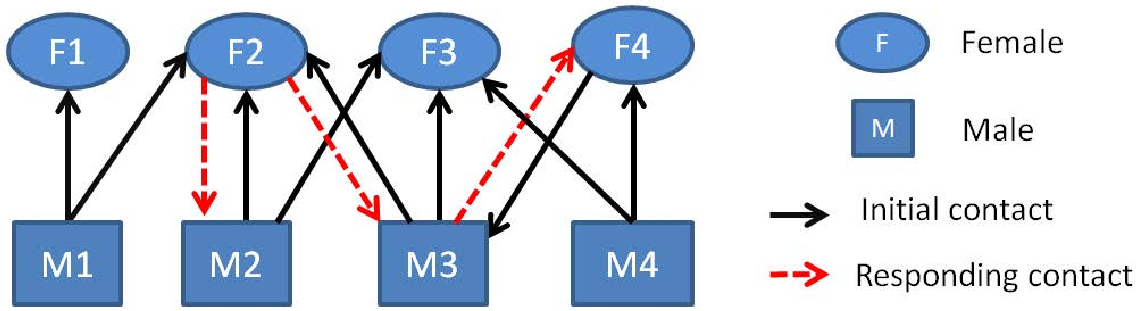 Figure 1: Visualizing the contact network and the flow from initial contact to reciprocal response.
Experiments: Proving the Hybrid Advantage
The researchers tested their model against a dataset of 15,131 users from a U.S. dating site. They compared three models:
- Baseline CF: Focuses only on initial contacts (Taste).
- Reciprocity-Only: Only looks at successful matches (loses too much data).
- Hybrid Model: The proposed approach.
Key Findings
- Reciprocity Gains: The Hybrid model outperformed the baseline by 17.41% in RC Precision—meaning users were much more likely to actually get a reply from the people recommended.
- Information Preservation: Unlike the Reciprocity-only model, the Hybrid model still performed well on "Initial Contact" metrics because it didn't throw away the data from unrequited interests.
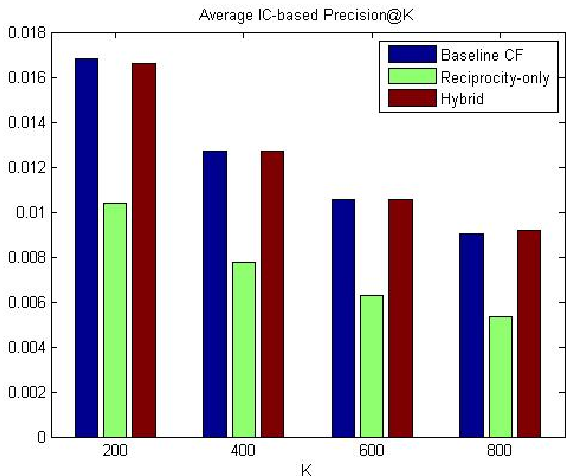 Figure 2: The Hybrid model (blue line) consistently dominates across different 'K' values in both Recall and Precision.
Critical Insight & Future Outlook
The beauty of this research lies in its handling of negative signals. In many recommendation tasks, a non-interaction is ignored. Here, an unresponded message is a data point: it defines the boundaries of a user's "Attractiveness."
Limitations: The model assumes users stay in the system. As the authors note, the greatest challenge for a dating recommender is its own success—if the system works perfectly, the user finds a partner and leaves the platform, becoming an "inactive" node.
Broader Impact: While this study focused on dating, the logic applies to any marketplace where both sides must say "Yes," such as College Admissions or Job Recruitment. In those fields, recommending a candidate who is "out of reach" for a company (or vice versa) is a waste of resources; modeling mutual attractiveness is the key to efficiency.
Takeaway
Success in reciprocal social networks isn't just about finding what you like; it’s about finding where your Taste meets the world's Attractiveness perception of you.