
PRM: Harmonizing Personal Interest and Social Context in Recommender Systems
8810_Recommendation via user's personality and social contextual.
The paper proposes a Personalized Recommendation Model (PRM) that integrates user personal interest, interpersonal interest similarity, and interpersonal influence into a unified Probabilistic Matrix Factorization (PMF) framework. It specifically addresses the balance between social context for new users and individuality for experienced users, achieving significant performance gains on the Yelp dataset.
TL;DR
Recommendations often face a tug-of-war between what you like and what your friends like. The Personalized Recommendation Model (PRM) presented in this paper solves this by integrating personal interest, interpersonal similarity, and social influence into a single Probabilistic Matrix Factorization (PMF) framework. By adjusting the weight of personal traits based on user experience, the model consistently outperforms traditional social recommendation baselines.
Background: The Limits of Social Influence
First-generation recommender systems relied heavily on Collaborative Filtering (CF). However, as platforms grew, the "Cold Start" problem (new users with no history) and "Data Sparsity" (unrated items) became major bottlenecks. Social-based recommendation emerged as a solution, using friend networks as a proxy for interest.
But there is a catch: experienced users have distinct personalities. If a system relies too much on what a user's friends like, it might ignore the user's specific tastes matured over years of activity. The authors of this paper argue that a truly "Personalized" system must account for both social context and individual personality.
Methodology: The Three Pillars of PRM
The core of PRM lies in a unified objective function that regularizes latent features using three distinct social factors:
- User Personal Interest (): This represents the direct relevance between a user’s interest and an item’s topic. Topics are derived from item categories (e.g., "Restaurants," "Nightlife").
- Interpersonal Influence (): Reflects who you trust within your social circle.
- Interpersonal Interest Similarity (): Reflects whose interests align closest with yours, regardless of direct trust.
Architecture and Objective Function
The model extends Probabilistic Matrix Factorization (PMF) by adding regularization terms for each social factor. This ensures that a user’s latent feature vector is not only close to their friends' vectors but also aligns with the items they naturally gravitate toward.
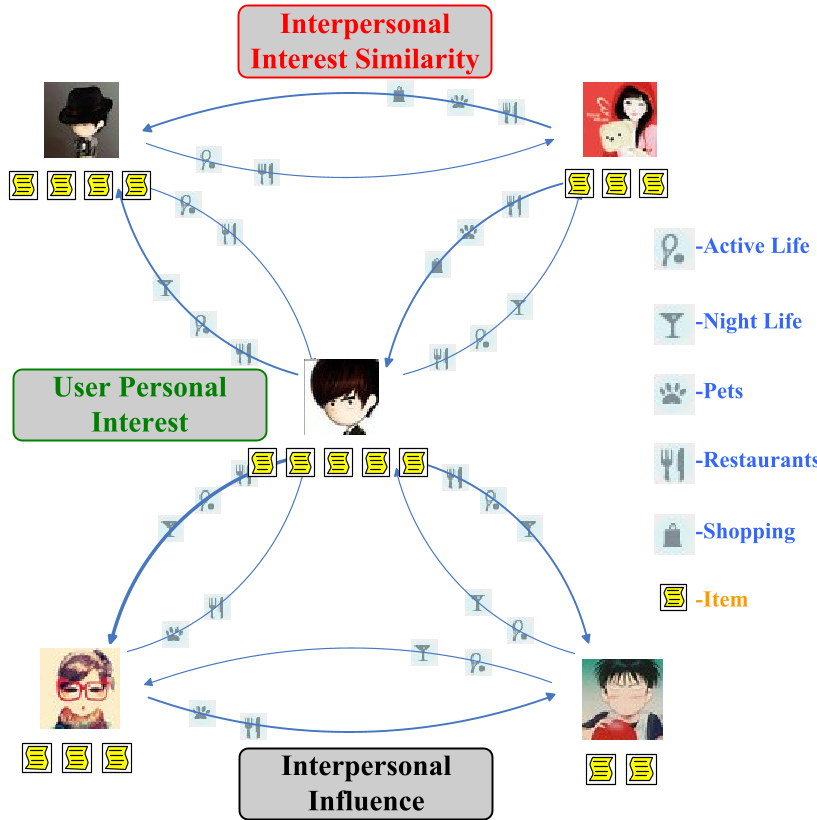 Figure 1: Illustration of the three social factors: Personal Interest, Interest Similarity, and Interpersonal Influence.
The objective function is minimized through gradient descent, allowing the model to learn latent profiles for both users () and items ().
Experimental Results
The authors validated PRM on a massive Yelp dataset containing over 10,000 users and 1.7 million items. They compared PRM against BaseMF, CircleCon, and ContextMF.
Key Numerical Findings:
- Average MAE Improvement: PRM achieved an average Mean Absolute Error (MAE) of 1.079, significantly lower than BaseMF (2.144) and outperforming the strong ContextMF baseline (1.137).
- Robustness across user types: As shown in the performance breakdown, PRM remains superior for "experienced users" (those with 40+ ratings), proving that its "Personal Interest" factor successfully captures individuality where other social models fail.
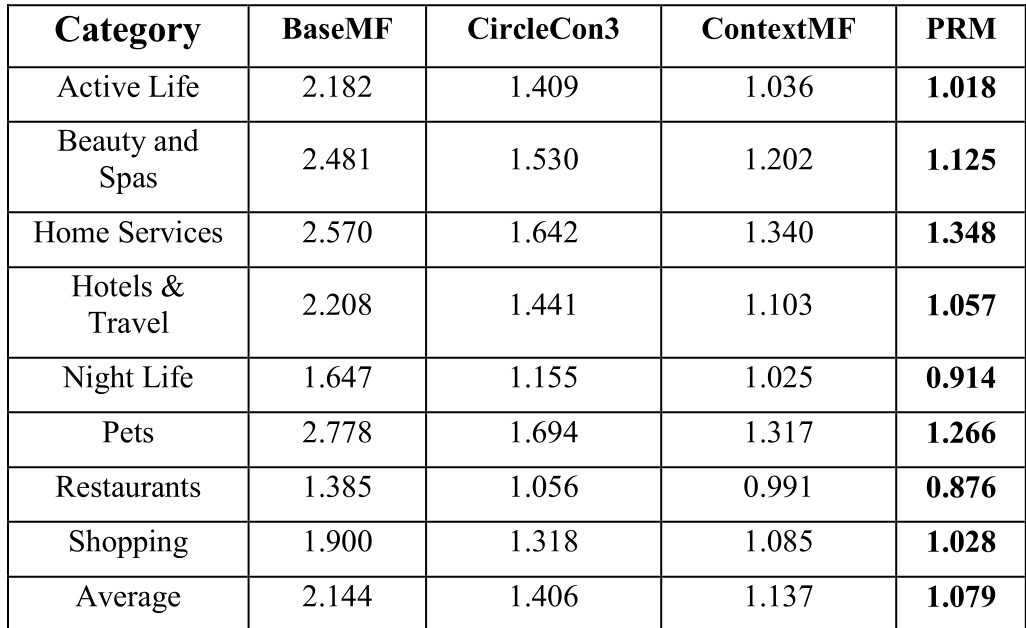 Table 1: Performance comparison across different Yelp categories. PRM shows the lowest MAE in almost all categories.
Critical Insight: Why it Works
The "Secret Sauce" is the variable , the normalized number of items a user has rated. In the objective function, this term weights the Personal Interest component. For an expert user with a high , the model prioritizes their own historical patterns. For a novice user with a low , the model leans more on social influence and similarity to fill the gaps. This adaptive nature makes the system both flexible and precise.
Conclusion and Future Outlook
PRM demonstrates that individuality and social context are not mutually exclusive but are two ends of a spectrum defined by user experience. While this 2013 work laid a foundational stone for hybrid social-matrix factorization, future iterations—as suggested by the authors—now look toward incorporating location-based (LBSN) data and Real-time Context to further refine the "Personality" of the recommendation.
Takeaway for Practitioners: When building recommendation engines, don't just "average" your friends' preferences; weight the user's specific category-affinity more heavily as their interaction count grows.