
Upsaily: Leveraging Collective Intelligence for Advanced Customer Segmentation in E-Commerce
Recommendations Based on Collective Intelligence – Case of Customer Segmentation
The paper introduces "Upsaily," a hybrid recommendation system for e-commerce that utilizes collective clustering for customer segmentation. By integrating multiple algorithms like k-means, GMM, and DBSCAN through a unification process involving RFM (Recency, Frequency, Monetary) analysis, the system achieves a semantically rich and business-oriented classification of customer loyalty and value.
TL;DR
Customer segmentation is the bedrock of personalized marketing, yet relying on a single algorithm often leads to a "one-size-fits-all" failure. This paper presents Upsaily, a system that employs Collective Clustering—a method that synthesizes insights from k-means, GMM, and DBSCAN. By merging mathematical density with human expertise (RFM analysis), it creates hyper-specific segments that significantly improve the semantic value of e-commerce recommendations.
Background: Beyond Simple "Others Also Bought"
Modern recommendation systems have evolved past simple collaborative filtering. The challenge today lies in Customer Intelligence: transforming transactional logs into a clear psychological and behavioral image of the buyer. The stakes are high: in many Polish online stores, over 75% of customers are one-off visitors. Converting these into loyal, repeat buyers requires an analytical depth that standard k-means clustering—often biased by Euclidean distance—simply cannot provide.
The Problem: The Limitations of Single-Algorithm Paradigms
Standard clustering techniques have inherent inductive biases:
- k-means: Heavily influenced by variables with the largest numerical ranges, often ignoring subtle but vital dimensions.
- GMM (Gaussian Mixture Model): Excellent for finding outliers but can produce segments too small to justify a marketing campaign.
- DBSCAN: Great for density-based grouping but often leaves a significant portion of the population "unassigned."
The authors argue that no single algorithm is "perfect." Instead, we need a Collective Approach where the discrepancies between these algorithms are unified into a cohesive business strategy.
Methodology: The Science of Unification
The Upsaily system architecture integrates transactional data with social and geo-location insights. The "secret sauce" is the Unification Process:
- Cluster Identification: Using the C4.5 Inductive Decision Tree algorithm to define clusters through symbolic rules (e.g., "If Recency < 30 days AND Orders > 5").
- Similarity Mapping: Calculating the intersection and semantic overlap between clusters from different algorithms using similarity matrices.
- Expert Intervention: Marketing analysts apply Must-Link and Cannot-Link constraints, visually narrowing down the cluster boundaries to align with economic reality.
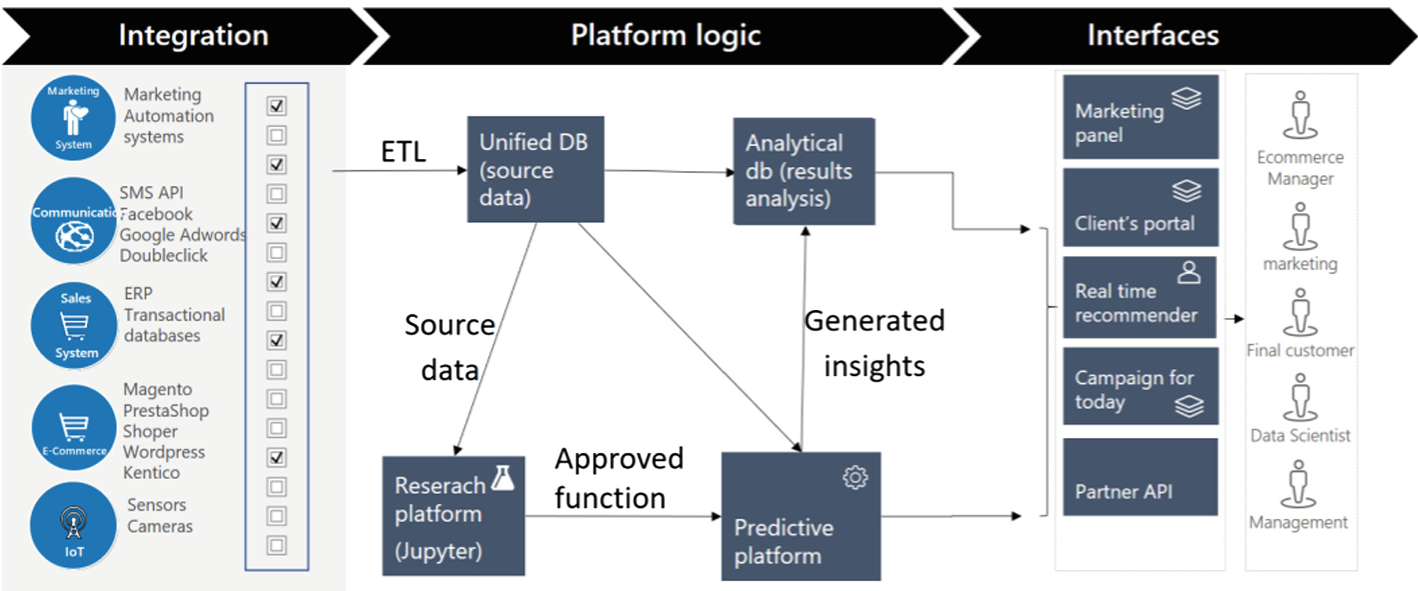 The Upsaily Functional Architecture: Merging Transactional Data with Collective Clustering Experts.
Experiments & Results: Quantitative Precision
The researchers tested their approach on 56,237 customers. To visualize the 4D RFM space (Recency, Frequency, Monetary, Order Count), they utilized UMAP (Uniform Manifold Approximation and Projection), which preserves the local and global structure of the data better than traditional PCA.
The "Collective" result produced 52 initial segments. While too many for a human to manage manually, these segments provided the raw material for highly precise automated recommendation engines. When merging clusters using domain knowledge, the Davies-Bouldin Index (a measure of cluster quality) saw a drastic improvement:
- Bisecting k-means only: 9489.7
- GMM only: 14445.7
- Unified Final Cluster (Cf): 4007.6
A lower score indicates tighter, more distinct clusters—proving that the collective approach is mathematically superior to its constituent parts.
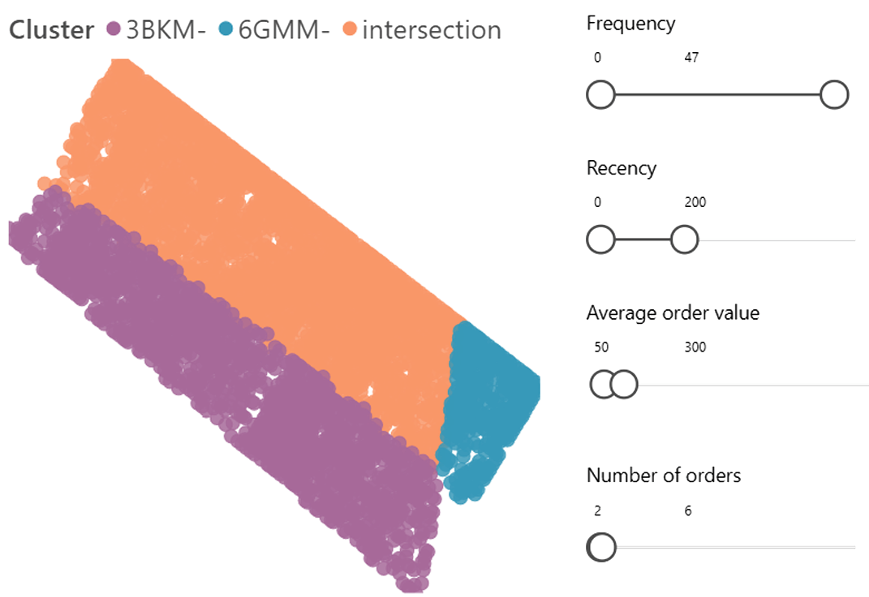 Comparative Visualization: Individual algorithm clusters vs. the Unified Final Cluster.
Critical Insight & Conclusion
The true value of this paper isn't just in the algorithms—it's in the Unification Policy. By treating data mining as a "collective of experts" and providing a "human-in-the-loop" interface (using sliders for boundary adjustments), Upsaily bridges the gap between abstract data science and pragmatic marketing.
Limitations: The primary drawback is the computational overhead of running multiple algorithms in parallel and the reliance on semi-manual unification for high-level strategy. Future work aims to automate the "optimal cluster number" identification to further reduce the burden on marketing analysts.
Final Takeaway: For e-commerce leaders, the message is clear: don't trust a single model. The future of customer loyalty lies in the consensus of collective algorithms directed by human business intent.