
Deciphering Digital Choice: A Triple-Influence Approach to Social Media Recommendations
Recommendations Based on Different Aspects of Influences in Social Media
This paper proposes a multi-faceted recommendation framework for social media (specifically Flickr) that integrates social, interest, and popularity influences. By applying personalized weights to these three factors based on individual user tendencies, the system predicts preference scores to suggest photos with high relevance.
TL;DR
This paper introduces a sophisticated recommendation engine that moves beyond simple collaborative filtering. By analyzing Social, Interest, and Popularity influences, the authors assign personalized "tendency weights" to each user, allowing the system to understand whether a user is a trend-follower, a social-conformist, or interest-driven. Tested on Flickr, this holistic approach significantly boosts recommendation accuracy.
The Motivation: Why Do We "Like" What We Like?
Current recommender systems often suffer from a "one-size-fits-all" logic. However, human decision-making in social media is nuanced. You might "Favorite" a photo because:
- Social Connection: Your best friend uploaded it or liked it.
- Personal Interest: You have a niche passion for "Macro Photography," regardless of who took the photo.
- Popularity: The photo is trending globally, and you don't want to miss out.
The authors argue that the "Information Overload" on platforms like Flickr cannot be solved by looking at these in isolation. The core challenge is that influence is subjective: one user might care deeply about their friends' opinions, while another might only care about global trends.
Methodology: The SIP Framework
The paper proposes the SIP (Social, Interest, Popularity) model. The architecture is built on three pillars:
1. Social Influence Calculation
Instead of just checking if two users are friends, the authors calculate influence from two perspectives: the Influencer (how many people they affect) and the Influenced (how easily they follow others). They also account for Social Influence Propagation, allowing the system to suggest items liked by "friends of friends" through a recursive scoring mechanism.
 Equation 8: The final prediction score combining Social (SI), Interest (II), and Popularity (PI) weights.
2. Personalized Weights (The "Secret Sauce")
This is the most critical innovation. The system calculates a Weight of Influence () for each factor per user. If 80% of your past favorites were photos your friends liked first, your (Social Weight) will be high. This ensures the recommendation engine adapts to your specific decision-making persona.
3. Temporal Awareness
The model doesn't treat all data equally. It incorporates a timefactor(i), ensuring that recent interactions carry more weight than those from years ago, effectively capturing shifting trends and interests.
Experimental Evidence
The authors utilized a massive Flickr dataset involving 2 million photos to validate their hypothesis.
Key Findings:
- Synergy Wins: Combining all three influences (SIP-IF) yielded the highest F1-measure compared to individual components.
- Social vs. Interest: Social influence (S-IF) generally performed better than Interest influence (I-IF) alone on the Flickr dataset, indicating the high impact of community ties on the platform.
- Weight Accuracy: Applying personalized tendency weights resulted in noticeably higher precision than using static or uniform weights.
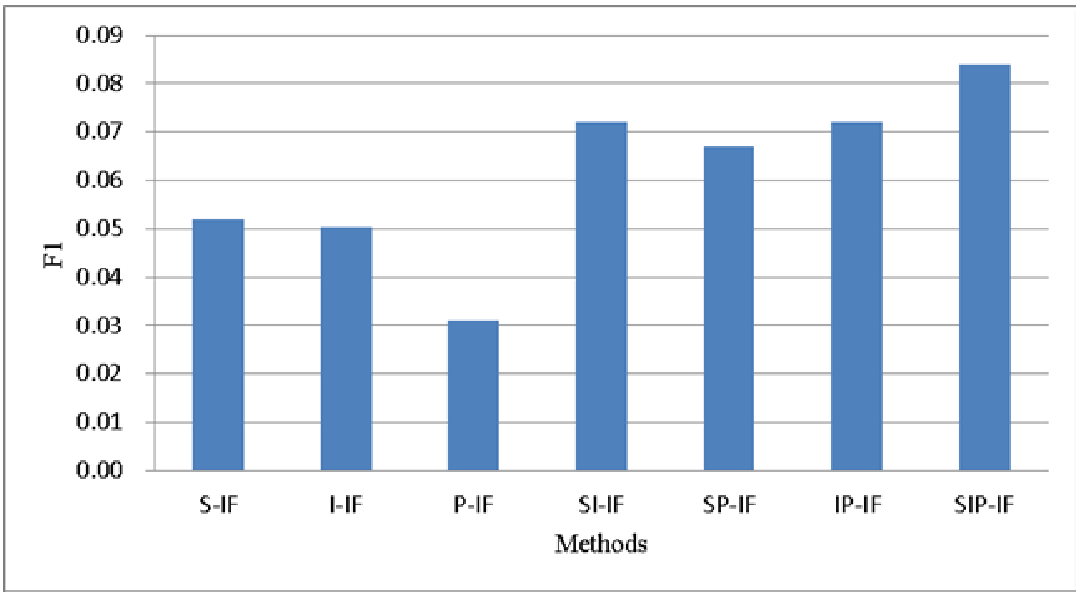 Fig 1: Comparison of different variations. SIP-IF (combining all) provides the best performance.
Critical Analysis & Future Outlook
The strength of this work lies in its psychological grounding—acknowledging that users are not monolithic entities but are driven by different social and cognitive biases.
Limitations:
- Cold Start: The model relies on historical "Favorite" data to calculate weights. New users without a history would likely see a default or "popularity-heavy" recommendation.
- Computational Complexity: Calculating propagation scores across a social graph of 90,000+ users is computationally expensive for real-time systems.
Takeaway for Practitioners: If you are building a recommendation engine, don't just optimize for content similarity. Start tracking user susceptibility. Knowing why a user engages is just as important as knowing what they engage with.