
Beyond the Matrix: Why Your Friends Are Better Algorithms Than Collaborative Filtering
Recommendations in Taste Related Domains: Collaborative Filtering vs. Social Filtering
The paper introduces and evaluates Social Filtering, a recommendation method that leverages explicit social network structures (friends and friends-of-friends) instead of rating similarities to generate neighborhoods. Using a dataset of Munich club ratings, the authors demonstrate that social filtering significantly outperforms traditional Collaborative Filtering (CF), particularly in high-sparsity scenarios.
TL;DR
This seminal research by Groh and Ehmig challenges the dominance of Collaborative Filtering (CF). By conducting an extensive empirical study on Munich's nightlife scene, they prove that Social Filtering—using your real-world friends to generate recommendations—consistently beats statistical "rating neighbors" in accuracy, especially when data is scarce.
The Problem: The Mathematical "Cold-Start"
Most recommender systems today are "black boxes." They use Collaborative Filtering to find users who rated items similarly to you. However, this method has a fatal flaw: The Sparsity Problem.
If you haven't rated many items, the system can't find your "twins." In these "cold-start" scenarios, CF breaks down, producing inaccurate or repetitive results. Furthermore, CF lacks transparency—you don't know why the machine suggested that obscure jazz club.
The Insight: Cliques as Centers of Taste
The authors hypothesized that social relations (friendships) are not random; they are governed by Homophily—the tendency of individuals to associate with similar others.
They mathematically modeled social groups as cliques (subgraphs where every member is connected). Their first experiment proved a strong correlation: the larger the clique (2-member pairs up to 4-member groups), the more similar their tastes in clubs became.
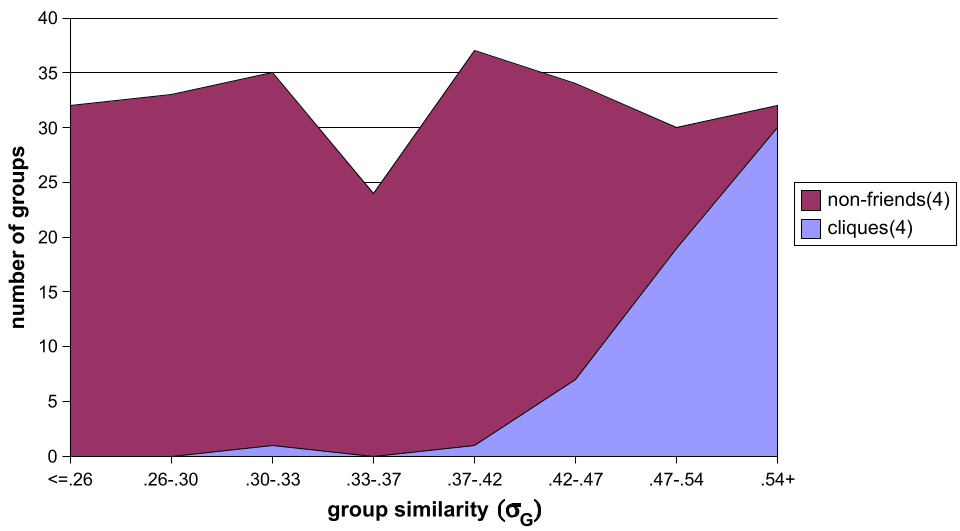 Figure 1: Comparison of rating similarity between friend-cliques and random groups. As clique size increases, the taste similarity significantly tightives.
Methodology: Social vs. Collaborative Filtering
The researchers compared two primary architectures:
- Collaborative Filtering (CF): Neighborhoods are built using Pearson Correlation or Cosine Similarity of ratings.
- Social Filtering: Neighborhoods () are defined as .
They tested these against varying levels of "sparseness" (from 1,000 to 25,000 ratings) to see which model survived the "data desert."
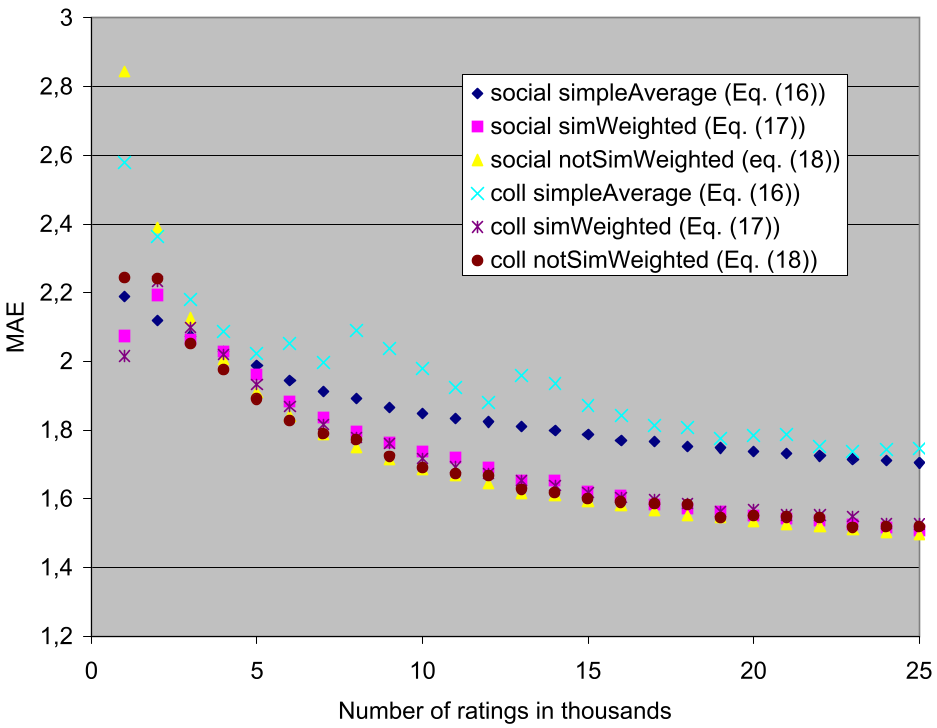 Figure 2: Mean Absolute Error (MAE) trends. Social approaches maintain lower error rates across different training set sizes.
Key Results: Social Filtering Dominates
The experimental results were striking:
- Accuracy: Social approaches yielded higher F-measures and lower Mean Absolute Error (MAE) than the best-tuned CF models.
- The Sparsity Resellience: In cases with very few ratings, social simple averaging was the clear winner.
- Novelty: Social filtering produced a higher number of "novel" predictions (recommending items the user didn't know yet) compared to CF, which tended to shrink its neighborhood to maintain accuracy.
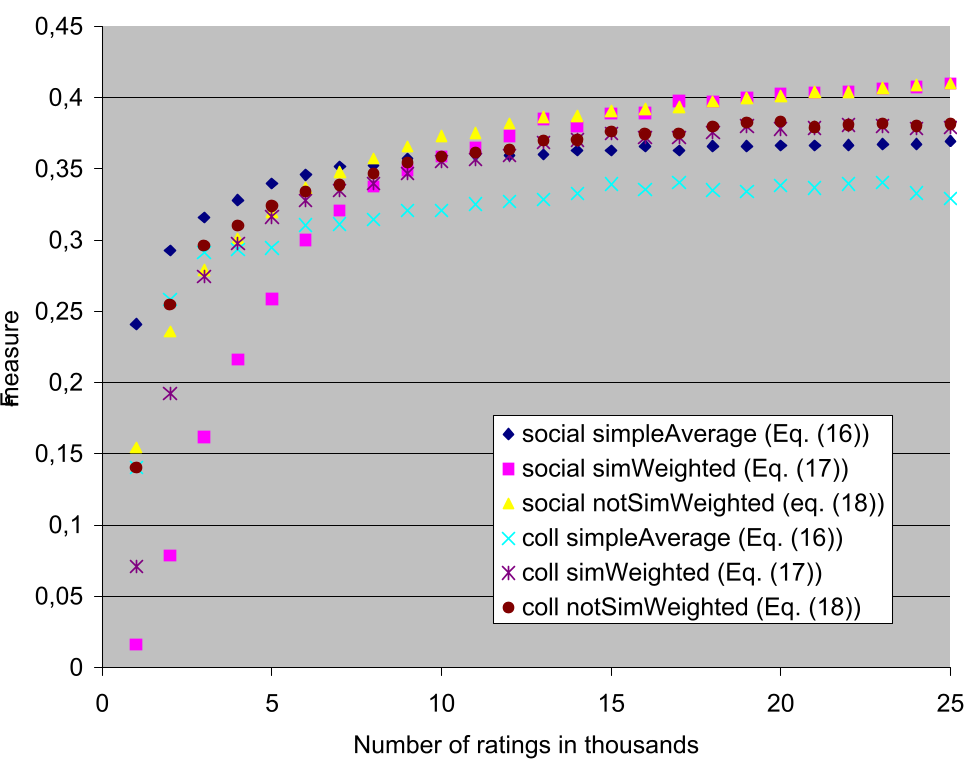 Figure 3: F-measure values showing Social Filtering consistently outperforming Collaborative Filtering variants.
Critical Insight: The "Horizon-Broadening" Effect
One of the most profound conclusions of the paper is the normative influence of groups. While CF tries to predict what you already like, Social Filtering introduces you to what your group likes. This provides "horizon-broadening" recommendations—things you might not have searched for yourself but will appreciate because of the social context and trust you place in your peers.
Conclusion
Groh and Ehmig demonstrate that in "taste-related" domains (nightlife, style, arts), the social graph is a more powerful predictor than the rating matrix. For future developers, the message is clear: if you want to beat the cold-start problem and build trust, stop look at the math alone and start looking at the social map.
Limitations: The study focuses on taste-based domains. It remains to be seen if social filtering is as effective for "utilitarian" products (like batteries or office supplies) where social influence is lower.