
Cloud-EMR Recommender: Bridging the Digital Divide in Regional Healthcare
The recommender system for a cloud-based electronic medical record system for regional clinics and health centers in China
This paper introduces a recommender system integrated into a cloud-based Electronic Medical Record (EMR) platform specifically designed for regional clinics in China. It utilizes the Apriori algorithm and Jaccard Index to provide two core functionalities: drug inventory optimization and auxiliary diagnostic decision support.
Executive Summary
In the landscape of Chinese healthcare, regional clinics and health centers account for a staggering 94% of providers, yet they remain the "last mile" of digital transformation. This paper presents a Cloud-Based EMR Recommender System that leverages centralized data to solve two critical pain points: Pharmacy Inventory Optimization and Auxiliary Diagnostic Support. By transitioning from isolated paper records to a cloud-integrated data pool, the system enables regional doctors to benefit from "collective intelligence," achieving SOTA-level efficiency for small-scale clinical settings.
The "Data Island" Problem
Traditional EMR systems are often a luxury of first-class comprehensive hospitals. For regional clinics, the barriers are twofold:
- Economic Barrier: High maintenance costs of localized IT infrastructure.
- Information Asymmetry: Data for patients cannot be exchanged, making it impossible to perform "Big Data" analysis on disease trends or drug efficacy across different regions.
The authors argue that a cloud-based approach doesn't just lower costs—it fundamentally changes the nature of the data from a "collection of islands" into a "unified ocean" ripe for mining.
Methodology: The recommendation Engine
The paper proposes two distinct mechanisms to assist clinicians and administrators.
1. Drug Recommendation (Association Rules)
To optimize pharmacy stocks, the system calculates an expectation value (E) for medicines. This isn't just a simple count; it factors in the relevance of a drug to specific diseases across multiple institutions, weighted by the prevalence of those diseases.
The Core Formula:
 Where represents the confidence of the association between a disease and a drug, and represents the disease prevalence.
2. Auxiliary Diagnosis (Jaccard Similarity)
For diagnosis, the system uses the Jaccard Index to quantify the similarity between a patient's current symptoms and known disease profiles.
- Logic: If a patient presents symptoms , the system traverses the database to find the disease with the highest overlap of clinical markers.
- Self-Correction: Interestingly, the system includes a threshold mechanism. If a specific symptom-disease correlation appears frequently (over 30%), the system updates its internal parameters to refine future recommendations.
Experimental Validation
The researchers conducted two primary experiments to test these engines.
Experiment 1: Inventory Ranking
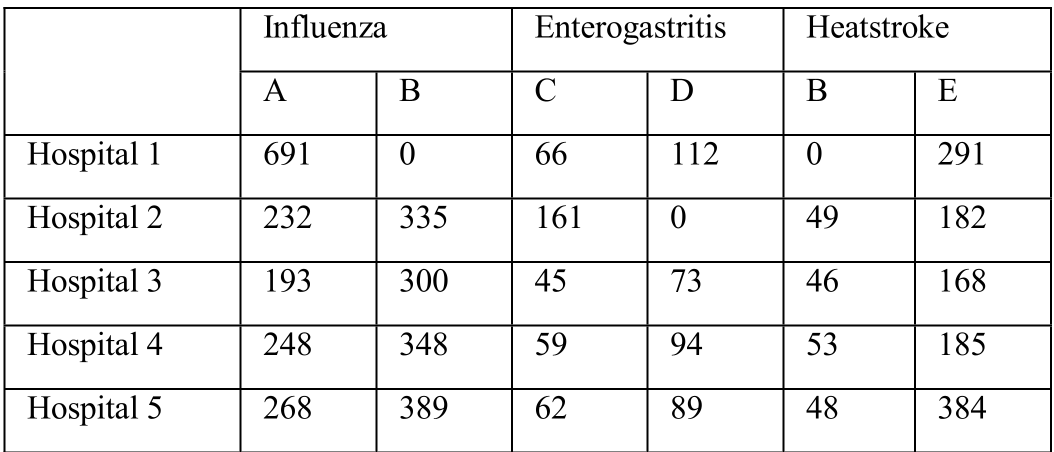
By simulating 5,000 disease records across five hospitals (with varying stock levels), the system was tasked with ranking drugs from most to least "needed."
- Key Finding: Small sample sizes initially caused noise (e.g., swapping ranks of Drug C and D).
- The Big Data Effect: Once the sample size increased, the recommendation ranking aligned perfectly with the ground truth (B > A > E > D > C), proving that the cloud's "aggregated data" mitigates the impact of extreme local variations.
Experiment 2: Diagnostic Accuracy
Using symptoms like Fever, Cough, and Expectoration, the system compared "Upper Respiratory Infection" vs. "Pneumonia."
- Result: The Jaccard Index clearly distinguished the two, successfully recommending the correct path even with overlapping symptoms.

Critical Insight & Future Outlook
While the algorithms used (Apriori and Jaccard) are mathematically "classic," their application in a Cloud-EMR context for regional China is highly pragmatic.
Takeaways for the Industry:
- Scalability: The authors acknowledge that as data grows, standard algorithms will hit a performance ceiling. The next frontier is moving toward Big Data optimized algorithms (like Spark-based ML) to handle real-time processing.
- The Human-in-the-loop: The system is designed as "auxiliary," meaning it supports rather than replaces the physician. The inclusion of the "30% probability threshold" for updating disease profiles shows a clever way to handle evolving medical knowledge.
- Mobile Integration: The future lies in extending this to a mobile-based end, allowing patients to monitor their own health profiles and receive automated alerts based on the recommender's insights.
Conclusion
This work provides a robust blueprint for digitizing regional healthcare. By focusing on low-cost cloud integration and high-value decision support, it transforms EMR from a mere storage tool into an active clinical assistant.