
Graph-Walking: Bridging the Sparsity Gap in Social Learning Recommenders
Which Recommender System Can Best Fit Social Learning Platforms?
This paper introduces a graph-walking recommender system tailored for social learning platforms like Open Discovery Space (ODS). By integrating a social influence metric (S-index) and Breadth-First Search (BFS) traversal, the method enhances Collaborative Filtering (CF) to achieve superior F1 scores on sparse educational datasets.
TL;DR
In the realm of social learning platforms, data sparsity is a "silent killer" for quality recommendations. This paper presents a graph-based framework that moves beyond direct user-item overlaps by using a modified BFS (Breadth-First Search) and a social influence metric (S-index). The result? A significant boost in F1 scores, proving that how users interact within a social graph is often more predictive than what they have explicitly rated.
The Motivation: The "Sparse" Reality of Education
Most world-class recommender systems (like those at Netflix or Amazon) thrive on millions of data points. However, educational platforms often suffer from extreme sparsity. While MovieLens has a sparsity of roughly 93.6%, educational datasets like MACE and OpenScout hit staggering levels of 99.7% and 99.5% respectively.
When the user-item matrix is that empty, traditional Collaborative Filtering (CF) can't find the "nearest neighbors" because nobody has enough in common. The authors realized that we need to look deeper into the social fabric of the platform to uncover hidden similarities.
Methodology: The Power of Inferred Neighbors
The core innovation lies in treating the user community as a graph rather than a static table.
1. The S-index (Social Index)
Inspired by the H-index for academic citations, the authors developed the S-index. It doesn't just count how many neighbors a user has; it measures their contribution to interactions on shared items. This metric is used to prioritize which users are "worth" following during a graph walk.
2. Walking the Graph with BFS
Instead of limiting similarity to users who rated the same item (Path Length ), the system uses a modified BFS to find neighbors at or .
- Dynamic Neighborhoods: Unlike kNN which has a fixed , this method discovers neighbors dynamically based on graph connectivity.
- Discounting Mechanism: To maintain accuracy, similarity scores are multiplied across hops, ensuring that a "friend of a friend" has a lower influence than a direct peer.
Experiments: How Did It Perform?
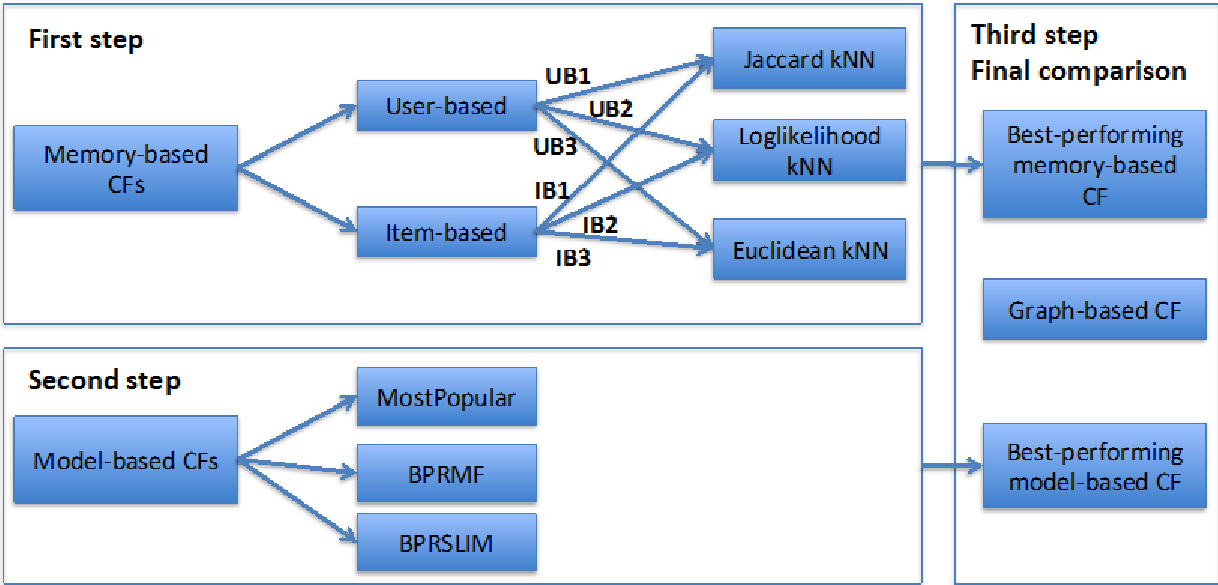
The researchers compared their graph-walking approach against two heavyweights:
- Memory-based CF: kNN using Jaccard and Loglikelihood.
- Model-based CF: Bayesian Personalized Ranking (BPR) and Sparse Linear Methods (SLIM).
Key Findings:
- User-based > Item-based: In sparse educational settings, finding similar people is much more effective than finding similar items.
- Graph Superiority: On the MACE dataset, the graph-based approach hit an F1 score of 8%, surpassing both BPRMF and standard Jaccard kNN.
- Sparsity Resilience: While the model-based BPRSLIM did well, the graph-based method showed more stability as neighborhood sizes changed.
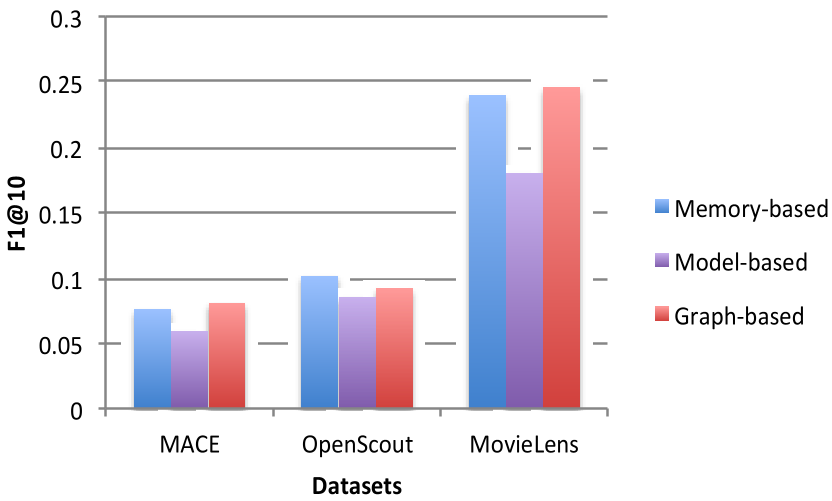 Figure: The graph-based approach (blue bars) consistently leads or stays competitive across different datasets (MACE, OpenScout, MovieLens).
Critical Analysis & Conclusion
The Takeaway
This study proves that Graph Topology is a powerful proxy for user preference when explicit data is missing. By "walking" through the graph, the system effectively fills in the blanks of the sparse user-item matrix.
Limitations & Future Work
The authors admit the lack of a "Golden Standard" dataset in Technology-Enhanced Learning (TEL) makes comparisons difficult across different research papers. Furthermore, they are looking to create a Hybrid Model that combines the latent feature learning of Matrix Factorization with the structural intelligence of graph-walking.
For developers of social learning apps, the message is clear: Don't just look at what your users click; look at who they are connected to.