
Computational Linguistics Reconstructed: Bridging the Gap Between Human Language and Machine Logic
Reconstruct the Scope, Content and Approaches of Computational Linguistics
The paper "Reconstruct the Scope, Content and Approaches of Computational Linguistics" redefines the interdisciplinary framework of computational linguistics (CL). It proposes a structural integration of linguistic theory with computer science layers, introducing a systematic "bridge" methodology that connects philosophy, mathematics, and software implementation.
TL;DR
Computational Linguistics (CL) has long suffered from a "boundary crisis," caught between the descriptive nature of humanities and the prescriptive nature of engineering. This paper by Qi Li et al. (Lanzhou University) provides a systematic reconstruction of the field. By establishing a rigorous pipeline from Philosophy → Mathematics → Algorithms → Software, the authors argue that even the most subjective elements of language, such as pragmatics, can be formalized and computed.
The Problem: The Vague Boundaries of Applied Linguistics
For decades, researchers have conflated Natural Language Processing (NLP) with Computational Linguistics (CL). The authors argue that while NLP is biased toward engineering and information extraction (often ignoring linguistic laws), CL is fundamentally an interdisciplinary pursuit of applied linguistics. The lack of a clear "subject orientation" has prevented linguists and computer scientists from effectively collaborating on complex problems like intent reasoning and contextual ambiguity.
Methodology: The "Triple Bridge" to Computation
The core contribution of this paper is the reconstruction of how a language problem is transformed into a computer program. The authors propose a five-step flow:
- Linguistic Interpretation: Analyzing the objective world through linguistic theory.
- Mathematical Modeling: Extracting formal features from those interpretations.
- Discretization: Using numerical analysis to turn continuous mathematical models into discrete steps.
- Algorithm Expression: Formulating the solving steps.
- Program Implementation: Software engineering to realize the solution.
The Theory-Computation Connection
The authors emphasize that philosophy and mathematics are the "bridges." To make linguistics computable, one must:
- Use philosophy to find the essence of language concepts.
- Abstract these concepts into mathematical structures.
- Simulate infinite mathematical dimensions within the finite limits of a computer's memory and processing power.
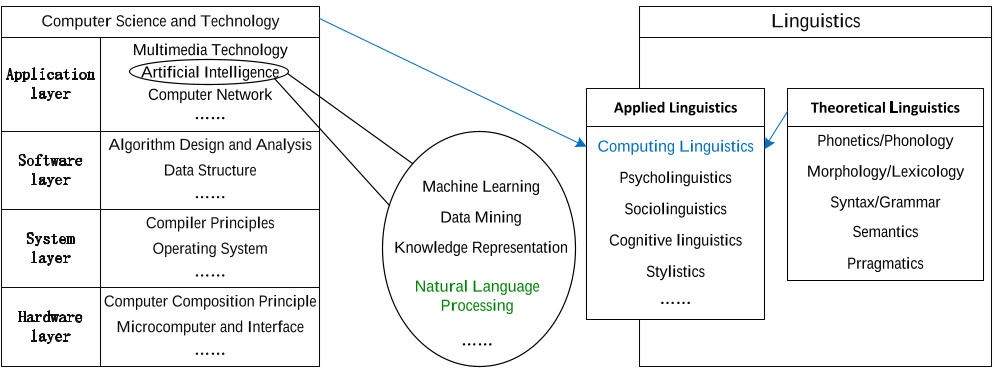 Figure 1: The proposed subject orientation, positioning CL as the interdisciplinary intersection of Applied Linguistics and the Application/Software layers of Computer Science.
Redefining the Scope: From Phonology to Pragmatics
The paper organizes CL into two main streams:
1. Computational Theoretical Linguistics
This includes traditional pillars like Computational Syntax (automatic parsing using algorithms like CYK) and Computational Lexicology. However, the authors identify Computational Pragmatics as the "new frontier," focusing on modeling speaker intentions, speech acts, and conversation structures.
2. Industry Applications
Beyond theory, the scope extends to Machine Translation (MT), Text Mining, and Automatic Composition Scoring, which use techniques ranging from Latent Semantic Analysis to Deep Neural Networks (CNN/BLSTM).
 Table 1: The mapping from practical problems to software implementation.
Future Directions: The Pragmatic Revolution
The most forward-looking part of the paper discusses applying computational logic to Pragmatics. The authors suggest four high-impact directions:
- Computability Theory: Proving whether certain pragmatic intents are actually solvable within finite steps (Church-Turing thesis).
- Community Detection: Using graph theory to analyze social networks and detect "outlier" pragmatic features (e.g., identifying if a text was modified by a different author).
- Compiler Optimization: Incorporating pragmatic context to reduce ambiguity in programming languages.
- Software Engineering: Using "conversational implicature" to refine customer requirements and reduce the high cost of misaligned software goals.
Critical Analysis & Conclusion
The value of this paper lies in its taxonomy. By clarifying that CL is not just "coding for words" but a philosophical and mathematical reconstruction of human communication, it provides a roadmap for future interdisciplinary PhDs.
Limitations: While the paper offers a robust theoretical framework, it remains at a high level of abstraction. The specific mathematical "bridges" required to convert complex pragmatic theories (like Relevance Theory) into discrete algorithms remain an open challenge for future research.
Takeaway: Computational Linguistics is the ultimate meeting point of the sciences and the humanities. As we move toward more sophisticated AI that understands intent rather than just pattern-matching, this paper's focus on Computational Pragmatics will likely become the standard research paradigm.