
Reconstructing the Digital Fossil Record: Using Search Engines to Map Social Evolution
Reconstructing History of Social Network Evolution Using Web Search Engines
The paper introduces a retrospective data collection method for social network evolution using web search engine hit counts. By applying temporal filters to search queries, the authors reconstructed the dynamic network of 93 influential figures in the US economy from 2005 to 2009, spanning the 2008 financial crisis.
TL;DR
Researchers have developed a clever way to "time travel" through the web. By using specific search query filters to include certain years and exclude others, they can reconstruct how social networks evolved in the past. To prove it, they mapped the shifting power dynamics of 93 US economic leaders during the 2008 financial crisis, accurately capturing the rise and fall of key figures like Alan Greenspan and Timothy Geithner.
The "Snapshot" Problem in Network Science
In network science, we are often great at seeing the now, but terrible at seeing the then. Most social network data comes from digital footprints like Facebook or Twitter, which are easy to track in real-time but difficult to reconstruct retrospectively if the data wasn't saved at the time.
The authors observed a critical gap: while search engines like Google can tell us how "connected" two people are based on the number of search results (hits) for their names, these hits are usually a jumbled mess of the entire history of the internet. How do we isolate the relationship between two CEOs specifically in the year 2007?
Methodology: Temporal Query Engineering
The core insight of this paper is a technique called Temporal Filtering. Instead of just searching for "Person A" AND "Person B", the authors crafted a hierarchical exclusion query.
The Logic of the Query
If you want to find the state of a relationship in 2007, you search for:
"Person A" "Affiliation A" "Person B" "Affiliation B" "2007" -2008 -2009 -2010
By adding the negative signs (-), they tell the search engine to ignore any documents created after the target year. This effectively "freezes" the web as it existed at the end of 2007.
Mathematically Weighting the Links
To turn these search hits into a network, they used the number of hits () as link weights. They further refined this into an Asymmetric Weighting formula to show who "targets" whom in the social space:
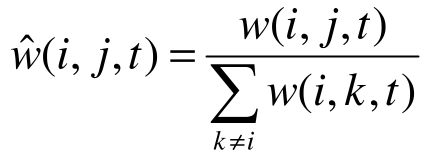 The weight of a link from i to j is determined by the co-occurrence of i and j relative to all of i's other connections.
Visualizing the 2008 Financial Crisis
The authors applied this to 93 figures in the US economy. The results weren't just random clusters; they clearly reflected historical reality.
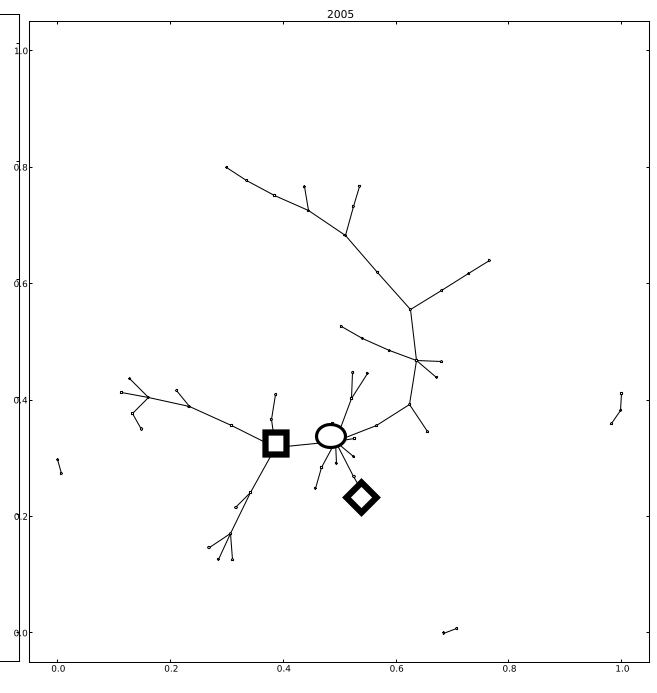 (Image: Progression of the economic social network through the crisis years)
Case Study: Paulson and Blankfein
The network analysis showed a massive spike in the connection between Henry Paulson (Treasury Secretary) and Lloyd Blankfein (Goldman Sachs CEO) in 2008. While the public at the time may not have known the extent of their cooperation, the search engine data captured the surge in documents linking them during the AIG bailout week—where they reportedly spoke over two dozen times.
Centrality as a Proxy for Power
The study used Betweenness Centrality (a measure of how often a person acts as a "bridge" between others) to track influence over time.
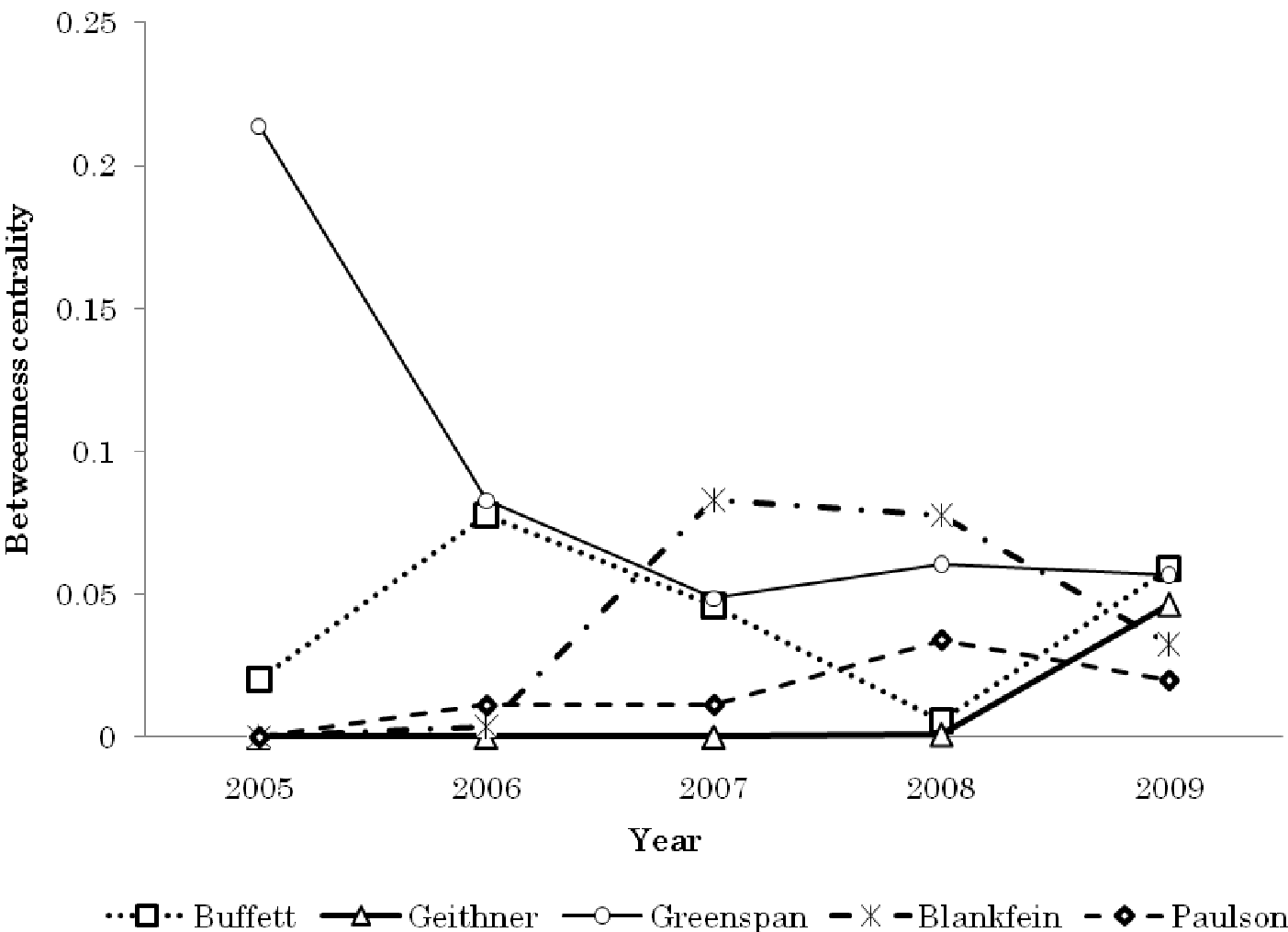 Fig 2: The decline of Alan Greenspan (circles) and the late-2008 surge of Timothy Geithner (triangles).
The data shows a "passing of the torch":
- Alan Greenspan: His centrality plummeted after he left the Federal Reserve.
- Timothy Geithner: His centrality exploded as he moved into the spotlight as Treasury Secretary in 2009.
Critical Insights & Future Outlook
Takeaway: This method is a "poor man's" historical database. It doesn't require access to private archives; it simply uses the existing index of the web more intelligently.
Limitations:
- Quadratic Complexity: Measuring every pair in a network of people requires queries. For 1,000 people, that's nearly a million searches—a task that would likely trigger Google's rate limits today.
- Search Volatility: Search hit counts are notorious for being "approximations." Re-running the same search a week later can yield different numbers.
Future Directions: In the age of AI, we could replace simple hit counts with Large Language Models (LLMs) to not only see if two people are connected but to analyze the sentiment and nature of that connection, providing a much richer "history of everything."
Conclusion
This paper serves as a foundational proof-of-concept that the web’s index is not just a tool for finding information, but a structured historical artifact that can be mined to understand the evolution of human society.