
Recursive RSS Field Estimation: Turning Crowdsourced Noise into Spectral Clarity
Recursive Estimation of Dynamic RSS Fields Based on Crowdsourcing and Gaussian Processes
2019-01-01
Summary
Problem
Method
Results
Takeaways
Abstract
This paper presents a recursive Bayesian framework for estimating time-varying Received Signal Strength (RSS) fields using low-cost, crowdsourced sensor data. The core method, based on Gaussian Processes (GP), jointly estimates spatial RSS distributions while accounting for uncertainties in sensor locations, transmitter parameters, and shadowing correlations.
## TL;DR
Mapping the "invisible" world of radio frequencies typically requires high-precision equipment. This paper introduces a **Recursive Gaussian Process (rGP)** framework that leverages "low-quality" signal data from smartphones (crowdsourcing) to build accurate, time-varying spectrum maps. By mathematically modeling the uncertainty of *where* the sensor is, it achieves SOTA performance in dynamic environments.
## The Problem: The High Cost of Precision
In spectrum sensing, we want to know the signal strength at every point in a city. Traditionally, this requires static, expensive sensors with perfectly known coordinates.
**Crowdsourcing** is the alternative—using thousands of mobile phones. However, phones provide "dirty data":
1. **Imprecise Locations**: GPS on a phone might be off by 10-20 meters.
2. **Dynamic Parameters**: The transmitter power and environment (shadowing) change constantly.
3. **Memory Bloat**: Most GP methods grow in complexity as more data arrives ($O(N^3)$), making them unusable for continuous monitoring.
## Methodology: Dealing with "Dirty" Data
The authors propose a robust propagation model that doesn't just treat signal noise as an outlier, but as a structured component of the system.
### 1. Modeling Location Uncertainty
Most models assume the distance $d$ between a sensor and a transmitter is a fixed number. This paper treats it as a random variable. They introduce an error term $u^{[t]}$ derived via Taylor expansion, which accounts for the fact that a small position error near a transmitter is much more damaging than an error far away.
### 2. Recursive Gaussian Processes (rGP)
To solve the memory problem, the authors use a **predefined grid**. Instead of storing every measurement, they store the *state of the grid*.

When new data arrives at time $t$, the system performs a Bayesian update:
$$ \boldsymbol{\mu}_{g}^{[t]} = \mathbf{m}_{\mathbf{X}_{g}}^{[t]} + (1 - \lambda) \boldsymbol{\mu}_{prior}^{[t]} + \lambda \boldsymbol{\mu}_{post}^{[t]} $$
The **forgetting factor ($\lambda$)** acts as a dial:
* Close to 1: Trust only the newest data (fast moving environments).
* Close to 0: Rely on historical averages (stable environments).
### 3. Architecture Overview
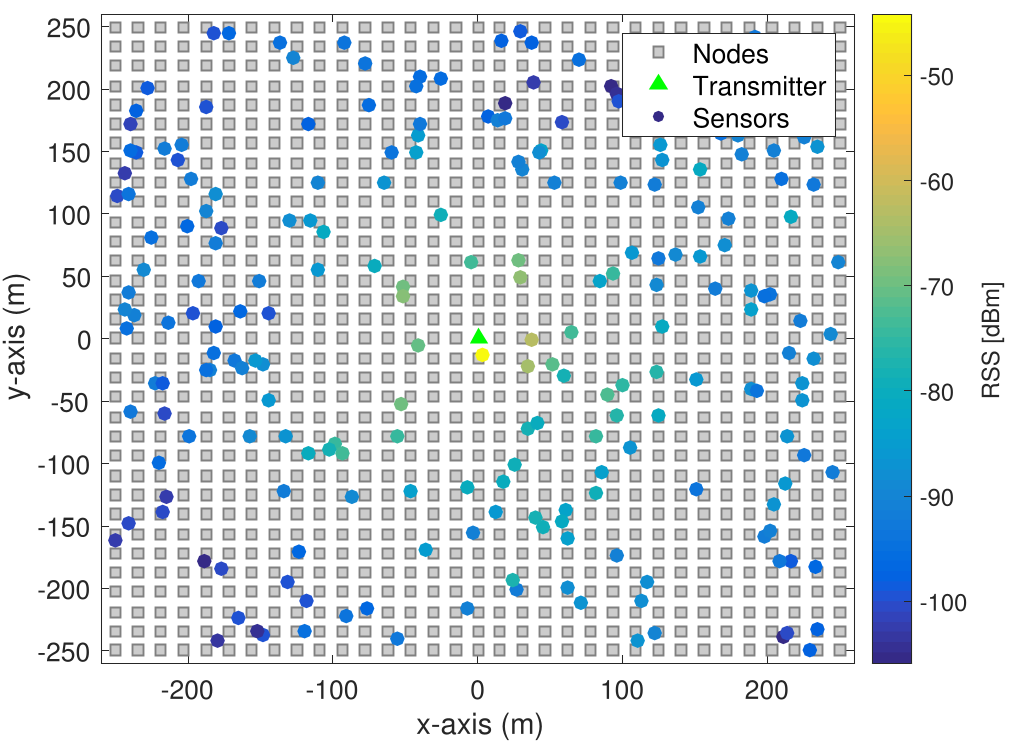
*Fig 1: The simulated scenario with a central transmitter (triangle), crowdsourced sensors (circles), and the estimation grid (red squares).*
## Experimental Insights
The research proves that **knowing you are inaccurate is better than pretending to be accurate.**
* **Location Error Robustness**: In Fig 3 of the paper, Case 2 (modeling location error) shows consistently lower Mean Squared Error (MSE) than Case 3 (ignoring location error).
* **Adaptive Performance**: In moving sensor scenarios, the recursive GP outperforms traditional "Ordinary Kriging with Detrending" because it learns the field’s spatial structure over time.
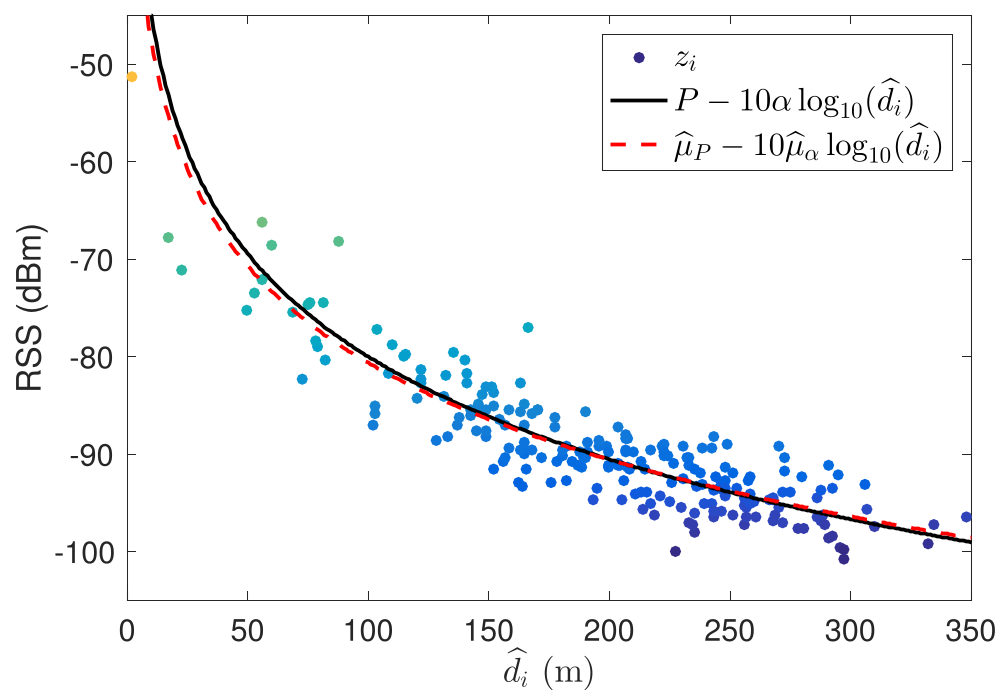
*Fig 2: The estimated RSS field. The GP provides a smooth "spectral surface" across the entire area, even in regions where no sensors are currently present.*
## Real-World Validation
The authors tested this on a GSM dataset from Stony Brook University. Even with obstacles and non-omnidirectional antennas (which the mathematical model doesn't explicitly include), the GP remained robust. It achieved a reasonable MSE by adapting its "Kernel" hyperparameters (like signal correlation distance) to the actual data.
## Critical Analysis & Future Work
**Takeaway**: This paper provides a mathematically rigorous way to handle the "noise" of crowdsourcing. By using a grid-based recursive update, they solved the computational bottleneck of Gaussian Processes.
**Limitations**:
1. **Single Transmitter**: The current model assumes one source. Multiple transmitters would require a more complex multi-modal GP or source separation.
2. **Obstacles**: The log-normal model is a simplification. Real cities have deep "shadows" from buildings that might require Deep Gaussian Processes to capture.
**Outlook**: This method paves the way for real-time "Radio Environment Maps" (REM) that could live inside 6G networks, allowing devices to dynamically find the best frequencies based on a live map created by the users themselves.