
Cloud Clone: Optimizing the Operational Costs of Multi-Screen Social TV
Reducing Operational Costs in Cloud Social TV: An Opportunity for Cloud Cloning
This paper proposes a cost-effective management framework for Cloud Social TV using "Cloud Clones" (VM-based user proxies). It addresses the operational challenge of video teleportation—seamlessly migrating sessions between devices—by formulating a Markov Decision Process (MDP) and employing a Q-learning approach to optimize Virtual Machine migration.
TL;DR
Providing a seamless "Video Teleportation" experience—where you flip a video from your TV to your smartphone instantly—is computationally and financially expensive. This paper introduces a Cloud Clone architecture that uses Q-Learning to decide exactly when and where to migrate a user's cloud-based virtual proxy to minimize transmission and VM migration costs. By learning user habits, the system slashes operational expenses by up to 25%.
Problem & Motivation: The Price of Ubiquity
The dream of Social TV is "anytime, anywhere, on any device." However, current implementations face a massive hurdle: Operational Expenditure (OPEX).
When a user switches from a 4K TV to a mobile phone, the "Cloud Clone" (a Dedicated VM) must transcode the stream. If the clone stays near the media source, transmission to the mobile device is cheap (low bitrate), but transmission to the TV is expensive (high bitrate). If it moves closer to the user, the "migration cost" of moving the VM state itself becomes a burden. Existing systems either use Fixed Placement (inefficient) or Greedy Migration (leads to "thrashing" and high migration fees).
Methodology: Balancing the Trade-off via MDP
The researchers treat the cloud clone migration as a Markov Decision Process (MDP).
1. User Behavior Modeling
The system models users as transitioning between two states: TV and Smartphone. These transitions are governed by probabilities ( and ), which are unique to every individual.
2. The Cost Function
The objective is to minimize: Where:
- Transmission Cost depends on the hop distance and the content size (transcoded vs. original).
- Migration Cost includes the bandwidth to move the VM image () and an overhead fee ().
3. The Q-Learning Solution
Since user behavior isn't known ahead of time, the authors propose a model-free Q-learning algorithm.
- Experience Replay: The system records user habits during a "warm-up" phase.
- Online Learning: The agent updates its Q-values () based on the actual costs incurred, allowing the system to "predict" if a user is likely to stay on a device long enough to justify a migration.
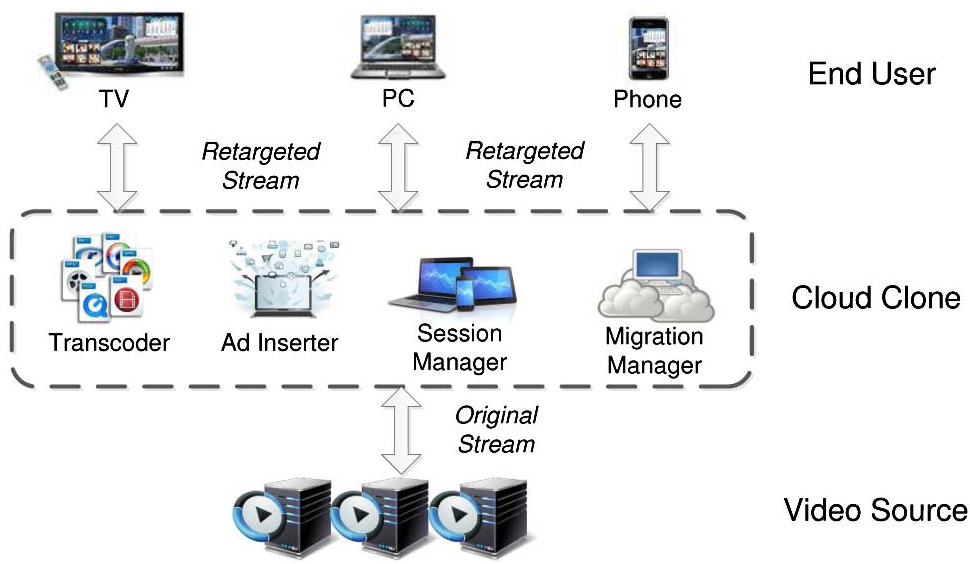 Fig. 1: The Cloud Clone serves as a proxy for transcoding and session management.
Experiments & Results
The authors validated their approach using simulated data and real traces from 200 students at Nanyang Technological University.
Key Performance Identifiers:
- Cost Reduction: Q-learning saved 25% compared to Random Fixed placement when user switching probability was low (long sessions).
- The Threshold Effect: Research found that if the VM image size () exceeds a certain threshold, the system intelligently defaults to a fixed placement, realizing migration isn't worth the cost.
- Optimal Placement Intuition: Interestingly, the optimal location for a clone is almost always the Media Source (for mobile viewing) or the Edge Node (for TV viewing), rarely in the middle of the network path.
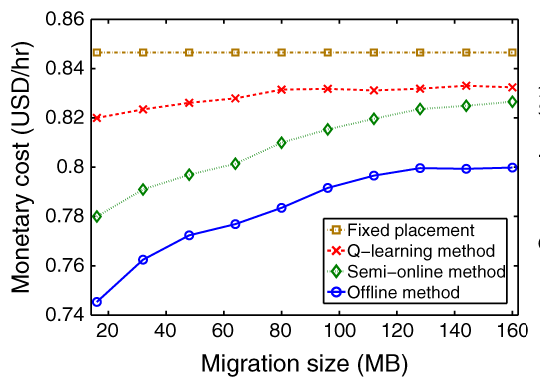 Fig. 2: Performance comparison showing Q-Learning (Red) tracking the theoretical Offline Lower Bound (Blue) much closer than traditional methods.
Critical Analysis & Conclusion
Takeaway
The "Cloud Clone" concept is a precursor to modern Edge Computing and Serverless Media Processing. By moving the intelligence of where processing happens into a Reinforcement Learning agent, service providers can offer premium features like video teleportation without going bankrupt on cloud egress fees.
Limitations & Future Work
- Scalability: While the state space for one user is small, managing clones for millions of users may require Deep Q-Networks (DQN).
- Cold Starts: The "warm-up" period is necessary to learn user habits; during this time, costs are sub-optimal.
- Multi-User Clones: Future extensions could explore sharing one cloud clone among "social groups" watching the same content to further aggregate bandwidth savings.
In conclusion, this work provides a rigorous mathematical foundation for the "fluid" deployment of media services in the cloud, proving that the best way to manage a network is to understand the human behavior driving the traffic.