
Distributed ETL: A Reference Architecture for Large-Scale Educational Data Mining
A reference architecture for educational data mining
This paper introduces a decentralized Reference Architecture (RA) for the ETL stages of Educational Data Mining (EDM) and Learning Analytics (LA). The core contribution is a distributed "Market-Basket" approach that enables heterogeneous virtual learning environments (VLEs) to pre-process data locally, significantly reducing bandwidth and central storage requirements.
TL;DR
As online education scales, centralizing data for mining becomes a bottleneck of privacy risks and bandwidth costs. This paper proposes a decentralized Reference Architecture (RA) that moves the "heavy lifting" of the ETL (Extract, Transform, Load) process to the local Virtual Learning Environments (VLEs). By using a Market-Basket Model, data is pre-processed into lightweight "baskets" locally before being sent to a central server, ensuring high scalability and improved privacy.
The Bottleneck: Why Traditional ETL Fails in EDM
In the world of Educational Data Mining (EDM), the standard approach is to "scoop up" all raw logs from various institutions and dump them into a central lake for analysis. The authors highlight two critical failure points for this method:
- Storage & Bandwidth: Using Moodle as a case study, the authors demonstrate that even a modest institution can generate gigabytes of log data annually. Multiplying this by 100+ institutions leads to a massive infrastructure cost.
- The Privacy/Management Barrier: Data owners (universities) are naturally resistant to sharing entire raw databases containing sensitive student and faculty information. Traditional ETL offers "all or nothing" access, which creates legal and administrative friction.
Methodology: The Farm and Silos Analogy
The authors solve this using a brilliant physical analogy: Farms and Silos.
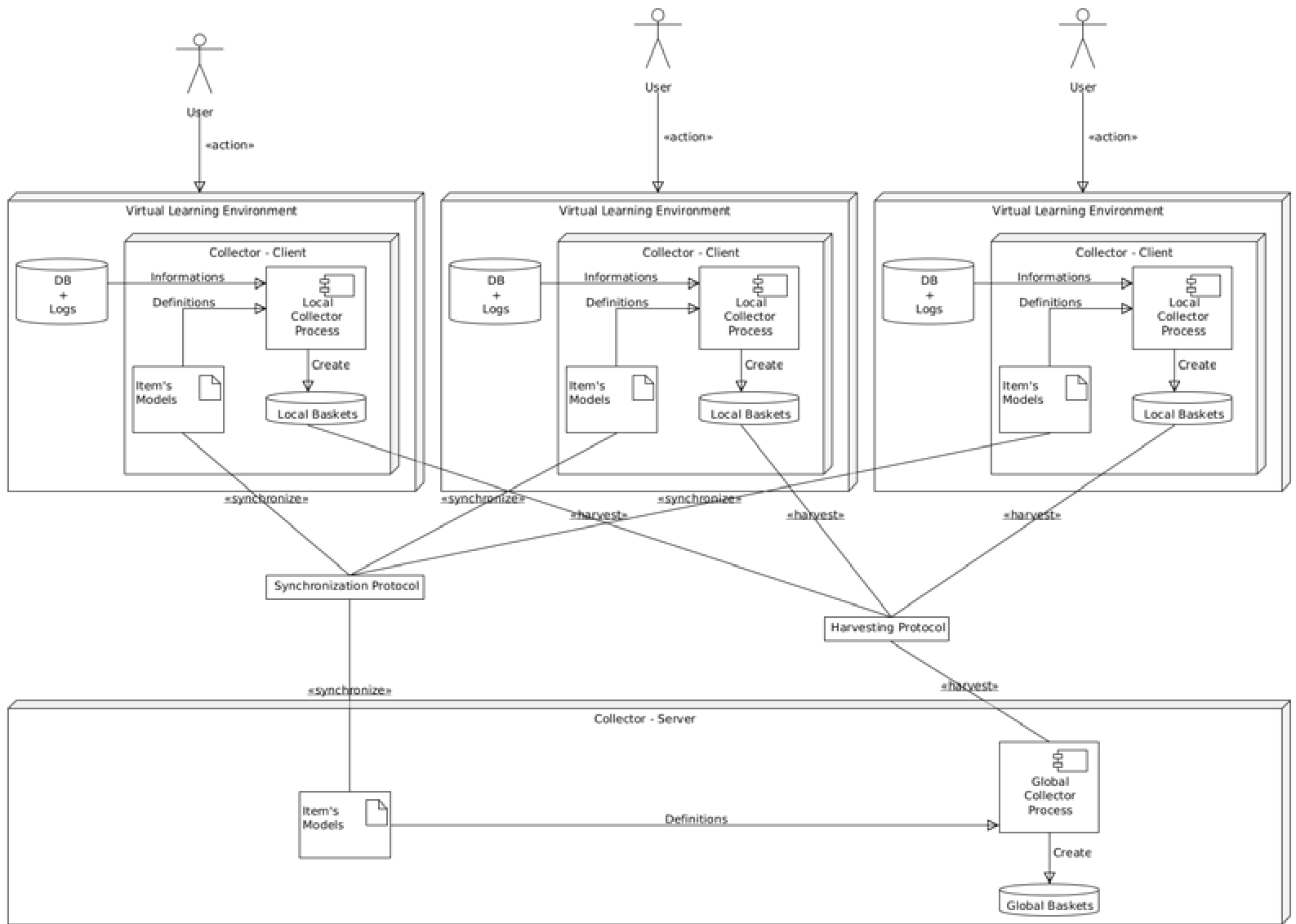
- Local Farms (VLEs): Instead of sending "all the soil/plants" to a central factory, each farm processes its own crop and puts them into Local Baskets.
- The Hub (Collector-Server): A truck (protocol) collects only the finished baskets and aggregates them into a Global Basket.
Core Components
The architecture relies on three pillars:
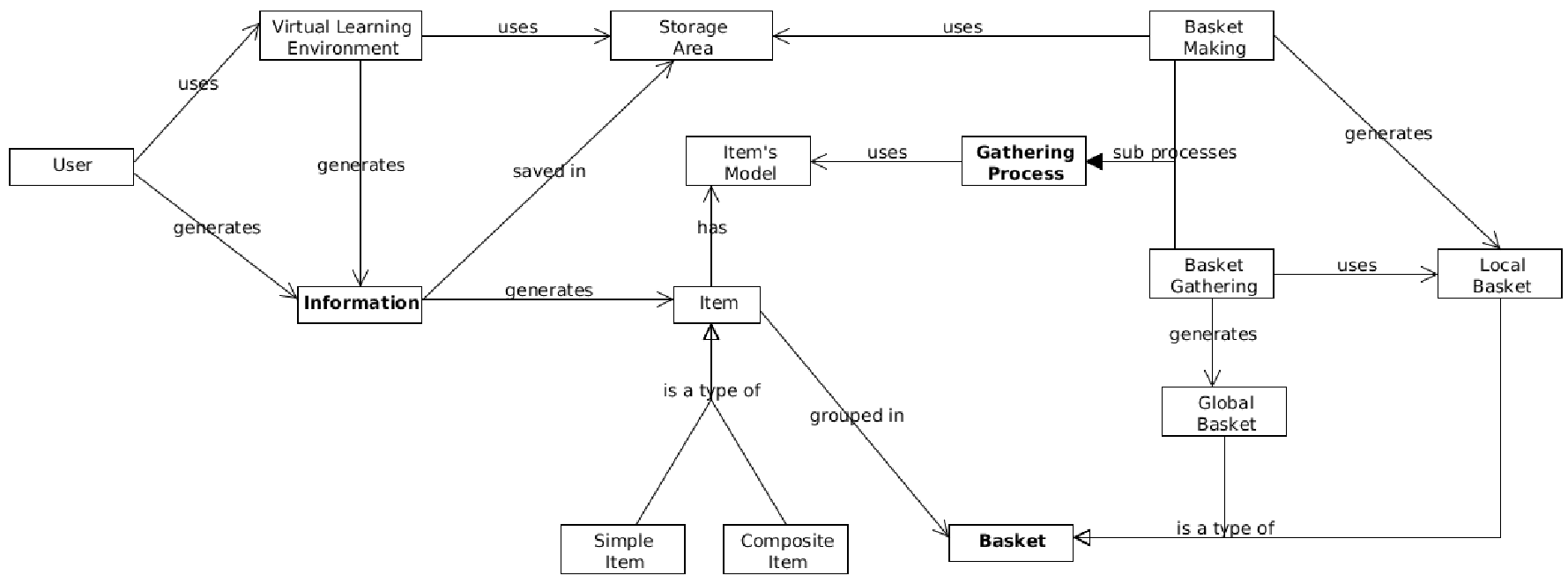
- Item Models: Standardized definitions of what data to extract (e.g., "Total Forum Posts").
- Collector-Client: A software layer inside the VLE that interprets these models and performs local computation.
- Synchronization Protocol: Ensures all clients are updated with the latest mining requirements without manual redeployment.
Deep Dive: The Market-Basket Evolution
By adopting the Market-Basket Model, the authors shift the focus from raw data points to meaningful sets.
- Simple Items: Direct counts from the DB (e.g., login count).
- Composite Items: Calculated metrics (e.g., percentage of posts answered).
This shift allows for parallel processing. Because the "Transformation" happens at the client level, adding 1,000 more schools doesn't explode the central server's CPU usage—it just adds 1,000 more edge processors.
Performance and Results
The architecture was battle-tested with a project for the Brazilian Ministry of Education involving over 100 institutions.
- Efficiency: Significant economy in storage and bandwidth was observed because only metadata (the final basket) was transmitted.
- Tenacity: If one institution's server was slow or offline, it did not block the data collection for the other 99 institutions.
- Privacy: Because the Collector-Client can anonymize data before it leaves the institution's firewall, it bypassed many of the legal hurdles associated with raw data sharing.
Critical Insight & Future Outlook
The beauty of this Reference Architecture is its Database Independence. As VLEs evolve or institutions switch from Moodle to Canvas, only the "Collector-Client" implementation needs to change; the central mining logic remains untouched.
However, a potential limitation is the Incentive Gap. Institutions must be willing to host the Collector-Client software. Future work should explore how to make these "Collector-Clients" even more lightweight (e.g., using containerization like Docker) to reduce the technical burden on the contributing institutions.
Final Takeaway
For researchers dealing with multi-institutional data, the message is clear: Stop moving the data to the algorithms; move the logic to the data.