
Breaking the Legal Maze: Robust Reference Resolution in Japanese Law
Reference Resolution in Japanese Legal Texts at Passage Levels
This paper introduces an automated framework for reference resolution in Japanese legal texts at the passage level, specifically targeting the Japanese National Pension Law (JNPL). The authors propose a two-step pipeline: a Conditional Random Fields (CRF)-based detector for identifying legal citations and a regular expression-based resolver for mapping those citations to specific articles, paragraphs, or items, achieving a SOTA F1-score of 88.5% in end-to-end performance.
TL;DR
Legal documents are notorious for their complex cross-references, making automated comprehension a nightmare. This paper presents a sophisticated two-step framework that first detects references using Conditional Random Fields (CRF) and then resolves them to specific legal passages (articles/paragraphs) using structural logic. The result? A highly accurate end-to-end system achieving an 88.5% F1-score on the Japanese National Pension Law.
The Motivation: Why Rules Aren't Enough
In the legal domain, precision is everything. However, legal Japanese is dense. A phrase might look like a reference—for instance, dai ni go (Item 2)—but in context, it might be part of a proper noun like dai ni go hi hoken sha (the second insured person).
Prior works relied heavily on Rule-Based Approaches. While these systems have high recall (they find almost everything that looks like a rule), they suffer from dismal precision because they cannot "read" the context. This paper shifts the paradigm by treating detection as a machine learning problem while retaining deterministic logic for the actual mapping (resolution).
Methodology: A Hybrid Pipeline
The authors propose a clean, two-stage architecture:
1. Reference Detection (The ML Layer)
Instead of hard-coded regex, the authors use Conditional Random Fields (CRF). They treat legal citations as entities in a sequence labeling task.
- Feature Engineering: They don't just use words; they incorporate Part-of-Speech (POS) tags, "readings" (phonetics), and chunking information.
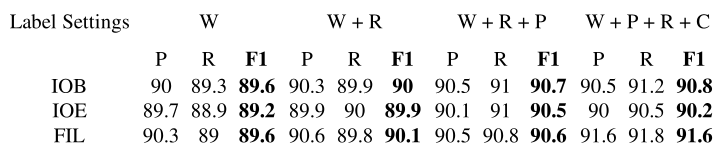
- Labeling Schemes: They experimented with IOB, IOE, and FIL (First, Inner, Last) notations, finding that FIL provided the most granular boundary detection for long legal citations.
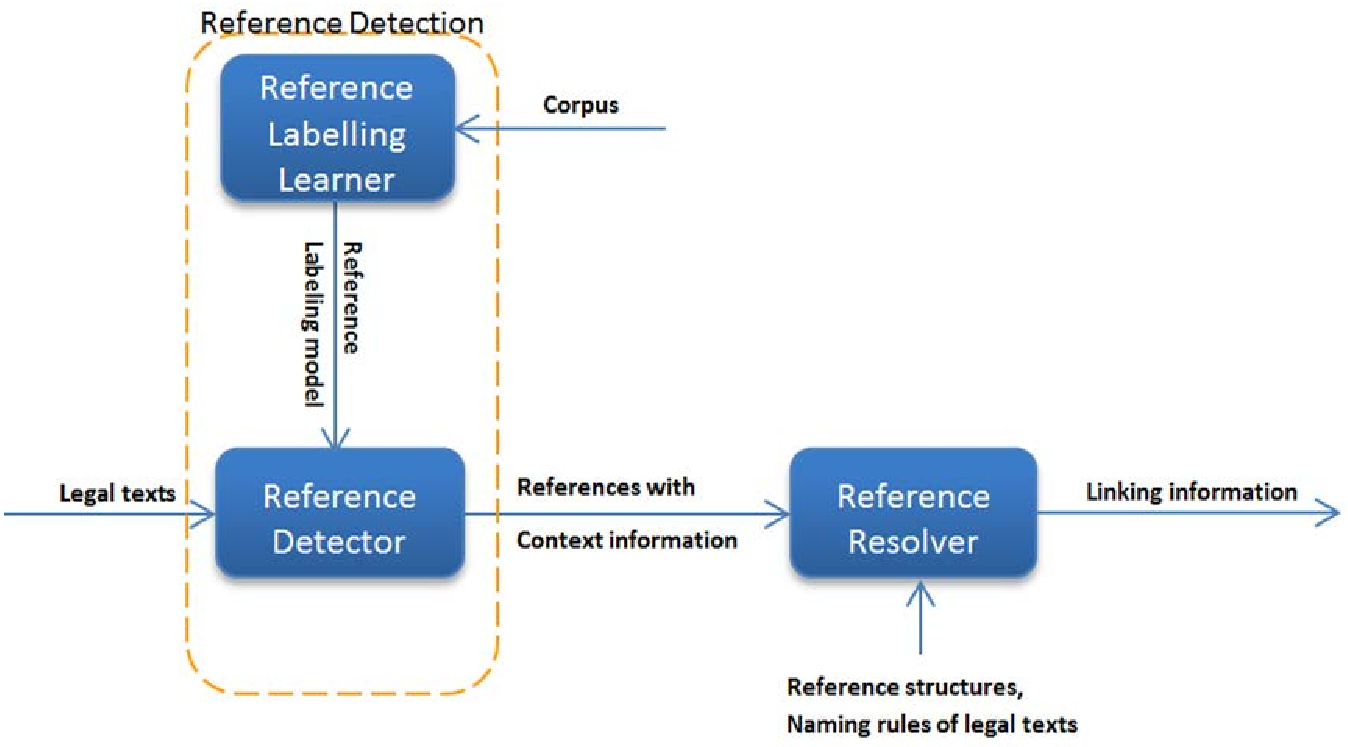
2. Reference Resolver (The Logic Layer)
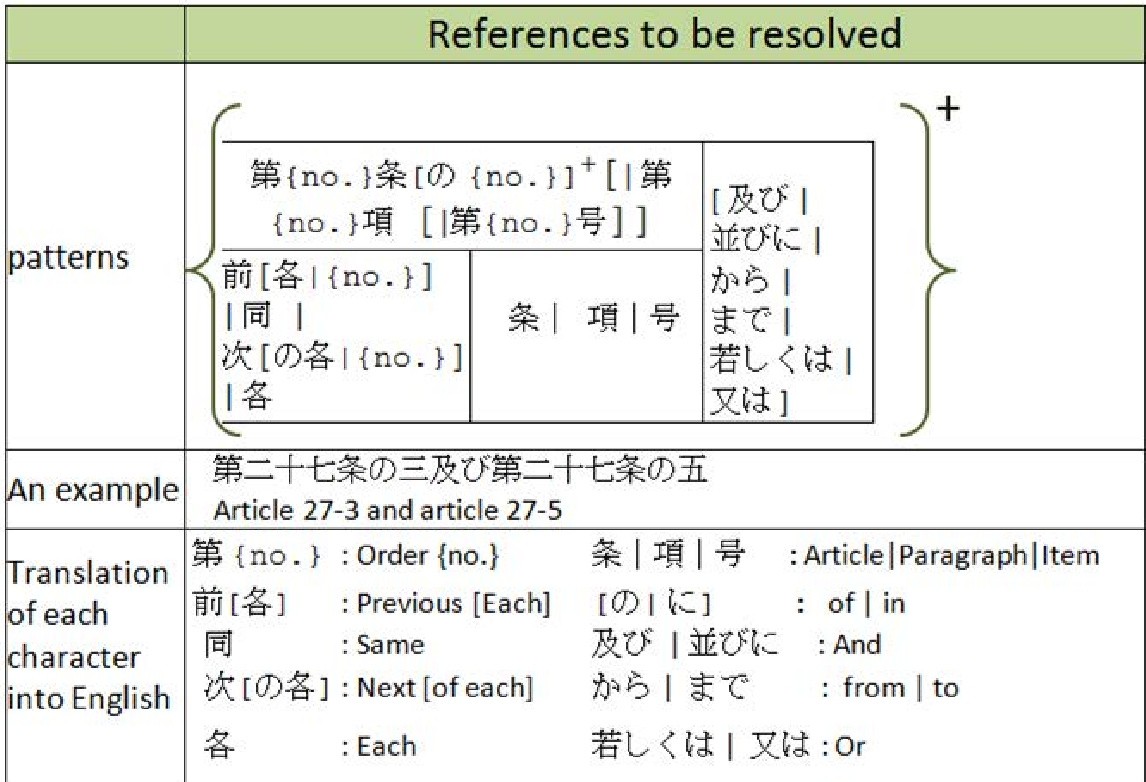
Once a reference is detected (e.g., "From Item 1 to Item 3 of Paragraph 1 of Article 90"), it must be resolved to a set of coordinates.
- Complete References: Directly mapped using regex.
- Anaphora & Indirect References: This is the "hard" part. Terms like dou kou ("the same paragraph") require the system to look back at the discourse history to find the most recently mentioned legal partition.
Experiments and SOTA Results
The system was tested on the Japanese National Pension Law (JNPL) corpus, a manually annotated dataset of 99 articles and 748 references.
- Detection Breakthrough: The ML approach hit 91.6% F1, crushing the rule-based baseline of 78.4%. The inclusion of linguistic features (W+P+R+C: Words, POS, Reading, Chunking) was the primary driver of this delta.
- Resolution Accuracy: With perfect input, the resolver correctly identified the target passage 96.18% of the time.
- End-to-End: Even with the noise introduced by the detection stage, the system maintained an 88.5% F1-score, proving its readiness for real-world legal tech applications.
Critical Analysis & Insights
The core "aha!" moment of this research is the realization that legal language is semi-structured. It is too messy for pure rules but too structural to be left entirely to "black-box" models.
Limitations:
- The system struggles with complex coordinated references (e.g., very long lists of non-consecutive articles).
- It is currently limited to intra-document references (links within the same law) rather than inter-document links (one law pointing to another).
Future Look: With the advent of Large Language Models (LLMs), the detection stage could potentially be handled via zero-shot prompting, but the Resolution logic derived in this paper remains vital. Integrating this structured logic with LLMs could prevent "hallucinations" when citing legal authorities—a critical requirement for the future of Trustworthy e-Society.
Conclusion
This work stands as a cornerstone in Legal Engineering. By proving that ML-driven detection combined with structural resolution works for complex Japanese laws, the authors have paved the way for automated legal auditing, smart legislative drafting, and enhanced digital law libraries.