
Navigating the Sociotechnical Gap: Reflexivity and Professional Vision in Maritime CSCW
Reflexivity of Account, Professional Vision, and Computer-Supported Cooperative Work: Working in the Maritime Domain
This paper explores the integration of Computer-Supported Cooperative Work (CSCW) insights into the engineering-driven maritime domain, specifically for designing remote control systems. It introduces "reflexivity of account" and "professional vision" as core mechanisms to bridge the persistent gap between ethnographic research and actual technical implementation.
TL;DR
Designing remote-controlled maritime systems is not just a software challenge; it is a social one. This paper reflects on five years of fieldwork to show how CSCW researchers can bridge the gap between "what we know socially" and "what we build technically" by making the invisible work of ship operators visible and accountable to engineers through Reflexivity of Account and Professional Vision.
The Motivation: Why Maritime Tech Often Fails Its Users
Despite decades of research, a massive disconnect remains between CSCW theory and engineering practice. In the maritime industry, systems developers often treat operators as "experimental subjects" rather than experts.
The author identifies a critical problem: Engineering projects follow a technology-centered paradigm. Requirements are usually prioritized by corporate needs and technological limitations first, while social responses—the actual work of the human operator—are considered last. This leads to the "human-in-the-loop" fallacy, where operators are expected to be backups for automated systems without being given the tools that reflect the reality of their "articulation work" (the work they do to organize and make sense of information).
Methodology: Crossing the Atlantic of Research Traditions
The author situates this work within the European Fieldwork Tradition, moving beyond just reporting data toward active intervention.
- Long-term Engagement: Fieldwork spanning 2015 to 2020, involving observations at sea and interviews with systems developers on land.
- The Analytic Account: Instead of "thick descriptions" that engineers don't have time to read, the author translates findings into diagrams and use-case techniques that speak to System Architecture, Reliability, and Manufacturability.
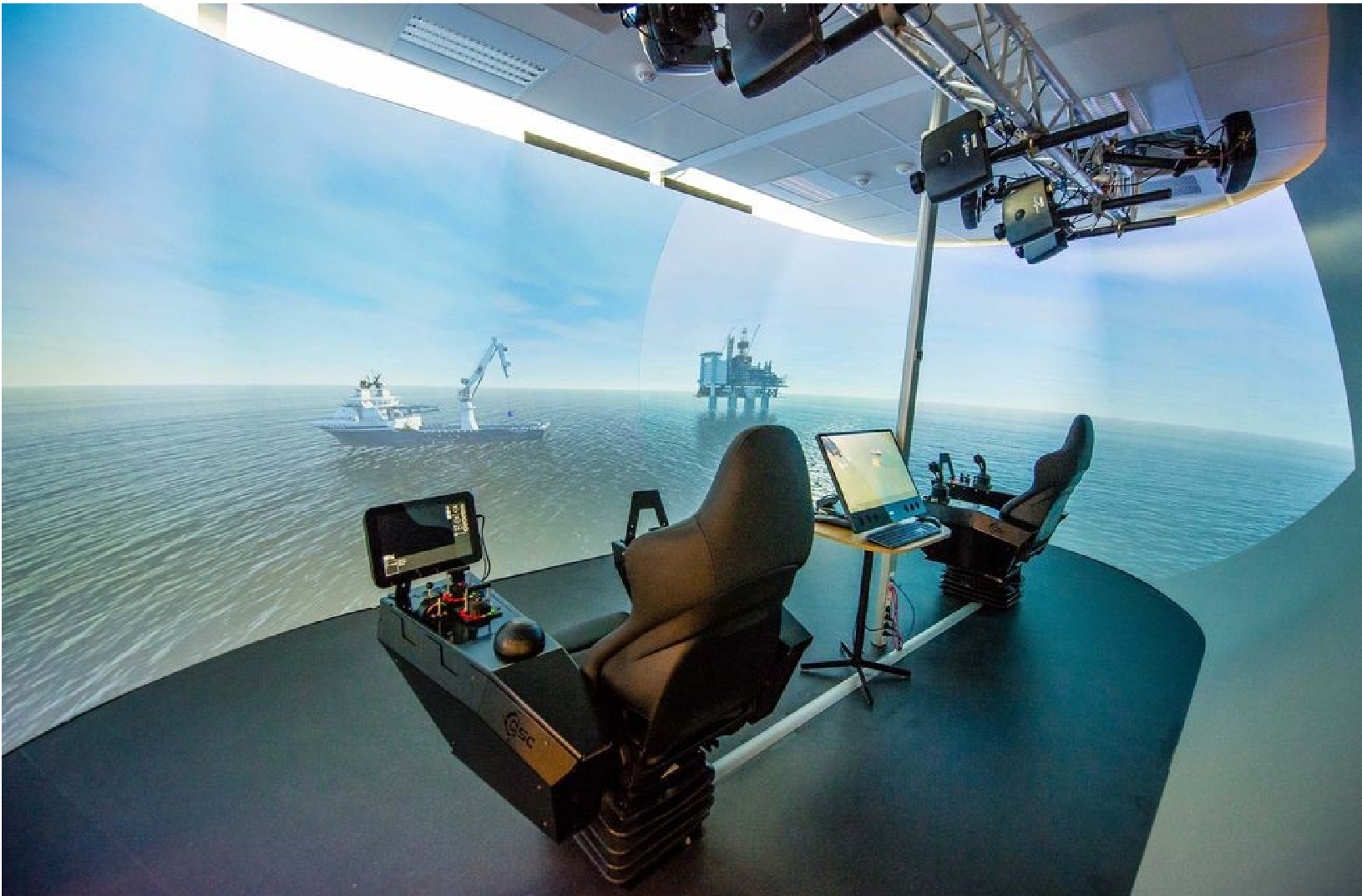 Figure 1: The duplicated setup of a remote control room, illustrating the intent to mirror on-board systems on land.
Core Insight: Reflexivity and Vision
The paper hinges on two powerful concepts:
- Reflexivity of Account: Borrowed from ethnomethodology, this refers to how members of a group make their actions "accountable" (understandable and reportable) through the actions themselves. The author's job was to take these "invisible" reflexive actions of sailors and make them visible to the "member group" of engineers.
- Professional Vision: Originally defined by Charles Goodwin, the author adapts this to act as a sociotechnical mechanism. It involves highlighting specific events in the work process so that stakeholders from different backgrounds can see the same "truth" within a complex perceptual field.
Experimental Evidence: Making Invisibility Visible
Through workshops and video analysis, the author presented "real-life" vs. "simulated" operations to shipowners.
| Setting | Observations | Key takeaway |
|---|---|---|
| At Sea | 1838 hours | Operators perform complex articulation work that machines cannot currently replicate. |
| Simulator Room | 48 hours | Developers believe duplicating UIs is enough, ignoring the environmental cues of the sea. |
 Table: The taxonomy of themes used to bridge the communication gap between stakeholders.
The "Aha!" moment came when shipowners saw videos of actual sea operations. They realized current training and designs were built on "mathematical models" that didn't hold up to the physical and social realities of the ocean. This led to a re-evaluation of design policies, moving from a "design-test-deliver" loop toward a "learner-centered" ecosystem.
Critical Analysis & Conclusion
The author’s journey reveals that a CSCW researcher in an engineering project must be a translator.
Limitations:
- Late Intervention: Often, CSCW researchers are brought in after the major architectural decisions are made.
- Power Dynamics: Developers are under market pressure to deliver "fast and cheap," which often contradicts the "deep and social" insights of CSCW.
The Takeaway: To fix the sociotechnical gap, we don't need a single universal language. We need accountable action spaces. As technology becomes more computer-supported, the CSCW researcher’s role is to ensure that the social logic of the workplace isn't lost in the technical logic of the machine.
Reference: Pan, Y. (2021). Reflexivity of Account, Professional Vision, and Computer-Supported Cooperative Work: Working in the Maritime Domain. PACM on Human-Computer Interaction, Vol. 5, CSCW2.